
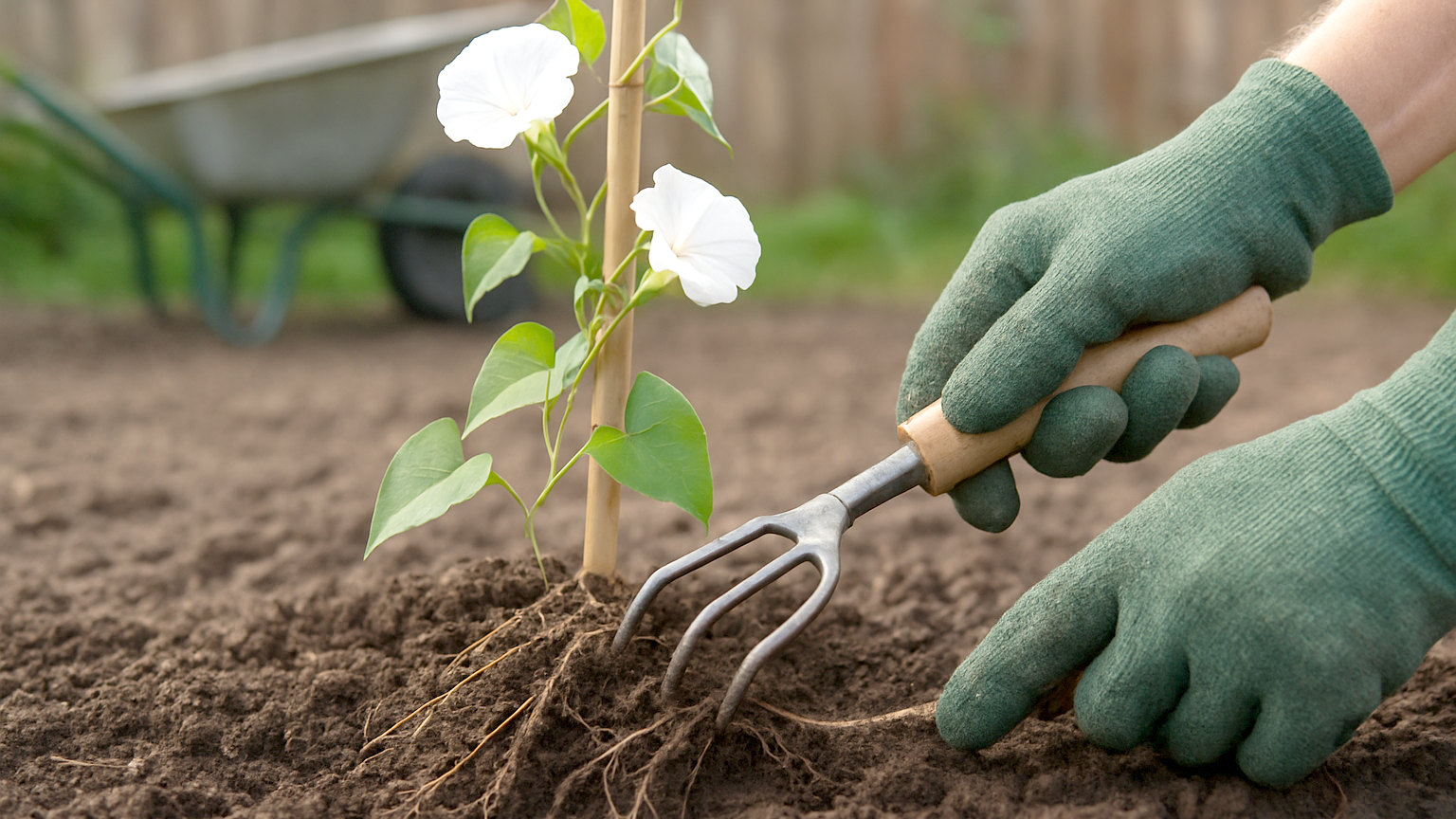
Bindweed spreads by brittle white underground roots, and every fragment left behind grows into a new plant. That single fact explains why half-hearted digging makes an infestation worse rather than better, and why patience is the main requirement.
Which bindweed you have
Hedge bindweed is the vigorous climber with large white trumpet flowers that twines up shrubs and fences. Field bindweed is smaller, with pink and white flowers, and tends to scramble across the ground and through borders.
Both spread by deep, extensive root systems, and hedge bindweed roots can reach well over a metre down. Both regrow from fragments.
Never rotavate
Rotavating ground infested with bindweed chops the roots into hundreds of pieces and plants every one of them. The same applies to ground elder, couch grass and horsetail.
An area with a light infestation can become an impenetrable mat within a season this way. If ground is infested, it must be dug and cleared by hand or smothered, never rotavated.
Digging it out
This works, provided it is done thoroughly and repeatedly.
Use a fork rather than a spade, since a spade cuts roots and a fork lifts them. Work slowly, easing the roots out whole and following them as far as you can. Sift the soil through your fingers around each plant.
Expect to repeat it. Every regrowth is a fragment you missed, and pulling or digging each regrowth as it appears steadily exhausts the root reserves. Two or three seasons of persistence clears most infestations.
Bin the roots or burn them. Do not compost bindweed root, and do not put it on a bonfire heap that will sit for months, since it will grow in it.
Smothering
For a whole bed or an area you are not using, excluding light works and requires no effort beyond laying it out.
Cover with thick cardboard overlapped generously, then a heavy mulch, or with light-excluding sheeting weighted down at the edges. Leave it for at least a full growing season, and preferably two, since bindweed has substantial reserves and will survive one.
Check the edges, where it will emerge and climb out.
The cane technique
The difficulty with treating bindweed in a border is that it grows through the plants you want to keep, so any weedkiller reaching the foliage of both kills both.
The technique is to push a bamboo cane into the ground beside the bindweed, untangle the shoots from the surrounding plants and let them twine up the cane instead. They will do this readily over a week or two.
Once the growth is isolated on the cane, it can be treated or removed without touching anything else. Some gardeners lay the isolated growth into a plastic bag or an old plant pot before treating so nothing drips onto neighbouring foliage.
If you use a weedkiller
Systemic products based on glyphosate are absorbed by the leaves and moved down to the roots, which is what makes them effective against deep-rooted perennials where contact products are not.
Apply when the plant is growing strongly and has plenty of leaf, typically midsummer, and ideally when it is flowering, since more of the product moves to the roots at that point. Repeat applications are usually needed.
Read the label and follow it exactly. Never apply near a pond, watercourse or drain. Do not use it on a windy day. Observe any interval before replanting or before children and pets use the area. Keep it off anything you want to keep, since it kills grass and ornamentals just as effectively.
Ground elder and couch grass
Both spread the same way and need the same approach. Ground elder roots are shallower than bindweed but even more brittle, and couch grass produces long white wiry rhizomes with sharp points. Neither should be rotavated, both regrow from fragments, and both respond to the same combination of persistent forking and smothering.
Preventing reinfestation
Bindweed frequently comes in from a neighbouring garden or a hedge line, which means clearing your side is only half the job. A physical barrier of heavy-duty membrane sunk vertically to sixty centimetres along the boundary slows it considerably.
Check imported topsoil and manure, and inspect the rootballs of donated plants, since perennial weed roots travel very effectively that way.
Dense planting and mulching help, since bindweed seedlings and weak regrowth struggle to establish where there is no light and no bare soil.


