
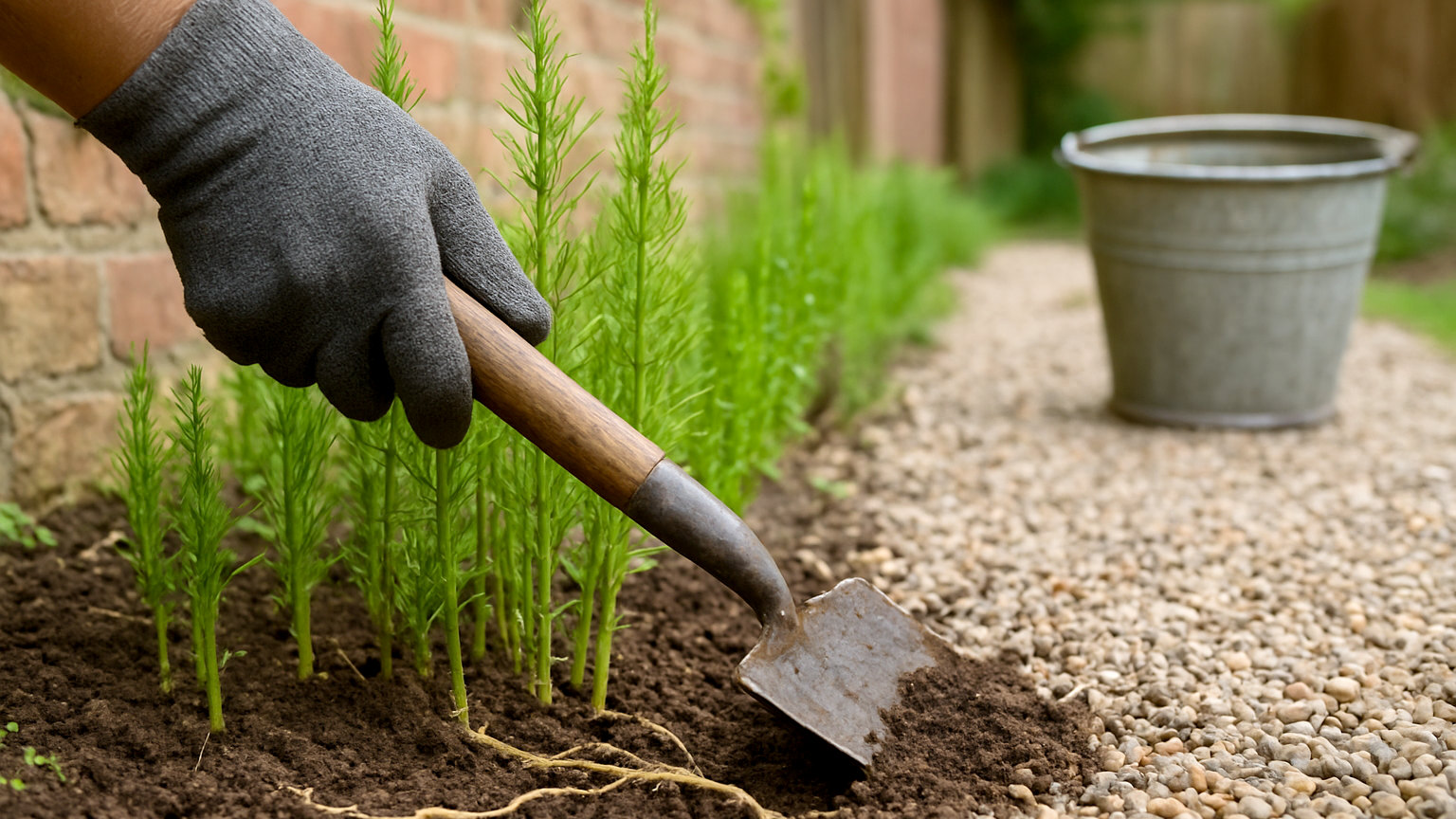
Horsetail, often called mare's tail, is the most difficult weed in most gardens that have it. It is worth being honest at the outset: eradication is rarely achievable, and management is the realistic aim.
Recognising it
Upright stems with whorls of narrow needle-like branches at each joint, like a bottle brush or a miniature conifer.
In spring, pale brown fertile shoots appear first, topped with a cone-like structure that releases spores. Green vegetative shoots follow.
The stems are jointed and pull apart at the nodes.
It is not related to mare's tail proper, which is an aquatic plant, though the name persists.
Why it is so persistent
Three reasons, and each is significant.
The rhizomes go extremely deep, commonly to a metre and frequently to two metres or more. No amount of digging reaches them.
They also spread laterally over considerable distances, and store substantial reserves.
Every fragment regrows, so cultivation multiplies it.
The foliage has a waxy silica-rich coating that repels water-based sprays, so systemic weedkillers are absorbed poorly and much of what is applied runs off.
The plant is also extremely ancient in evolutionary terms, and it has survived a great deal.
What does not work
Digging it out. The rhizomes are far deeper than any excavation, and cutting them stimulates regrowth.
Rotavating, which distributes fragments through the plot.
Short-term covering. Horsetail pushes through most membranes and emerges at the edges, and it has the reserves to persist under cover for a long time.
Single applications of weedkiller, which have little effect.
Management that helps
Persistent removal of top growth. Cut or pull every shoot as it appears, every week or two through the growing season, so it can never photosynthesise for long.
Over several years this genuinely weakens the stand, since the rhizomes are drawing on reserves that are never replenished.
It requires consistency rather than intensity, and stopping for one season undoes much of the progress.
Improve drainage. Horsetail favours damp, poorly drained and compacted ground. Improving drainage and soil structure reduces its vigour, though it tolerates a wide range of conditions.
Dense planting and heavy mulch make the area harder to colonise and make removal of emerging shoots easier to see and do.
Grow through it. In a lawn, regular mowing keeps it entirely in check, and it is barely noticeable in mown grass. Converting a badly infested area to lawn is a legitimate strategy.
In a border, vigorous ground cover competes to some degree.
Chemical control
Limited and worth understanding.
Systemic products are poorly absorbed because of the waxy coating.
Bruising or crushing the foliage before application, by treading or with a rake, damages the coating and improves uptake considerably. This is the standard advice where a product is used.
Even then, repeated applications over several seasons are needed and eradication is unlikely.
The label is a legal document, and using a product other than in accordance with it is an offence.
Never apply anything near water without the specific approval required.
Where it comes from
Frequently present before a garden was made, since it colonises rough and disturbed ground.
It also arrives in imported topsoil, which is a reason to ask about the source of any soil brought in.
Check bought plants, since rhizome fragments travel in pots.
A realistic view
A garden with horsetail is not spoiled. It is a garden that requires a weekly walk through the growing season pulling shoots.
Accept that it will not be eradicated, keep it suppressed, plant densely, mow where you can, and treat the removal as routine maintenance rather than a battle to be won.
Gardeners who take that view find it far less troubling than those who expect to clear it entirely.
In paving and gravel
Horsetail pushes up through paving joints, gravel and even tarmac.
Remove shoots as they appear and keep joints well filled, since there is little else to be done about it.
Sound well-filled jointing gives it nowhere to emerge, which helps considerably.
Is it harmful
It competes with plants and does not damage them directly, and it is not poisonous to touch.
It is toxic to horses and livestock if eaten in quantity, fresh or dried in hay, which matters where a garden adjoins grazing.


