
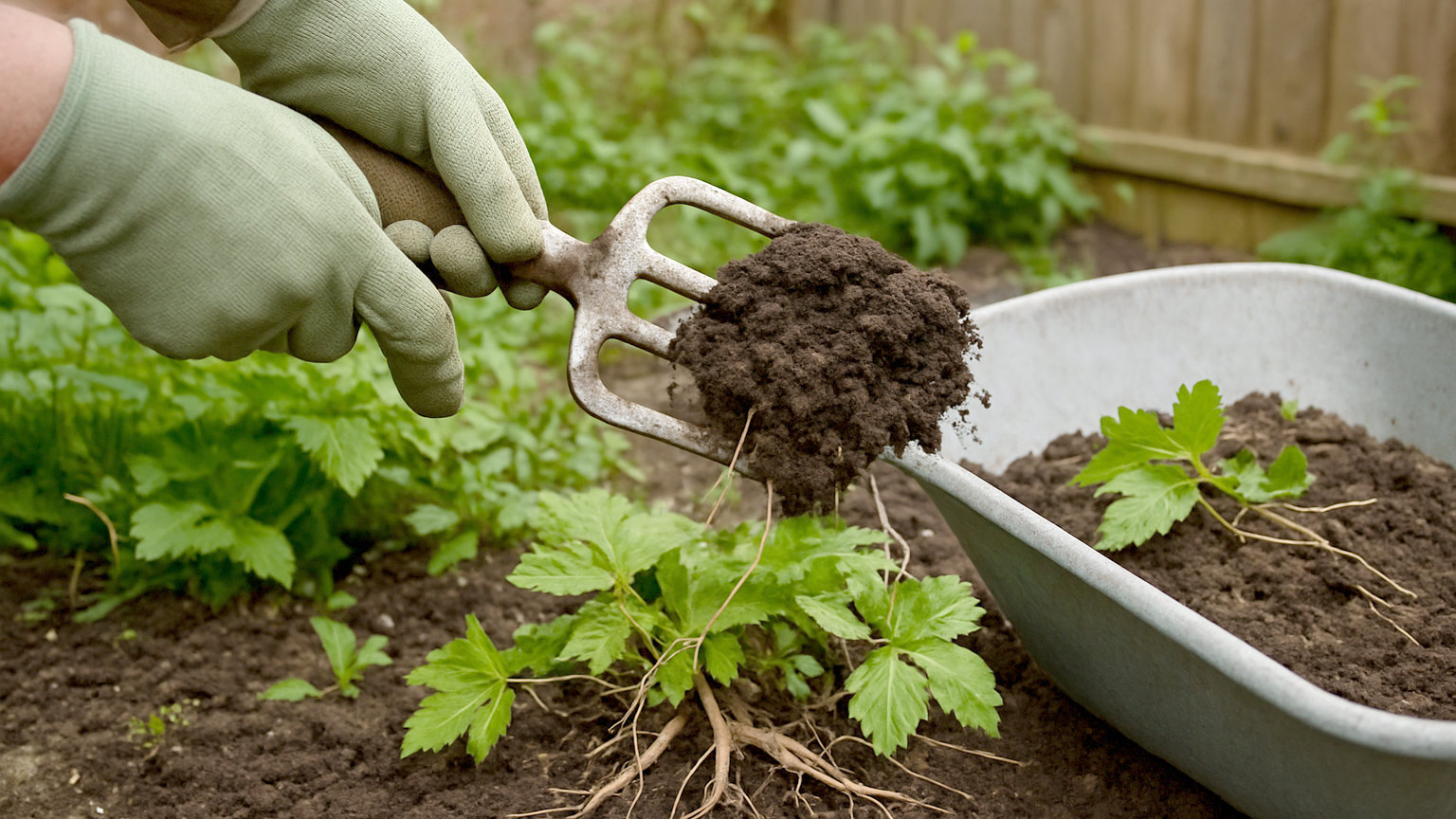
These two share the characteristic that makes a weed genuinely difficult: they spread by underground rhizomes, and every broken piece grows into a new plant.
Ground elder
Leaves divided into groups of three, in threes again, on grooved stalks. White umbel flowers in early summer.
White, brittle rhizomes running horizontally just below the surface, snapping readily when pulled.
Introduced long ago as a pot herb and now thoroughly established.
Thrives in shade and among planting, which is where it is most difficult to remove.
Couch grass
Coarse grass with flat leaves and a distinctive rhizome: white, wiry, with sharp pointed tips that drive straight through the crowns of other plants.
Rhizomes run horizontally at varying depths and branch extensively.
Also spreads by seed, though the rhizomes matter more.
Why half measures fail
Every fragment of rhizome with a node produces a new plant.
Hoeing chops the rhizomes and multiplies them.
Rotavating is the worst possible action, turning one infestation into hundreds of plants distributed through the whole plot.
Pulling the tops removes the leaves and leaves the entire system intact.
Anything short of complete removal, or complete exhaustion, results in regrowth.
Digging out
Effective on clear ground and requires real thoroughness.
Use a fork, never a spade, which cuts the rhizomes into pieces.
Loosen the soil and lift it gently, teasing the rhizomes out whole.
Work systematically across the area rather than jumping about.
Sieve or hand-sort the soil where the infestation is heavy.
Go over the ground again after two or three weeks, when anything missed will have produced shoots that reveal its position.
Expect to repeat this several times over a season.
Do not compost the rhizomes in a domestic heap. Dry them thoroughly on a hard surface until dead, drown them in water for several weeks, or dispose of them through green waste collection.
Light exclusion
The most reliable non-chemical method for a clear area, and it takes time.
Cut the top growth down.
Cover the ground with thick opaque material: heavy black polythene, old carpet is now generally discouraged, or a proper woven landscape membrane, weighted down at every edge with no gaps.
Cardboard covered with a thick mulch works for less vigorous weeds and is usually insufficient on its own for these two.
Leave it for a full growing season at minimum, and preferably twelve to eighteen months.
The plant uses its stored reserves trying to reach light and eventually exhausts itself.
Check the edges regularly, since rhizomes travel sideways and emerge beyond the cover.
Among established planting
The hardest situation, and there is one honest answer.
Lift the plants you want to keep, wash every trace of soil from their roots, and check for rhizome fragments hidden within the crowns.
Pot them up temporarily in fresh compost, and hold them for a season while the ground is cleared.
Divide congested clumps at the same time, discarding any part you cannot be certain of.
Then clear the ground completely before replanting.
This is drastic and it is the only approach that reliably works. Picking rhizomes out from among established plants year after year does not.
Persistent removal
Where clearing is impossible, repeatedly removing every shoot as it appears weakens the plant over several seasons.
It must be done consistently, every week or two through the growing season, so no leaf ever photosynthesises for long.
This takes years and it does work.
Chemical control
A systemic weedkiller applied to actively growing foliage is carried down to the rhizomes.
Repeat applications are usually needed, and it cannot be used among plants you wish to keep.
The label is a legal document and using a product other than in accordance with it is an offence.
Preventing reinfestation
Check the boundaries, since both spread in from neighbouring ground.
A vertical barrier of heavy membrane buried along the boundary, to a depth of at least forty-five centimetres, blocks incoming rhizomes.
Inspect every bought plant and every gift plant before it goes in, since both weeds travel readily in pots.
How long it takes
Digging out a small patch thoroughly, with follow-up over a season, can clear it.
Light exclusion takes twelve to eighteen months.
Persistent shoot removal takes two or three years.
Anyone expecting to deal with either weed in a single weekend will be disappointed, and the work is finite if it is done properly once.
Half-hearted attempts repeated annually take far longer in total than one thorough clearance.


