
Taking on an overgrown garden or allotment is mostly a question of patience and sequence. The temptation to plant something in the first month is what causes years of subsequent trouble.
Wait and look first
Do not clear everything immediately.
A neglected garden frequently contains bulbs, perennials, fruit bushes and shrubs that are invisible in July and worth keeping.
Where the situation allows, watch through a full year before removing anything except what is obviously dead or dangerous.
Where that is not practical, clear in stages and mark anything that appears.
Cut everything down
The first physical step, and it reveals what you are dealing with.
Use shears, a scythe, a brushcutter or a strimmer, working in stages rather than all at once.
Check for wildlife before cutting, particularly hedgehogs in long grass, nesting birds in scrub between March and August, and slow worms and grass snakes in compost and rough ground.
Wear eye protection, ear defenders, stout boots, gloves and long trousers.
Look for hidden hazards: wire, glass, metal, old paving and abandoned rubbish.
Cutting down does not kill anything perennial, and it lets you see the layout, the boundaries and what weeds are present.
Identify the perennial weeds
This determines everything that follows.
Bindweed, ground elder, couch grass, horsetail, brambles, docks and thistles all need dealing with before planting.
Japanese knotweed and other listed invasive species are an entirely separate matter with legal implications, and require professional advice.
Do not rotavate
This is the single most common and most damaging mistake.
A rotavator chops every rhizome and root fragment into hundreds of pieces and distributes them evenly through the plot.
Ground that had bindweed in one corner has it everywhere by the following spring.
Rotavating is only appropriate on ground that is genuinely free of perennial weeds, which a neglected plot never is.
Choose a clearance method
Light exclusion is the most reliable and the slowest. Cut down, cover with thick opaque material weighted at every edge, and leave for a full growing season and preferably longer. The weeds exhaust their reserves.
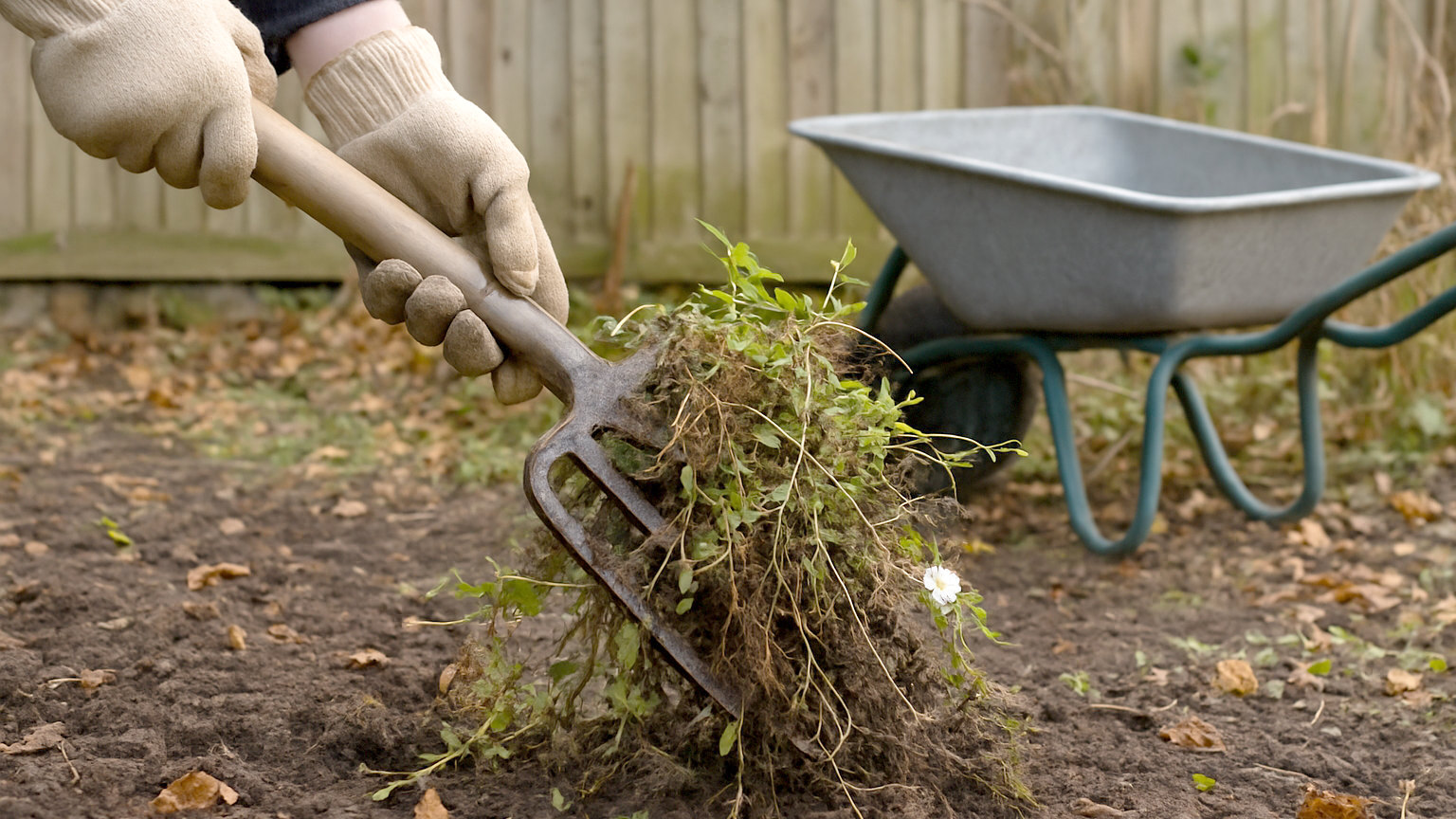
Digging out works for a smaller area. Use a fork rather than a spade, lift gently, remove every fragment, and go over the ground repeatedly as regrowth reveals what was missed.
Repeated cutting weakens perennials over two or three seasons where neither of the above is practical.
Systemic weedkiller applied to actively growing foliage is an option, requires repeat applications, and the label is a legal document.
Combining methods works well: clear a section by digging, cover the rest, and work across the plot over two or three years.
Work in sections
Clearing a whole plot at once is demoralising and rarely finished.
Clear one bed properly, plant it, and cover the rest.
A small area that is genuinely clean and productive is worth more than a large area half done.
Covered ground is not wasted ground; it is being cleared while you work elsewhere.
Then improve the soil
Once clear, add organic matter generously and mulch.
Test the pH, since neglected ground can be anything.
Deal with compaction by forking rather than turning.
Plant and cover
Plant densely and mulch thickly, so there is no bare ground for weeds to recolonise.
Use green manures on vegetable ground that is not in use.
Bare soil in a cleared plot regrows weeds within weeks.
The boundaries
Weeds return from adjoining ground continuously.
Keep a clear strip along boundaries, or bury a vertical membrane barrier to at least forty-five centimetres where a neighbour has ground elder or bindweed.
Realistic timescales
A season to assess and cut down.
One to two years to clear perennial weeds properly.
Three years before a neglected plot is genuinely under control.
Doing it properly once is far quicker than planting into uncleared ground and fighting it for a decade.
What to keep
Mature trees and established shrubs are worth assessing before removal, since they take decades to replace.
Fruit trees and bushes frequently recover well from renovation pruning.
Bulbs, hellebores, peonies and other long-lived perennials are often present and worth lifting and holding while the ground is cleared.
Check for a Tree Preservation Order and conservation area status before any tree work, since unauthorised work is an offence.


