
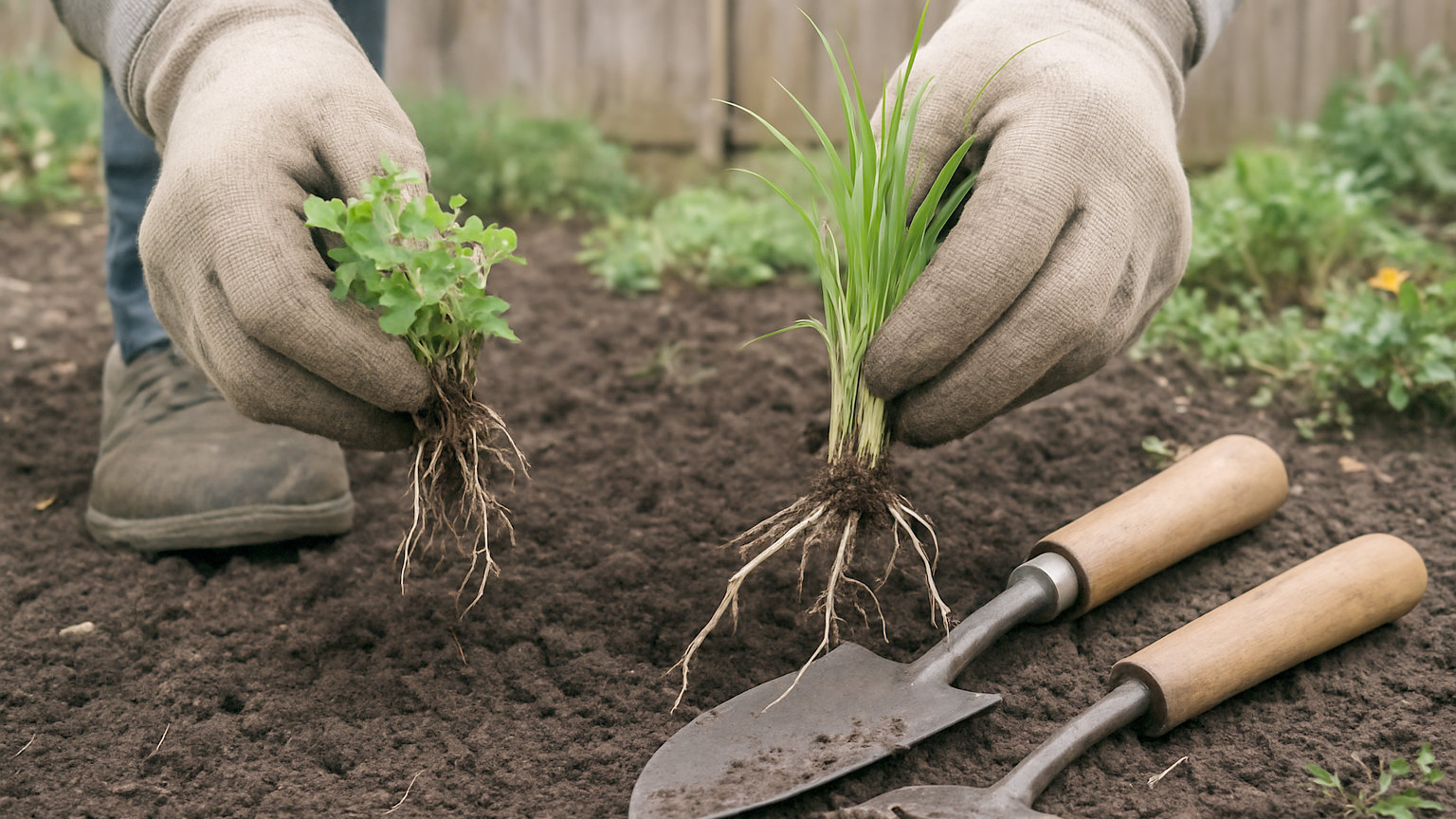
Almost every mistake in weed control comes from treating one type as if it were the other. Establishing which you have is the first step and determines everything that follows.
Annual weeds
Germinate, grow, set seed and die within a year, and often complete several generations in a season.
They survive as seed in the soil rather than as living plants.
Common examples: groundsel, chickweed, annual meadow grass, hairy bittercress, fat hen, shepherd's purse, speedwell, cleavers and annual nettle.
The entire strategy is to prevent seeding. Kill the plant before it flowers and you have removed that generation permanently.
Hoeing is the ideal method. Sever the stem from the roots just below the surface on a dry day, and the seedling shrivels.
Hand pulling, mulching and covering all work.
They are easy to kill and produce enormous quantities of seed, so timing matters far more than effort. One year's seeding is seven years' weeding.
Perennial weeds
Live for years, surviving winter as roots, rhizomes, bulbs or tubers.
Common examples: bindweed, ground elder, couch grass, docks, dandelions, creeping buttercup, nettles, creeping thistle, horsetail and oxalis.
They spread both by seed and, more importantly, by underground growth.
Hoeing makes several of them worse. Chopping a bindweed or ground elder rhizome into pieces creates a new plant from each fragment.
The strategy is to remove the entire underground system, or to exhaust it.
Why the distinction matters
Hoeing a bed of annual weeds clears it. Hoeing a bed of ground elder multiplies it.
Rotavating ground containing perennial weeds is the classic disaster: it chops every rhizome into hundreds of pieces and plants them all.
Mulching suppresses annual weed seedlings effectively and will not stop an established perennial pushing through.
Removing the top growth of an annual kills it; removing the top growth of a perennial merely prunes it.
Recognising which
Dig one up and look at the root.
Annuals have a modest fibrous or shallow tap root, and the whole plant comes out easily.
Perennials have thick fleshy roots, white brittle rhizomes running horizontally, deep tap roots, or bulbils.
If it snaps and leaves something behind, it is almost certainly perennial and will regrow.
Perennial weeds also reappear in exactly the same place year after year, which annuals do not.
Dealing with perennials
Dig out completely, following the roots and removing every fragment. Use a fork rather than a spade, which chops.
This works for dandelions, docks and thistles with a defined tap root, and is far harder for spreading rhizomes.
Exhaust them by exclusion. Cover the ground with thick opaque material for a full growing season or longer. Deprived of light the plant uses its reserves trying to grow and eventually dies.
This is the most reliable non-chemical method for bindweed, ground elder and couch.
Repeated removal of top growth weakens them over time, since every regrowth costs stored energy. It requires persistence over several seasons.
Where a chemical is used, it must be a systemic type carried down to the roots, applied to actively growing foliage, and the label is a legal document.
Biennials
A third group, completing their cycle over two years and behaving like annuals for control purposes.
Ragwort, spear thistle and burdock are examples. Remove before they flower in the second year.
A working approach
Clear perennial weeds thoroughly before planting anything, since removing them from among established plants is far harder.
Then keep on top of annuals by hoeing regularly and never letting anything seed.
That order matters, and doing it the other way round is the reason many borders are a permanent battle.
Weeds that are both
Some behave differently in different situations.
Annual meadow grass can persist and root at the nodes in a lawn.
Chickweed sometimes overwinters as a living plant in mild conditions rather than only as seed.
The practical test remains the root: if pulling it removes the whole plant, treat it as an annual.
Where they come from
Annuals arrive as seed on the wind, in bought plants, in manure and topsoil, and from the existing seed bank in the soil.
Perennials usually arrive as root fragments in bought plants, in imported soil, or by spreading in from a neighbouring boundary.


