
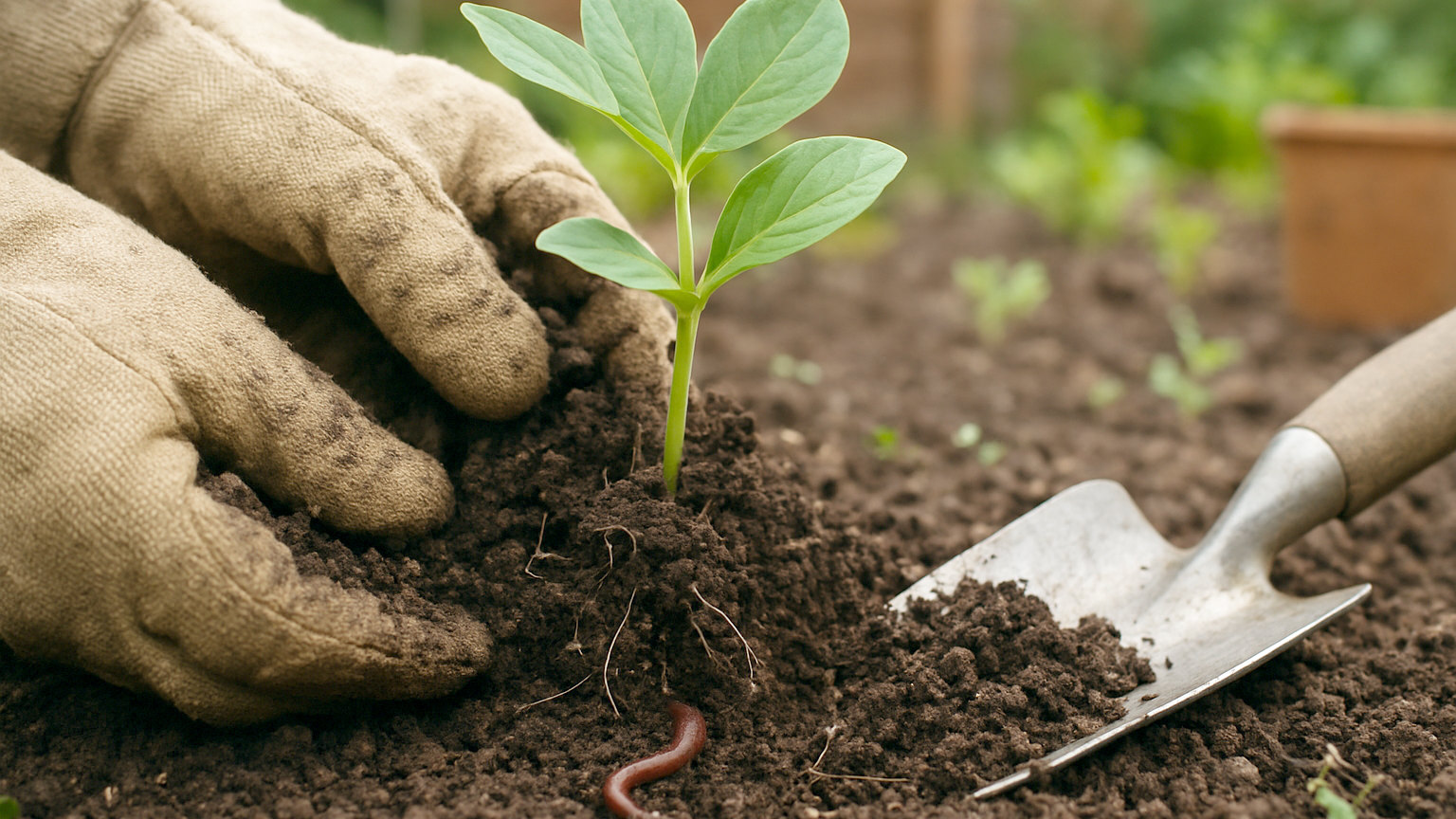
Soil is not an inert medium holding plants up. A teaspoon of healthy soil contains billions of organisms, and their activity is what turns organic matter into plant nutrition and builds structure.
Earthworms
The most visible and among the most useful.
They drag organic material down from the surface, mix the profile, create channels that drain and aerate, and produce casts richer in available nutrients than the surrounding soil.
Different species work at different depths: some in the surface litter, some in the topsoil, and deep burrowers that create permanent vertical channels.
Worm numbers are a good indicator of soil health. Dig a spade's depth and count.
They are reduced by frequent cultivation, by bare soil, by acidity and by loss of organic matter.
Mycorrhizal fungi
Fungi that form partnerships with plant roots, present in the great majority of plant species.
The fungal threads extend far beyond the root system, effectively increasing its reach enormously, and pass water and nutrients, particularly phosphorus, to the plant in exchange for sugars.
They also connect plants to one another and improve drought tolerance.
Disturbance breaks the networks up, which is one of the arguments for reduced cultivation.
High phosphorus fertiliser reduces the association, since the plant has less need of it.
Brassicas and a few other families do not form these partnerships.
Bacteria and other organisms
Bacteria decompose organic matter, fix nitrogen from the air in partnership with legumes, and cycle nutrients continuously.
Other fungi break down tough material including lignin, which bacteria cannot.
Protozoa and nematodes graze on bacteria and fungi and release nutrients in plant-available form as they do so.
Springtails, mites, beetles and other small creatures shred organic material and make it available to the microorganisms.
The whole assemblage is frequently called the soil food web, and plant nutrition depends on it.
Feeding the soil rather than the plant
The central idea in soil management.
Adding organic matter feeds the organisms, and the organisms feed the plants, releasing nutrients gradually in a form roots can take up.
This differs from applying soluble fertiliser, which supplies nutrients directly and bypasses the biology.
Both work, and the first also builds structure, improves water holding and produces a system that becomes more resilient over time.
What harms soil life
Frequent deep cultivation, which disrupts fungal networks, exposes organic matter and kills worms.
Bare soil, which dries out, overheats and offers no food.
Compaction, which removes the air spaces most organisms need.
Loss of organic matter where nothing is returned.
Strongly acid conditions, which suppress worms and bacteria.
Some pesticides and fungicides, and certain slug treatments, which affect non-target soil organisms.
Waterlogging, which excludes oxygen.
What supports it
Add organic matter annually. Compost, leaf mould, manure or mulch on the surface.
Keep the soil covered with mulch, planting or green manure.
Reduce cultivation, digging only where necessary.
Avoid compaction by staying off wet soil and using defined beds.
Rotate crops and grow a diversity of plants, since different plants support different organisms.
Use fertilisers judiciously rather than routinely.
Mycorrhizal products
Sold for planting trees, roses and shrubs.
Evidence for benefit in ordinary garden soil is mixed, since the fungi are usually present already.
They may help on disturbed, degraded or newly created ground where soil life is depleted.
Apply in contact with the roots at planting, since they must reach the root surface to establish.
The practical conclusion
The measures that support soil life are the same ones that improve structure, retain water and reduce weeding.
Add organic matter, cover the surface, disturb it less, and stay off it when it is wet.
None of that costs anything, and the effect compounds over years.
Judging progress
Dig a spade's depth and look, once a year, in the same place.
Count the worms, look at the colour and the crumb structure, and see how easily the spade goes in.
Improvement is gradual and unmistakable over three or four seasons.
Photograph the spade full of soil each year if you want a record, since the change is easy to forget.
Compost and cultivation
Every pass with a spade or a rotavator burns off organic matter and disrupts the organisms.
Reducing cultivation and adding material to the surface preserves both, and worms do the incorporating.


