
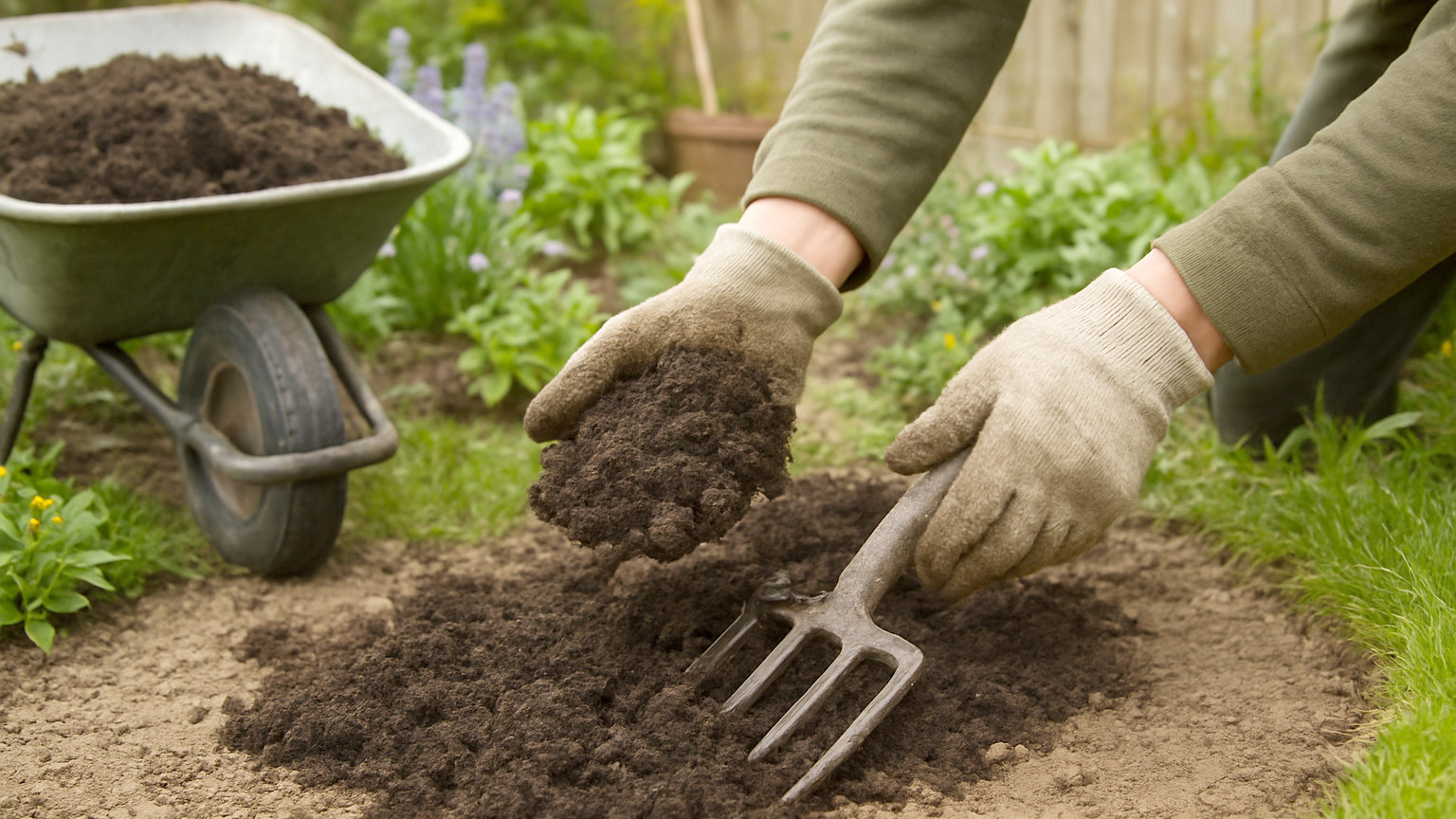
If there is one thing worth doing to any soil, it is adding organic matter. It improves heavy soil and light soil in opposite ways, and the same material does both.
What it does
In clay, it binds particles into crumbs, opening up the structure so water drains and air reaches the roots. Heavy soil becomes workable.
In sand, it acts as a sponge, holding water and nutrients that would otherwise drain straight through.
In both, it feeds the soil organisms whose activity builds structure, releases nutrients gradually as it decomposes, buffers pH, and improves the soil's ability to hold nutrients rather than lose them to leaching.
It also moderates temperature and protects the surface from rain compaction when used as a mulch.
Humus
The stable, well-decomposed fraction that remains after the easily broken down material has gone.
It is dark, colloidal and long lasting, and it is what gives good topsoil its colour and its water-holding capacity.
Fresh organic matter decomposes quickly and feeds the biology; humus persists and holds the structure together.
Both matter, which is why regular additions are better than one large one.
Sources
Garden compost is the best all-round material, free, and made from what the garden produces.
Well-rotted manure is excellent and supplies more nutrients. It must be well rotted, and the source should be checked because of possible hormone weedkiller residues.
Leaf mould is low in nutrients and excellent as a soil conditioner and mulch, particularly for woodland planting.
Composted bark and wood chip last well and are low in nutrients, suiting shrub borders.
Green manures, grown and incorporated or cut and left as a mulch.
Municipal green waste compost, available cheaply in bulk in many areas, though quality varies and it can contain fragments of plastic.
Spent mushroom compost is alkaline, so avoid it around lime-hating plants.
Avoid peat, since extraction damages habitats that store very large quantities of carbon, and it is being phased out for amateur sale.
How much
A layer of five to seven centimetres over a bed is a reasonable annual application.
Roughly a cubic metre covers fifteen to twenty square metres at that depth.
It must be replaced regularly, since organic matter decomposes continuously and is lost faster in warm well-aerated soil.
An annual application maintains the level; a single large one produces a temporary improvement.
Dig it in or spread it on top
Both work, and surface application is increasingly preferred.
Spreading it on the surface lets worms incorporate it gradually, preserves soil structure and fungal networks, suppresses weeds and protects the surface. It also involves far less work.
Digging it in incorporates it faster and is useful when preparing new ground, planting a shrub border, or improving a badly compacted area.
Do not dig organic matter into the bottom of an individual planting hole, which creates a sump. Improve a wide area instead.
Timing
Autumn or late winter, onto moist soil, is the usual choice.
Mulch before the spring flush of weed seed germinates.
Apply to weed-free ground, since mulch suppresses germination rather than killing established weeds.
Cautions
Manure must be well rotted, at least six months and preferably longer. Fresh manure scorches roots and robs nitrogen as it breaks down.
Ask about hormone weedkiller residues in manure from treated pasture, which cause distorted growth on tomatoes, beans and potatoes and persist for years.
Wear gloves handling compost and manure, and avoid breathing the dust. Open bagged compost at arm's length in the open air, since bagged composts carry a small legionella risk.
Wash hands afterwards and keep tetanus vaccination current.
The long view
Soil improved with organic matter every year for a decade is transformed.
There is no shortcut and no substitute, and it is the most useful habit a gardener can have.
Where to concentrate it
Vegetable ground, which is cropped hard and loses organic matter fastest.
New borders, before planting, worked into a wide area.
Anywhere the soil is poor, thin, sandy or heavy.
Around hungry plants such as roses, fruit and clematis.
Gravel gardens and Mediterranean plantings are the exception, since these want lean conditions and organic matter works against them.
There, grit for drainage is added and compost for fertility is not.


