
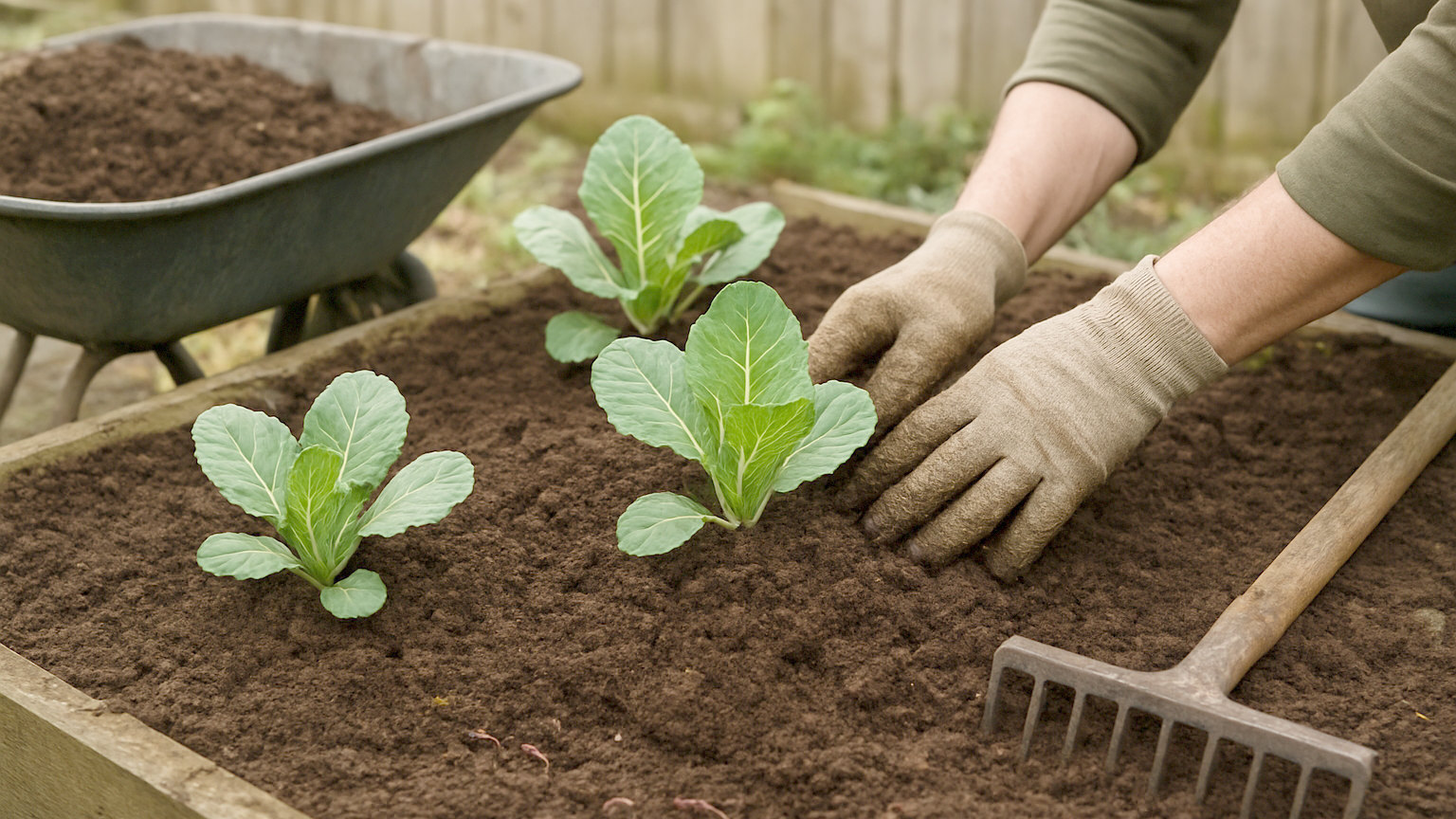
No-dig growing means leaving the soil undisturbed and adding organic matter to the surface, letting worms and soil organisms incorporate it. It produces good results with considerably less work.
The reasoning
Digging destroys structure that soil organisms have built, breaking crumbs and disrupting fungal networks.
Digging brings weed seed to the surface. Most weed seed needs light to germinate, and buried deeply it stays dormant. Every turn of a spade brings a new supply into the light.
Digging exposes organic matter to oxygen, which accelerates its loss.
It also damages worms and disturbs the profile.
Leaving the soil alone and feeding the surface allows the biology to do the work it does in an undisturbed system such as a wood.
Starting a bed
On grass or weedy ground, over an existing bed, or on cleared soil.
Clear perennial weeds first. This is essential and is where the method is misrepresented. Bindweed, ground elder, couch and horsetail will grow through mulch and must be dealt with by digging out or by prolonged exclusion.
Cut existing growth down.
Lay plain cardboard over the area, removing tape and staples, overlapping generously and wetting it thoroughly.
Spread compost over the cardboard, at least ten to fifteen centimetres for a new bed.
Plant straight into the compost. The cardboard suppresses grass and annual weeds while roots pass through it, and it rots within a season.
Maintaining it
Spread three to five centimetres of compost on the surface each year, usually in autumn or late winter.
Do not fork it in. Worms take it down.
Plant and sow directly into the surface layer.
Pull or hoe weeds shallowly, disturbing as little as possible.
Keep off the beds. This is why no-dig usually uses defined beds narrow enough to reach across, with paths between.
What it achieves
Substantially less weeding after the first year or two, as the surface seed bank is depleted and never replenished.
Better structure and more soil life.
Better moisture retention, since the surface is covered and the structure is intact.
Earlier working in spring, since an undug surface is walkable sooner.
Considerably less physical effort.
Yields comparable to, and frequently better than, dug ground.
What it requires
A great deal of compost, which is the main practical constraint. A large annual application over a whole plot needs either serious composting or bought material.
Patience through the first season while the system establishes.
Thorough perennial weed clearance at the outset.
Where digging is still needed
Clearing perennial weeds from infested ground.
Relieving genuine compaction or breaking a hard pan, though this can be done by forking and levering without turning.
Lifting root crops such as potatoes and parsnips, which is unavoidable.
Planting trees and shrubs, which requires a hole.
Incorporating material into a very poor subsoil when creating a new bed from scratch.
Correcting drainage problems.
Common misunderstandings
It is not no-weeding. Windblown seed still arrives and needs removing.
It does not deal with established perennial weeds on its own.
It is not no-effort at the start, since establishing beds and sourcing compost is real work.
It is not a requirement. Ground that is dug and well managed grows excellent crops.
A middle course
Many gardeners adopt the principles without the label: dig less, mulch the surface annually, keep off the beds when wet, use defined beds, and cultivate only where there is a reason.
That captures most of the benefit without a change of religion.
Sourcing the compost
The practical limitation, and worth planning.
Make as much garden compost as you can, add leaf mould, and consider municipal green waste compost, which is available cheaply in bulk in many areas.
Check any bought material for hormone weedkiller residues if it contains manure, by growing broad beans in a sample first.
Bulk delivery costs far less than bags for anything beyond a small plot, and it is worth ordering it tipped as close to the beds as access allows.
Getting started
Convert one bed rather than the whole plot, and compare it with a dug bed alongside over a season.
That settles the question for your own soil far better than any argument about it.
In ornamental borders
The principles apply just as well, and most gardeners already follow them without calling it no-dig.
An established border is rarely dug, and an annual mulch on the surface is standard practice.


