
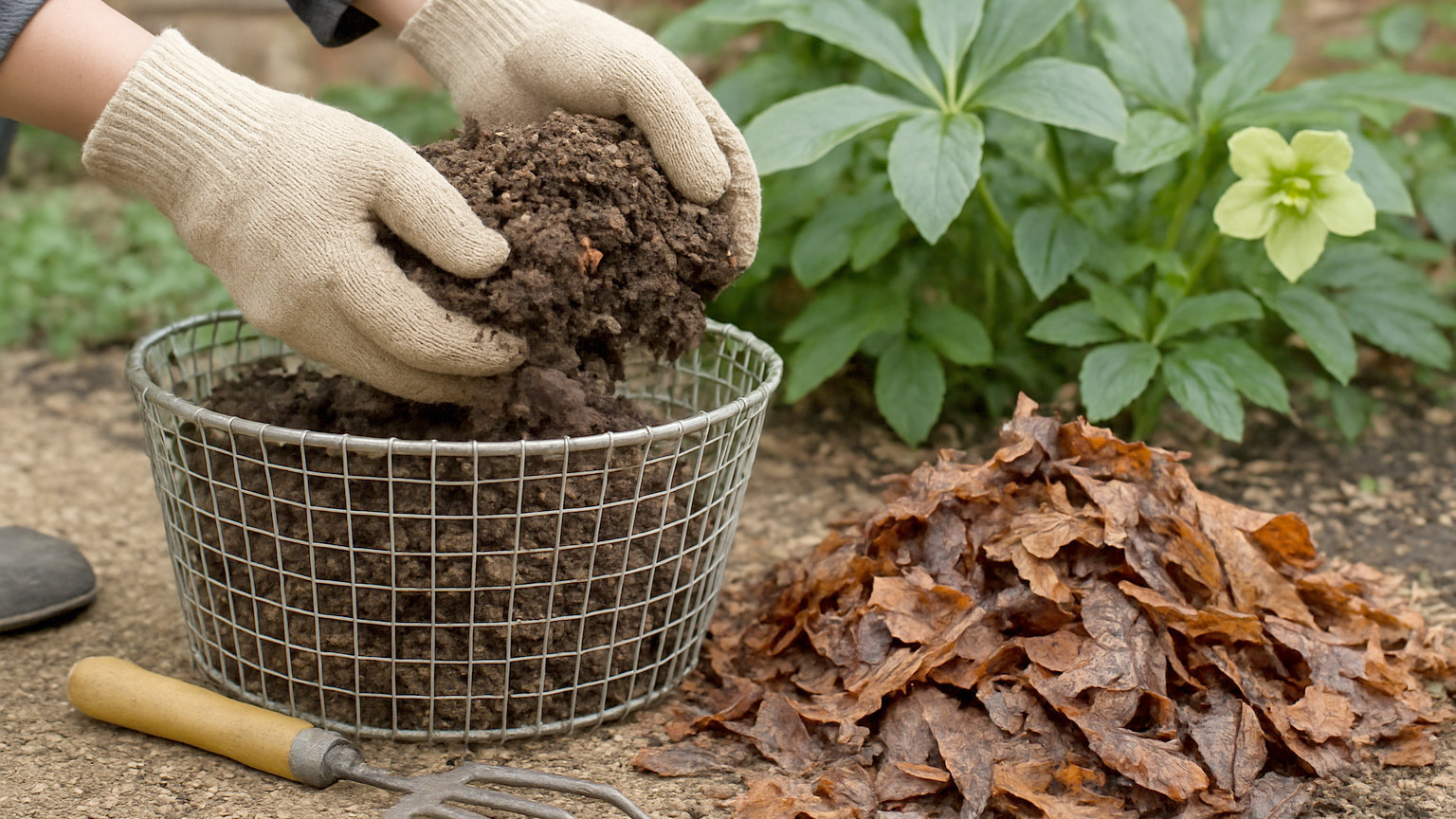
Leaf mould is made by an entirely different process from garden compost, which is why it belongs in its own heap and why it takes so much longer.
Why it is different
Garden compost is produced largely by bacteria, working fast in warm conditions with a mixture of greens and browns.
Leaf mould is produced by fungi, working slowly and coolly on material that is almost entirely carbon.
Leaves added in quantity to a compost heap slow it down and mat together. Kept separately they produce something better.
The result is low in nutrients and outstanding in structure, which makes it a soil conditioner rather than a feed.
Making it
Two methods, both simple.
A wire cage of chicken wire on four posts, in an out-of-the-way corner. Fill it with leaves, tread them down, and water if they are dry.
Bin bags, filled with damp leaves, pierced several times for air, tied loosely and stacked out of the way. Simplest for a small garden.
Either way, the leaves must be damp. Dry leaves do nothing at all.
Shredding the leaves, or running a rotary mower over them, speeds the process considerably.
No turning is required, though it does no harm.
Timescales
Roughly a year for a rough mulch, and two years for a fine crumbly material.
Species vary considerably. Oak, beech and hornbeam rot slowly and produce excellent leaf mould. Ash, elm, cherry and lime rot faster.
Evergreen leaves, conifer needles and laurel are slow and best kept separate or excluded.
Plane and horse chestnut leaves are large and leathery and benefit from shredding.
Pine needles produce an acidic material suited to mulching lime-hating plants.
Collecting leaves
Rake from lawns and paths, where a covering of wet leaves kills grass and makes surfaces slippery.
Leave them in borders, where they rot down naturally, feed the soil and shelter overwintering insects. This is not untidiness; it is what happens in a wood.
Collect from paths and gutters promptly.
A rotary mower with the collector on both shreds and gathers leaves from a lawn in one pass, and mixes in a little grass, which speeds rotting.
Do not take leaves from woodland or public land in quantity, since they are part of that system.
Using it
As a mulch on borders, particularly woodland and shade planting, where it mimics natural leaf fall.
As a soil conditioner dug in or spread on the surface, improving structure and water holding.
In potting mixes, where well-rotted leaf mould replaces peat effectively as a component, combined with loam and grit.
For seed sowing, where two-year-old sieved leaf mould is low enough in nutrients to suit.
Around trees and shrubs as an annual mulch.
Nutrient content
Low, which is a feature rather than a shortcoming.
It conditions the soil without adding fertility, which suits woodland plants, alpines and anything that resents rich conditions.
Where nutrients are wanted, use compost or manure instead, or in addition.
Practical points
Site the heap or bags where they are out of sight, since the process takes two years and needs no attention.
Make a new heap each autumn, so you have a rotation of one rotting and one ready.
Check for wildlife before disturbing an old heap, since hedgehogs, toads and slow worms all shelter in them.
Wear gloves and wash hands, and avoid breathing the dust when handling well-rotted material.
Wildlife
A pile of leaves left in a corner shelters hedgehogs, amphibians, invertebrates and overwintering insects.
Leaving some leaf litter undisturbed through winter costs nothing and supports a great deal.
The economics
Leaf mould costs nothing but time and a corner of the garden.
It replaces bought soil conditioner and a proportion of bought compost, and it is produced from material most people pay to have taken away.
Common mistakes
Adding leaves to the compost heap in quantity, where they mat and slow everything down.
Letting the leaves dry out, so nothing happens at all.
Expecting it within a year, when two is normal for a fine material.
Clearing leaves from borders where they would have done good work rotting down in place.
Mixing evergreen and conifer material in, which rots far more slowly than deciduous leaves and holds the whole heap back.


