
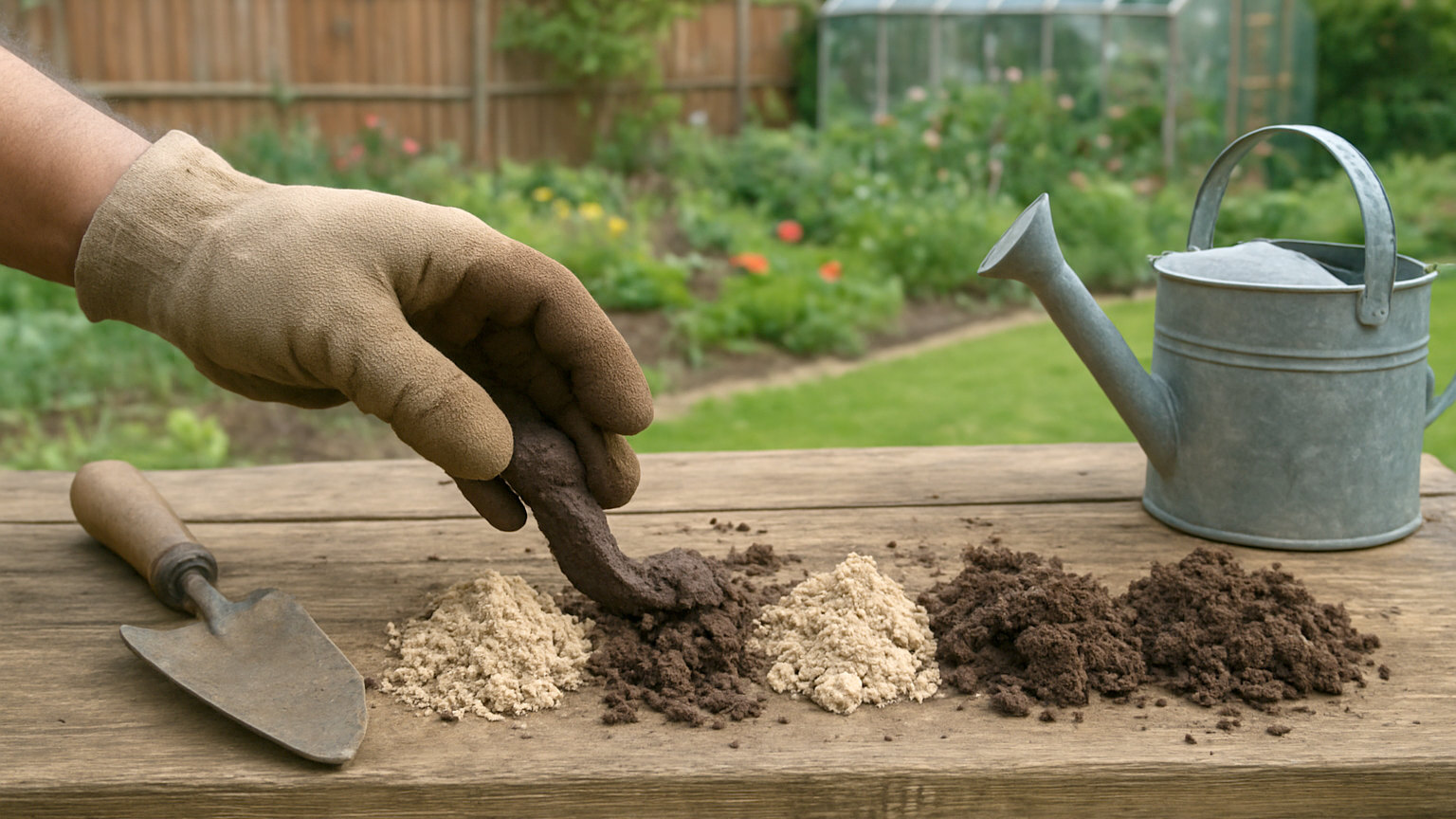
Soil type determines what will grow, how often you water and when you can work the ground. Two simple tests identify it in an afternoon, and almost everything you then do follows from the answer.
The ribbon test
Take a small handful of moist soil and roll it between your palms.
If it forms a smooth ball and can be rolled into a sausage and bent into a ring without cracking, you have clay. If it feels gritty and falls apart, you have sand. If it feels silky or soapy and forms a weak ball that breaks easily, it is silt. If it forms a ball that just holds together but crumbles when pressed, you have loam, which is the ideal.
Chalky soil is pale, often stony with visible white flecks, shallow over rock, and drains very freely.
The jar test
For a more precise answer, fill a jar a third full with soil, top it up with water, add a drop of washing-up liquid, shake thoroughly and leave it to settle for a day.
The particles separate into layers. Sand settles first at the bottom, then silt, then clay at the top, with organic matter floating. The relative depths give you the proportions.
Clay
Heavy, sticky when wet, rock hard when dry, slow to warm in spring and prone to waterlogging. It is also the most fertile soil there is, holding nutrients well, and a good clay garden outperforms a good sandy one once managed.
Never dig or walk on clay when it is wet, which destroys the structure and compacts it for years. Wait until it crumbles.
Add organic matter generously and repeatedly, which opens the structure and improves drainage. Coarse grit helps in planting holes. Raised beds are a practical answer where drainage is poor, and autumn planting suits it less well than spring, since plants can rot over winter.
Sand
Light, free-draining, easy to dig, warms early in spring, and loses water and nutrients almost as fast as you supply them.
The answer is the same: organic matter, in quantity and repeatedly, which increases the water and nutrient holding capacity. Mulch heavily to reduce evaporation, and feed little and often rather than in large doses that simply wash through.
Sandy soil suits Mediterranean plants, bulbs, carrots and root crops, and anything that resents winter wet.
Chalk
Free-draining, alkaline, often shallow over solid chalk or limestone, and low in nutrients. It dries out quickly and the high pH locks up iron and manganese, which is why acid-loving plants yellow and fail on it.
Organic matter again, and choose plants that suit it rather than fighting the pH. Attempting to grow rhododendrons, camellias, blueberries or pieris on chalk is a long expensive disappointment, and they are better in containers of ericaceous compost.
Clematis, lilac, buddleja, hellebores, dianthus and many Mediterranean plants all do well on chalk.
Testing pH
A cheap kit or a meter gives you the acidity or alkalinity. Most garden soils sit between pH 5.5 and 7.5, and the majority of plants are happy across that range.
Test in several places, since it can vary across a garden, particularly near a house where builders' rubble raises the pH locally.
It is far easier to choose plants that suit your pH than to change it. Adding lime raises pH and is reasonably straightforward. Lowering it is difficult, temporary and mostly futile, which is why growing ericaceous plants in containers is the sensible route on chalk.
Soil life
Healthy soil is a living system rather than a growing medium, containing worms, fungi, bacteria and countless invertebrates that make nutrients available to plants. Digging repeatedly, walking on wet soil and leaving ground bare all damage it.
Keeping the surface covered, either with planting or with mulch, and disturbing it as little as possible, does more for soil health over five years than any product.
The universal answer
Whatever your soil, the same treatment improves it: bulky organic matter, applied as a mulch each year and let the worms do the work.
Garden compost, well-rotted manure, leaf mould and spent mushroom compost all work, though mushroom compost is alkaline and best avoided on chalk. Five to seven centimetres spread over the surface annually in autumn or spring transforms clay and sand alike over a few years.
There is no need to dig it in. Applying it to the surface and leaving it alone preserves soil structure and the fungal networks within it, and the worms incorporate it more effectively than a spade does.


