
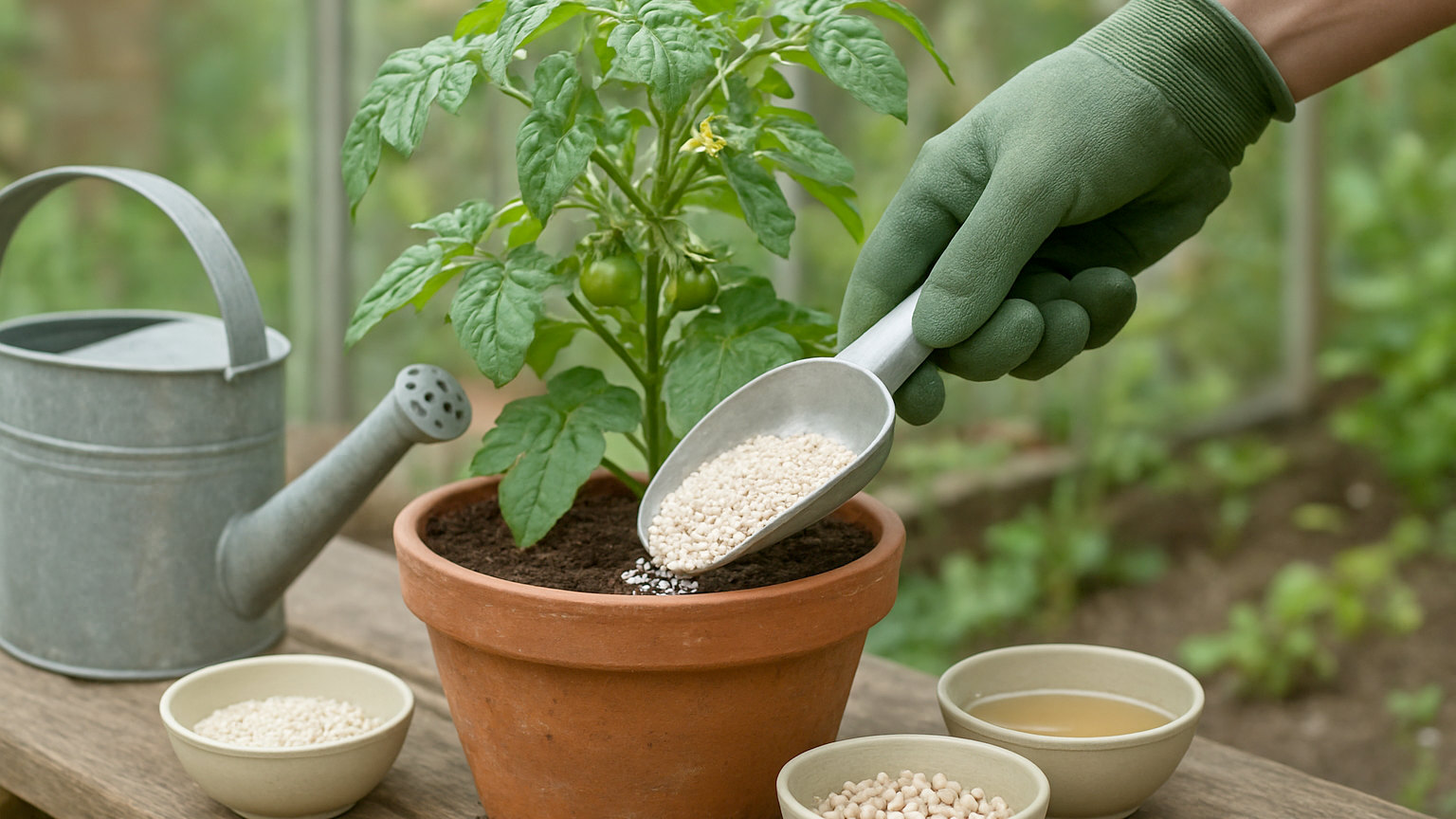
Every fertiliser packet carries three numbers. Understanding them means you can choose the right feed for what you want a plant to do, rather than buying whatever is nearest.
The three numbers
They give the percentage of nitrogen, phosphorus and potassium, always in that order.
Nitrogen, N: leaf and stem. Drives green leafy growth. Short of it, plants are pale, yellowing from the oldest leaves, and stunted. Too much produces soft sappy growth that attracts aphids, flowers poorly and is damaged by frost.
Phosphorus, P: roots and establishment. Important for root development, seedlings and young plants. Deficiency is uncommon in gardens and shows as poor growth with dull purplish foliage.
Potassium, K: flowers, fruit and hardiness. Promotes flowering and fruiting, improves disease resistance and toughens growth against cold. Deficiency shows as scorched leaf margins and poor flowering.
So 7-7-7 is balanced, 20-5-10 is high nitrogen, and something like 5-5-10 or a tomato feed with a high last figure is high potash.
Common fertilisers
Growmore and similar balanced general fertilisers, roughly equal in all three, for general use before planting and sowing.
Blood, fish and bone, an organic-based balanced feed releasing more slowly. Note that it attracts foxes, cats and dogs, which dig where it has been applied.
Bonemeal, high in phosphorus and slow acting, traditionally used at planting for roots. Wear gloves and a mask when applying, and note that in most garden soils phosphorus is not short.
Sulphate of ammonia, high nitrogen, fast acting, and it acidifies the soil.
Dried blood, high nitrogen and fast acting, for a quick boost to leafy growth.
Sulphate of potash, high potassium, for flowering and fruiting plants.
Tomato feed, high potash and liquid, and just as useful on roses, dahlias, containers and any flowering or fruiting plant.
Pelleted poultry manure, a moderate organic general feed.
Seaweed extract, low in the major nutrients and rich in trace elements, used as a tonic.
Fast and slow
Liquid feeds act within days and wash through, so they need repeating, usually weekly or fortnightly in the growing season. Ideal for containers and for correcting a shortage quickly.
Granular feeds are scratched into the surface and act over weeks.
Slow-release granules release over months as temperature and moisture allow, and suit containers and permanent planting.
Organic fertilisers generally release slowly as soil organisms break them down, which means they work with the soil biology and act more slowly in cold conditions.
Trace elements
Needed in tiny amounts and limiting when absent.
Magnesium deficiency shows as yellowing between the veins of older leaves, common on light soils and in containers. Epsom salts, applied as a foliar spray or to the soil, corrects it.
Iron deficiency shows as yellowing between the veins of the youngest leaves, usually because of high pH rather than absence. Sequestered iron corrects it.
Manganese, boron and others are occasionally short. A seaweed-based feed supplies a broad range.
Applying it
Follow the rate on the packet. More is not better and excess damages roots, pollutes water and produces poor growth.
Apply to moist soil, never to a dry rootball.
Water granular feeds in.
Feed during active growth, roughly March to September, and stop in autumn.
Wear gloves and wash hands afterwards.
Do you need it
Many established garden plants in reasonable soil need no fertiliser at all.
Feeding matters most for containers, which have no reserves, for hungry crops, for fruit, and for plants showing a clear deficiency.
Organic matter and healthy soil biology supply most of what plants need in open ground.
Feeding a plant that is struggling from drought, waterlogging or root damage does no good and frequently harm.
Storage
Keep fertilisers dry, in original labelled containers, closed and out of reach of children and pets.
Granular fertilisers absorb moisture and set solid if left open.
Buy quantities you will use within a season or two rather than large sacks that deteriorate.
Organic and synthetic
Synthetic fertilisers supply nutrients directly in soluble form, acting quickly and washing through.
Organic fertilisers are broken down by soil organisms and release more slowly, which works with the soil biology and is less prone to leaching.
Both feed plants effectively. Only the organic route also feeds the soil.


