
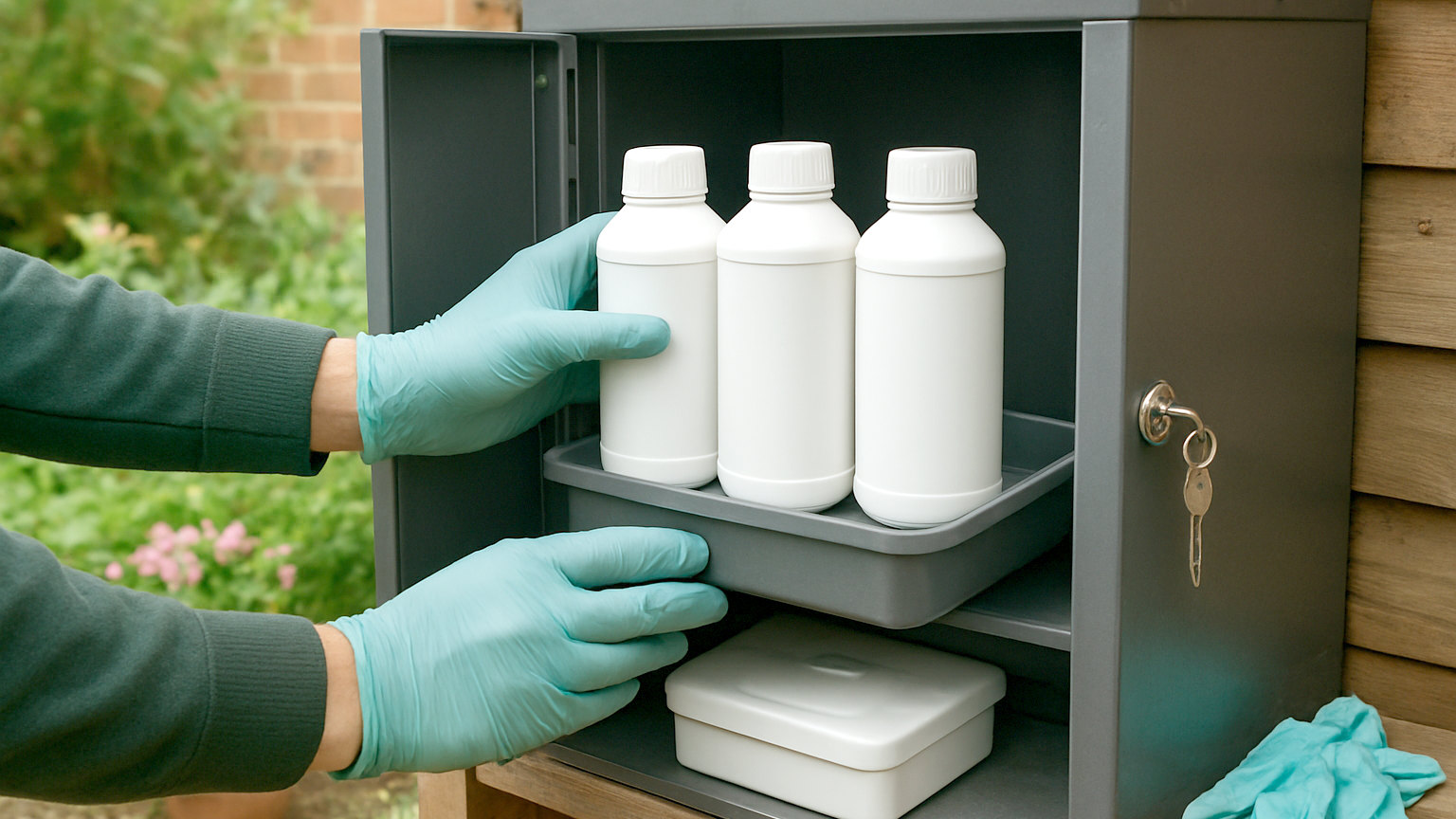
Most sheds contain products bought years ago, some of which are no longer legal to use. Dealing with them properly is straightforward and is frequently put off indefinitely.
Storing safely
In the original container with the label intact. The label carries the instructions, the hazards, the emergency information and the legal conditions of use.
Never decant into another bottle. This is how serious accidents happen, particularly where a drink bottle is used. It is also unlawful, since the product then has no label.
Keep containers closed and upright.
Locked away, out of reach and out of sight of children and pets.
Frost free, since freezing damages many formulations, and out of direct sunlight and heat.
In a dry ventilated place, away from food, animal feed, seeds and produce.
On a shelf with a lip, or in a closed container, so a leak is contained rather than spreading.
Keep granular fertilisers dry and closed, since they absorb moisture and set solid.
Buy less
The simplest way to avoid a disposal problem.
Buy the smallest quantity that will do the job.
Buy ready-mixed products for small jobs rather than concentrate, since concentrate is the hazardous stage and a large bottle sits for years.
Approvals are withdrawn regularly, and a product bought today may not be legal to use in a few years. A large container is a liability.
Products no longer permitted
Several once-standard garden products have been withdrawn.
Metaldehyde slug pellets may no longer be sold or used outdoors in Great Britain.
Strychnine for moles was withdrawn many years ago.
A range of insecticides and fungicides formerly sold to amateurs are no longer approved.
If you have any of these, do not use them. Using a withdrawn product is an offence.
Check the current position rather than assuming a product on the shelf is still permitted.
Disposal
This is where things go wrong.
Never pour anything down a drain, a gully, a toilet or a sink. Surface water drains discharge to watercourses, and foul drains lead to treatment works not designed for pesticides.
Never tip it on the ground, into a hedge, a ditch or a watercourse.
Never put concentrate in a household bin.
Take it to a household hazardous waste facility. Most local authority recycling centres accept garden chemicals, and it is worth checking in advance what yours takes and whether an appointment is needed.
Keep it in the original labelled container for transport, upright and secure, and tell staff what it is.
Where a diluted spray remains after a job, apply it to an area listed on the label rather than tipping it away.
Empty containers
Rinse three times, adding the rinsings to the sprayer and applying them to a treated area.
Then dispose of the container as the label directs, which is usually with household waste rather than in recycling, since residues contaminate the recycling stream.
Do not reuse empty containers for anything.
Spills
Contain the spill with sand, soil or an absorbent material rather than washing it away.
Wear gloves and eye protection, and collect the material for hazardous waste disposal.
Keep spills out of drains above everything else.
Accidents
In case of contact with skin or eyes, follow the first aid instructions on the label and rinse thoroughly.
If anyone swallows a garden chemical, seek medical help immediately and take the container with you, since the label tells medical staff what they are dealing with.
The same applies to a pet: contact a vet at once and take the container.
An annual check
Once a year, go through what is stored.
Check labels are legible and containers sound.
Identify anything out of date or no longer permitted and take it for disposal.
That is a job of twenty minutes, and it removes both a hazard and a legal risk from the shed.
Other things stored alongside
The same principles apply to fuels, preservatives, paints and cleaning products.
Petrol must be kept in an approved container in a cool ventilated place away from the house and any ignition source.
Keep everything labelled, closed and locked, and take what you no longer need for proper disposal.
A last word
The best outcome is a shed with very little in it, because a garden run on prevention, exclusion, resistant varieties and encouraging predators needs almost nothing on the shelf.
Where something is genuinely required, buy a small quantity, use it properly, and dispose of what remains responsibly.


