
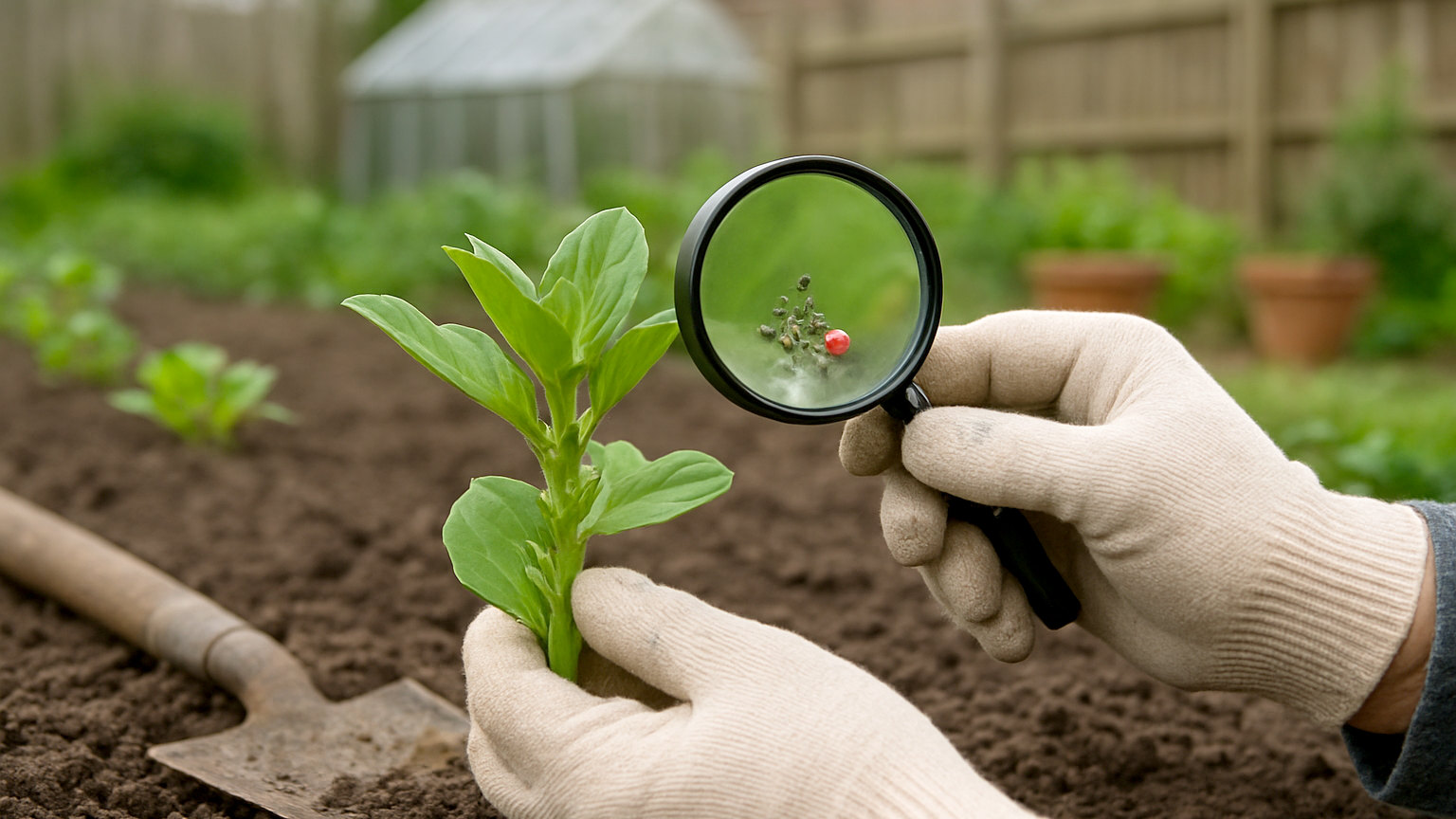
Integrated pest management is a way of deciding what to do rather than a set of products. It works through a sequence, and most garden problems are resolved before the end of it.
The sequence
Prevent, by choosing suitable plants, growing them well, using resistant varieties, rotating crops, and keeping the garden clean.
Monitor, by looking regularly and knowing what you are looking at.
Decide whether it matters, using a threshold rather than acting on the presence of a pest.
Intervene with the least drastic method: cultural, then physical, then biological.
Use a chemical last, targeted, at the right time, and following the label.
Each step reduces the need for the next, which is the point.
Prevention
The stage that does most of the work and gets least attention.
Right plant, right place. A plant suited to its position is far more resistant to everything.
Resistant varieties, which are available for roses, apples, potatoes, tomatoes, brassicas, lettuce and much else.
Good growing: adequate water, sensible feeding, correct spacing, air movement.
Hygiene: clearing debris, removing infected material, clean pots and tools.
Rotation in the vegetable garden.
Buying clean plants, since a great many problems arrive on new stock.
Monitoring
Look regularly, turn leaves over, and check the plants that always suffer.
Know the timing: cabbage whites from late spring, carrot fly in two generations, codling moth from late May, slug damage in April and May.
Use traps to monitor rather than to control. Pheromone traps and sticky traps tell you when a pest is active so any action can be timed properly.
Catching a problem early makes every subsequent option more effective and less drastic.
Thresholds
The presence of a pest is not a reason to act.
Ask whether the damage affects the plant's survival, its crop or its flowering, or only its appearance.
Ask whether the damage is still happening or already finished, since a great deal of what is noticed in July was done in May.
Ask whether predators are arriving, since an aphid outbreak in May is frequently resolved without intervention by June.
A tolerable level of pest is necessary to sustain the predators that keep it in check.
Cultural and physical control
The most effective interventions available to a gardener.
Exclusion: fine mesh, netting on a frame, fleece, collars, cloches, fencing and tree guards. Nothing habituates to a physical barrier.
Removal by hand: caterpillars, slugs at night, affected leaves, scale insects.
Changing conditions: ventilation for botrytis, humidity for spider mite, drainage for root rots, spacing for mildews.
Timing: sowing carrots after the first carrot fly generation, planting out at a size that survives slugs.
Biological control
Nematodes for slugs, vine weevil, chafer grubs and leatherjackets. Predatory insects for greenhouse pests.
Effective when the conditions and timing are right, and harmless to everything else.
Encouraging existing predators is the version that costs nothing and improves each year.
Chemicals last
Where a chemical is genuinely needed, use it as a targeted intervention rather than a routine.
Identify the problem first, since the wrong product achieves nothing and kills predators.
Treat the affected plant rather than the whole garden.
The label is a legal document, and using a product other than in accordance with it is an offence.
Never spray open flowers or when pollinators are active.
Observe harvest intervals.
Why the order matters
Broad-spectrum sprays kill predators along with pests, and predators recover more slowly, so populations frequently rebound worse than before.
Resistance develops where a product is used repeatedly.
A garden managed by spraying stays dependent on spraying. A garden managed by prevention becomes progressively easier.
In practice
Most gardens can be run entirely on the first four steps.
The measures involved are the ordinary business of gardening well, which is the most reassuring thing about the approach.
Keeping records
Note what appeared, on what, and when.
Patterns emerge over two or three seasons that are invisible in one, and knowing when a pest arrives is what makes prevention possible rather than reaction.
Where it saves most
In the vegetable garden, where mesh and rotation prevent nearly everything.
Under glass, where hygiene, ventilation and biological controls handle the main pests.
On fruit, where timing and physical measures do most of the work.


