
Companion planting covers a wide range of claims, from the well supported to the entirely anecdotal. It is worth separating them, since the useful part is genuinely useful.
What is well supported
Growing flowers to attract predators and parasitoids. This works, is well documented, and is the most valuable form of companion planting.
Adult hoverflies, lacewings and parasitic wasps feed on nectar and pollen, and their larvae consume aphids and other pests in large numbers.
They need accessible open flowers rather than complex double ones: fennel, dill, ammi, coriander allowed to flower, poached egg plant, calendula, achillea, phacelia and other umbels and daisies.
Flowering over a long season, from early spring to late autumn, sustains them throughout.
Planting these among vegetables and through borders is straightforward, attractive and effective.
Ground cover and dense planting, which shelters ground beetles and other predators and reduces bare soil.
Diversity itself. A mixed planting is harder for a specialist pest to exploit than a block of one crop, and there is reasonable evidence for reduced pest pressure in mixed plantings.
Trap crops
Reasonably supported in principle, and requiring management to work.
Nasturtiums attract cabbage white butterflies and blackfly, drawing them from brassicas and beans.
The trap crop must be removed or dealt with once colonised, or it simply breeds the pest.
Sacrificial planting around slug-vulnerable plants works on the same principle.
What has weaker evidence
Onions and carrots planted together to confuse carrot fly and onion fly. The evidence is weak, and the effect, where any is found, requires a far higher ratio of onions than a garden would use. Mesh works; this does not reliably.
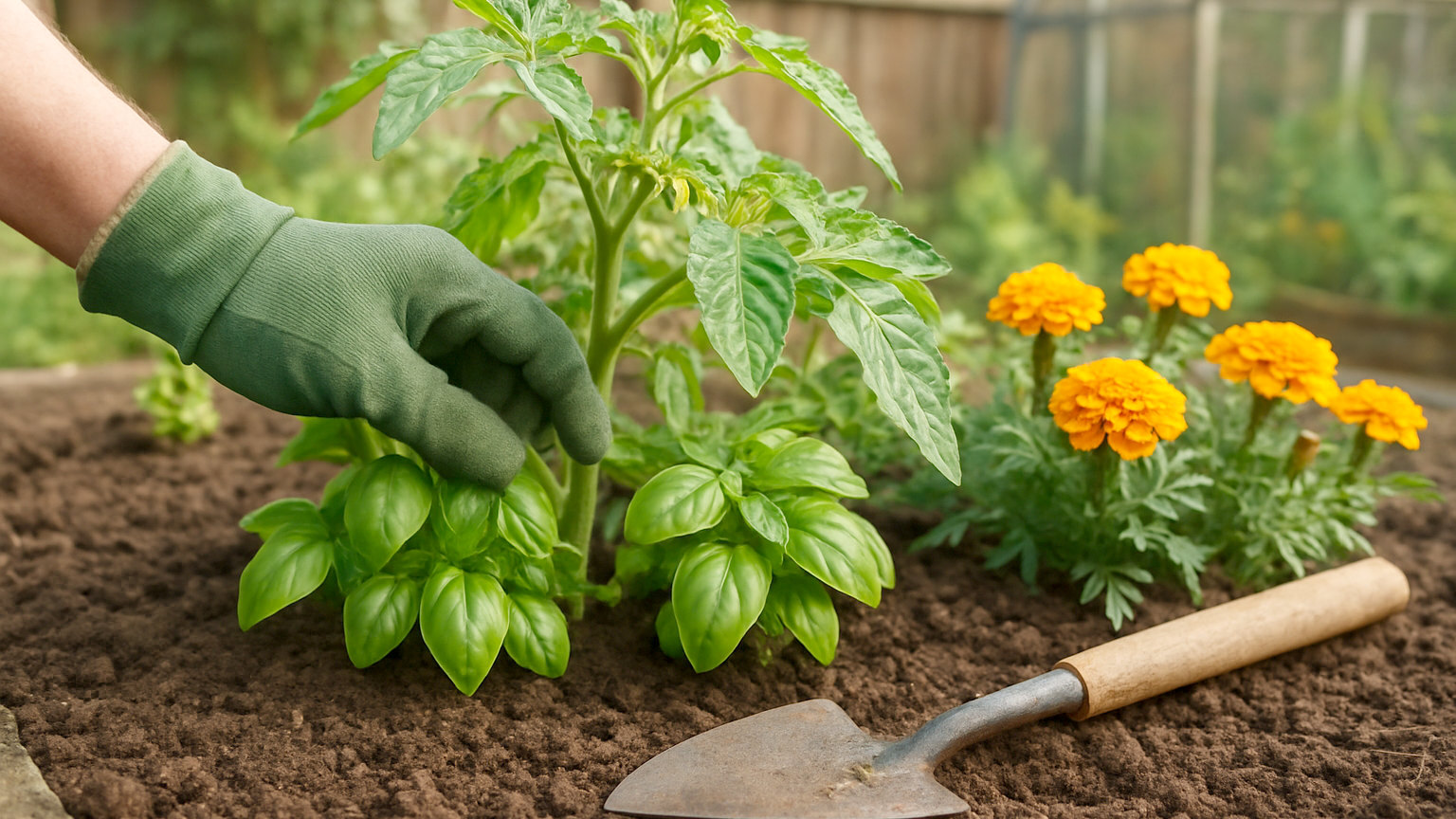
French marigolds against whitefly. There is some experimental support in glasshouse conditions on tomatoes, and the effect is modest and inconsistent outdoors.
Garlic and chives against aphids, and various aromatic herbs as general repellents. Widely claimed and poorly demonstrated.
Basil with tomatoes, and most of the traditional pairings. Pleasant and convenient in the kitchen, with little evidence of pest benefit.
Specific plants said to repel particular pests by scent. Effects are generally short lived, dose dependent, and difficult to reproduce.
Why the claims persist
Gardens vary enormously, and seasons vary more.
Nobody runs a control, so a good year is easily attributed to the method used.
A mixed planting frequently does have fewer pest problems, and the reason is usually the diversity and the predators rather than the specific pairing.
The advice is passed on in good faith, and much of it has circulated for generations.
Genuine drawbacks
Competition. A companion plant takes water, light and nutrients from the crop, and a heavily interplanted vegetable bed can crop less.
Some companions are themselves problems. Mustard is a brassica and does not belong in a brassica rotation slot or where clubroot is present.
Space taken by a companion is space not growing food.
A sensible approach
Grow flowers among and around vegetables, chosen for accessible nectar and a long season. This is the part that works.
Plant a diversity of crops rather than large blocks of one.
Use nasturtiums as a trap crop if you will manage them.
Rely on mesh, rotation, hygiene, resistant varieties and encouraging predators for the actual control.
Treat specific pairings as pleasant rather than protective.
Testing it yourself
Grow half a row with the companion and half without, and compare.
Repeat over more than one season, since a dry spring or a cold one changes everything.
This is the only way to know what works in your own garden, and it occasionally produces a surprise.
What is worth doing regardless
Interplanting flowers among vegetables is attractive, brings pollinators to crops that need them, and supports predators.
Even where the specific pest claims are unproven, a vegetable garden with flowers running through it is a better garden.
Herbs left to flower do the same job and are useful in the kitchen as well.
Fennel, dill, coriander, chives, thyme and marjoram all flower well and are among the best plants for hoverflies and parasitic wasps.
Letting a few plants of each run to flower costs nothing and gives a long season of nectar.
None of it does harm, and the honest position is that the benefit comes from the flowers and the diversity rather than from any particular pairing.


