
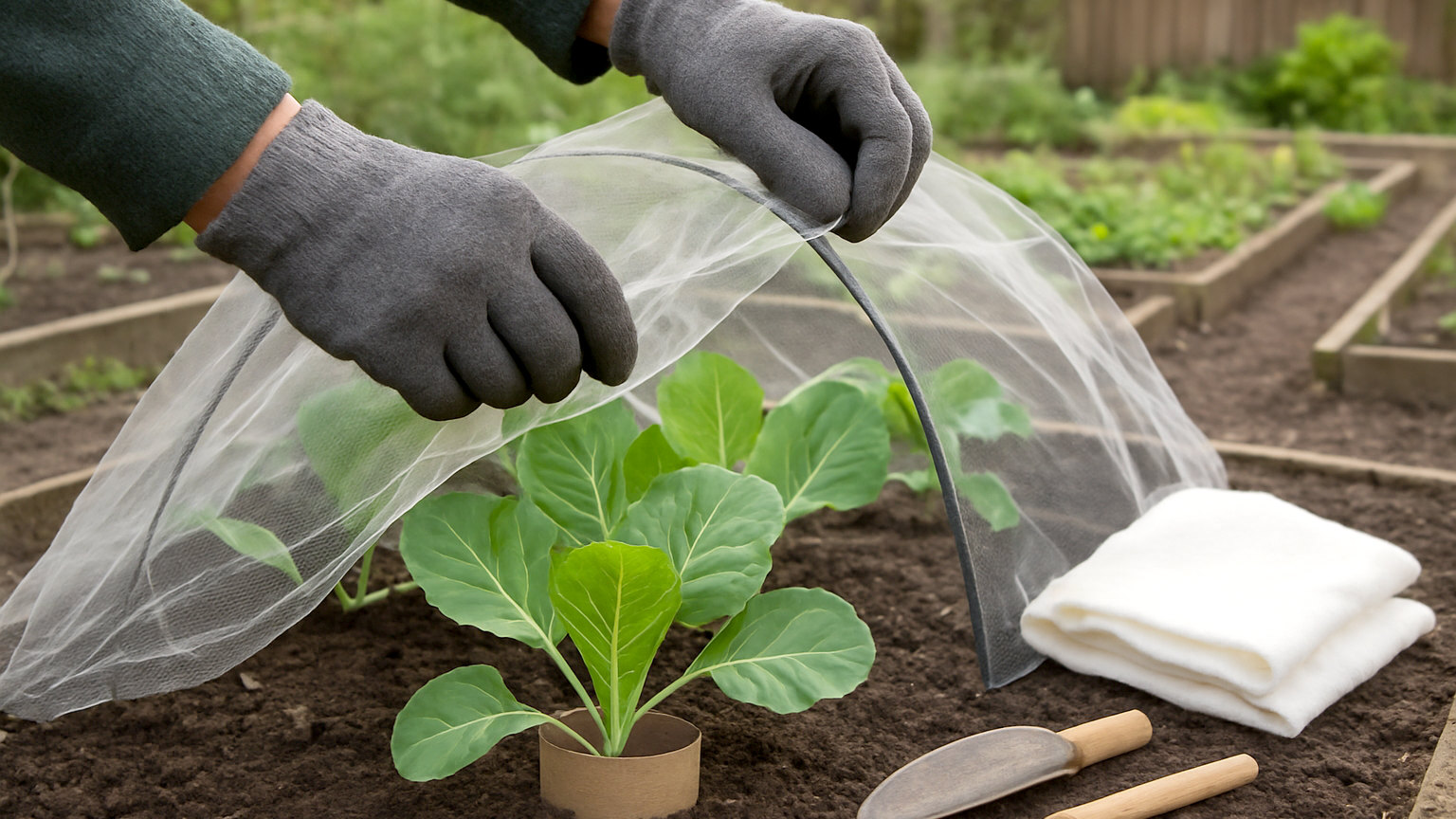
Keeping a pest away from a plant is nearly always more reliable, cheaper and less damaging than trying to kill it once it has arrived. Barriers work on the pests that cause most vegetable losses, and they work every year rather than needing repeat treatment.
Horticultural fleece
Lightweight fabric laid over a crop, letting light and water through while excluding insects and providing a couple of degrees of frost protection.
Useful for warming soil ahead of sowing, protecting early sowings, and excluding flying pests. It can be laid directly on the crop or over hoops, and the edges must be buried or weighted down completely, since anything that can walk or fly under it will.
Remove it from crops that need insect pollination once flowering starts, which includes courgettes, squash, beans and fruit.
Insect mesh
Finer and more durable than fleece, allowing better airflow and lasting several seasons. The mesh size determines what it excludes.
- Around 1.3mm excludes cabbage white butterflies and pigeons
- Around 0.8mm excludes carrot fly and cabbage root fly
- Very fine mesh excludes aphids and flea beetle
Get it on before the pest arrives, not after. Mesh over a crop that already has cabbage white eggs on it simply protects the caterpillars from birds. Cover at sowing or planting, and check underneath periodically.
Keep mesh clear of the foliage on hoops, since pigeons and butterflies will work through anything pressing against the leaves.
Carrot fly
The larvae tunnel into carrots, parsnips and celery, and the adult flies low to the ground, navigating by scent.
A vertical barrier of fine mesh or fleece sixty to seventy-five centimetres high around the bed is effective, since the flies cannot easily rise above it. Covering the crop entirely works too.
Sow thinly to avoid thinning, since crushed foliage releases the scent that attracts them, and thin in the evening if you must, removing all thinnings from the plot.
Brassica collars
Cabbage root fly lays eggs at the base of brassica stems, and the larvae eat the roots, causing plants to wilt and collapse.
A collar of card, carpet underlay or a proprietary disc, fifteen centimetres across, fitted snugly around the stem at soil level, prevents the fly reaching the soil to lay. It is cheap, quick and highly effective.
Other physical measures
Grease bands around fruit tree trunks in autumn catch female winter moths climbing up to lay. Copper tape around pots deters slugs and snails. Wire mesh laid over newly planted bulbs stops squirrels digging them up. Cloches protect early sowings from both weather and pests.
Crop rotation
Rotation means not growing the same family of crops in the same ground in consecutive years. It reduces the build-up of soil-borne pests and diseases, and it balances nutrient demands, since different families draw on the soil differently.
The traditional four-year cycle uses four groups.
- Legumes - peas and beans, which fix nitrogen
- Brassicas - cabbage, sprouts, kale, broccoli, swede, turnip, radish
- Roots - carrots, parsnips, beetroot, celery
- Potatoes and tomatoes - which share the same diseases
The order usually runs legumes, then brassicas, which use the nitrogen left behind, then roots, then potatoes.
Rotation on a small plot
A strict four-year rotation is impractical in a small garden, and a rough version still helps. Simply moving each crop group as far as possible from where it grew last year captures much of the benefit.
Prioritise the crops where it matters most. Potatoes and tomatoes should never follow each other, because of blight and eelworm. Brassicas benefit from the longest gap possible, because clubroot persists in soil for many years.
Onions and squash are less fussy and can fill gaps in the sequence.
Companion planting, honestly
Some companion planting has evidence behind it and much of it does not. Growing flowers to attract hoverflies and other predators genuinely works. Undersowing to confuse pests searching by sight has some support. Claims that particular plant pairings repel specific pests are mostly unsupported.
Treat it as worth doing where it costs nothing and improves the garden anyway, rather than as pest control you can rely on.
Timing and vigour
Sowing later into warmer soil produces faster, tougher growth that passes through the vulnerable seedling stage quickly, which avoids a good deal of damage without any equipment at all. A strong, well-watered, unstressed plant shrugs off damage that would finish a struggling one.


