
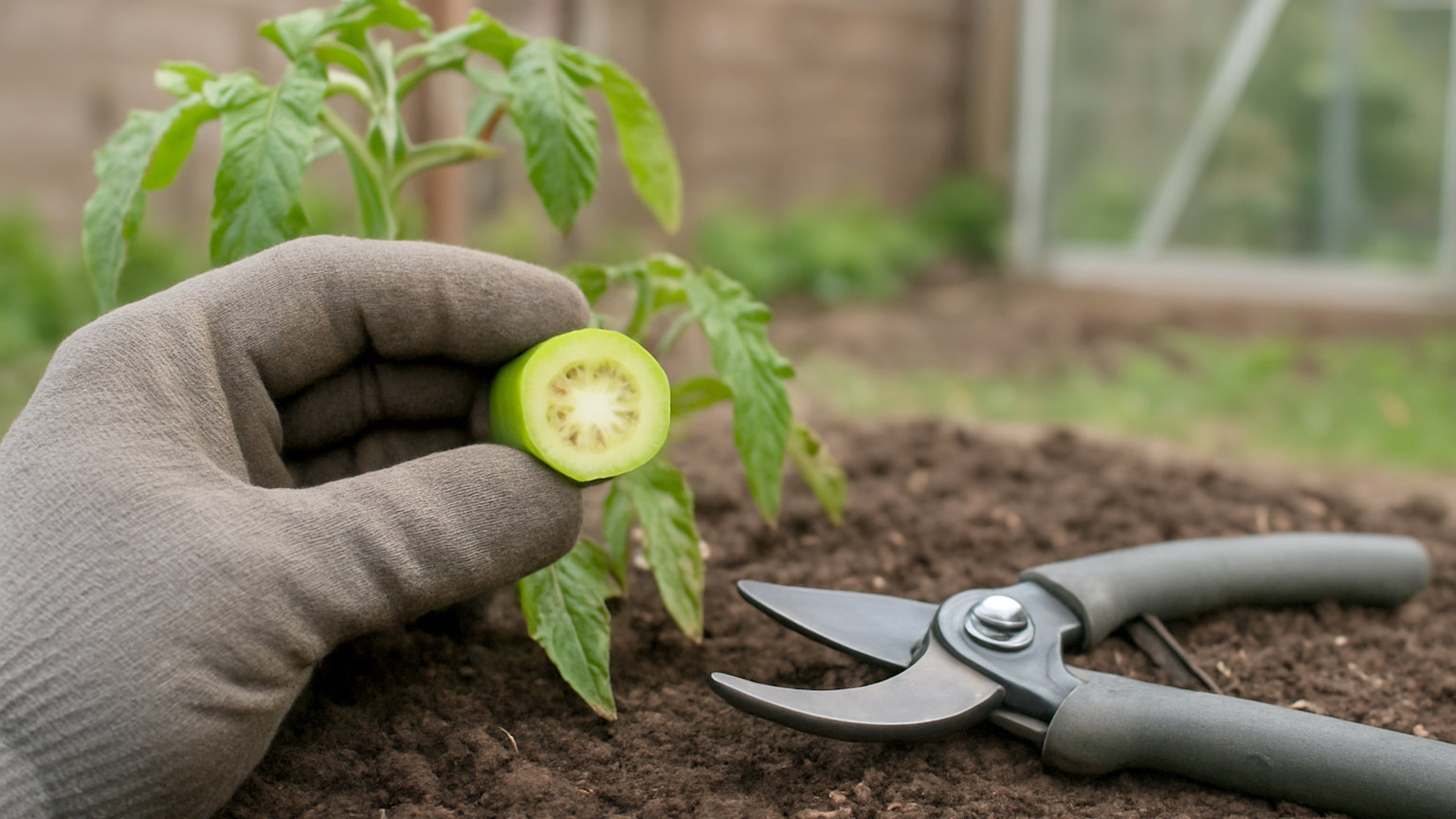
Vascular wilts attack from within, blocking the tissue that carries water up the stem. The plant wilts with roots in moist soil and healthy-looking foliage, and there is a diagnostic sign in the stem.
The diagnostic test
Cut through an affected stem and look at the cut surface.
A brown, grey or purplish stain in a ring or in streaks within the wood, just beneath the bark, indicates a vascular disease.
Slice lengthways as well, and the staining runs as streaks up the stem.
Healthy tissue is uniformly pale.
This distinguishes a wilt from drought, root rot and other causes.
Symptoms
Wilting despite adequate soil moisture, often worst in warm weather and sometimes recovering overnight at first.
Frequently one-sided: one branch, one side of a plant, or half a leaf, since the blockage affects particular vessels.
Yellowing of lower leaves, progressing upwards.
Gradual dieback over one or more seasons on woody plants.
Sudden collapse on herbaceous plants and vegetables.
Verticillium wilt
A soil-borne fungus with a very wide host range, affecting trees, shrubs, herbaceous plants and vegetables.
Maples, cotinus, catalpa, magnolia, roses, tomatoes, potatoes, strawberries, dahlias and chrysanthemums are among the many affected.
It persists in soil for many years as resting structures, and there is no treatment.
Grasses, conifers and monocots such as bulbs are generally not susceptible, which matters when replanting.
Fusarium wilt
Also soil-borne and persistent, and generally more host-specific than verticillium.
Different forms attack tomatoes, peas, beans, brassicas, carnations, asters and others.
Favoured by warm conditions, so it is often worse under glass and in a hot summer.
Fusarium also causes basal rots in bulbs and onions in store.
Clematis wilt
A different organism and a familiar problem.
Shoots collapse suddenly from the tip down, often on large-flowered hybrids and usually just as they are about to flower.
Cut affected stems right back to healthy tissue, or to ground level, and dispose of the material.
Plant clematis with the crown about seventy-five to a hundred millimetres below soil level, so dormant buds below ground can reshoot if the top is lost. This is the single most useful precaution.
Small-flowered species clematis are far less affected than large-flowered hybrids.
What can be done
There is no chemical control available.
Remove and dispose of affected plants, including as much root as possible, and do not compost them.
Do not replant a susceptible species in the same position.
Grow susceptible crops in containers with fresh compost where the ground is infected.
Use resistant varieties, which are available for tomatoes, peas, brassicas and several other crops and are frequently marked on the packet.
Rotate vegetable crops as widely as possible.
Keep plants growing well, since stressed plants show symptoms sooner and more severely.
Avoid damaging roots, which provides entry.
Clean tools and boots, and do not move soil from an affected area.
Reducing severity
Affected woody plants sometimes survive for years, losing a branch at a time.
Prune out affected branches well below the staining, disinfecting tools between cuts, and mulch, water and feed to support the plant.
Avoid high nitrogen, which produces soft growth.
This manages rather than cures.
Replanting
Choose species outside the host range: grasses, conifers, bulbs, ferns and monocots for verticillium.
Where a valued position is affected, replacing the soil to a substantial depth is sometimes attempted and is laborious and not always successful.
Confirming it
Because the consequences for replanting are long term, it is worth confirming a suspected wilt rather than assuming.
Photograph the cut stem showing the staining, and seek an identification.
Why plants recover and then wilt again
Early in an infection the blockage is partial, so a plant may wilt in warm afternoons and recover overnight.
As more vessels are blocked the recovery stops.
That pattern of daily wilting and recovery, on a plant in moist soil, is a useful early warning.
Under glass
Fusarium in particular is worse in the warmth of a greenhouse.
Use fresh compost or growbags each year, clean the structure thoroughly, and use resistant tomato varieties, which are widely available and clearly marked.
Never reuse compost from a crop that succumbed, and clean pots and growbag trays thoroughly.
Ventilate well, since the humid still air of a closed greenhouse in summer suits the organism.


