
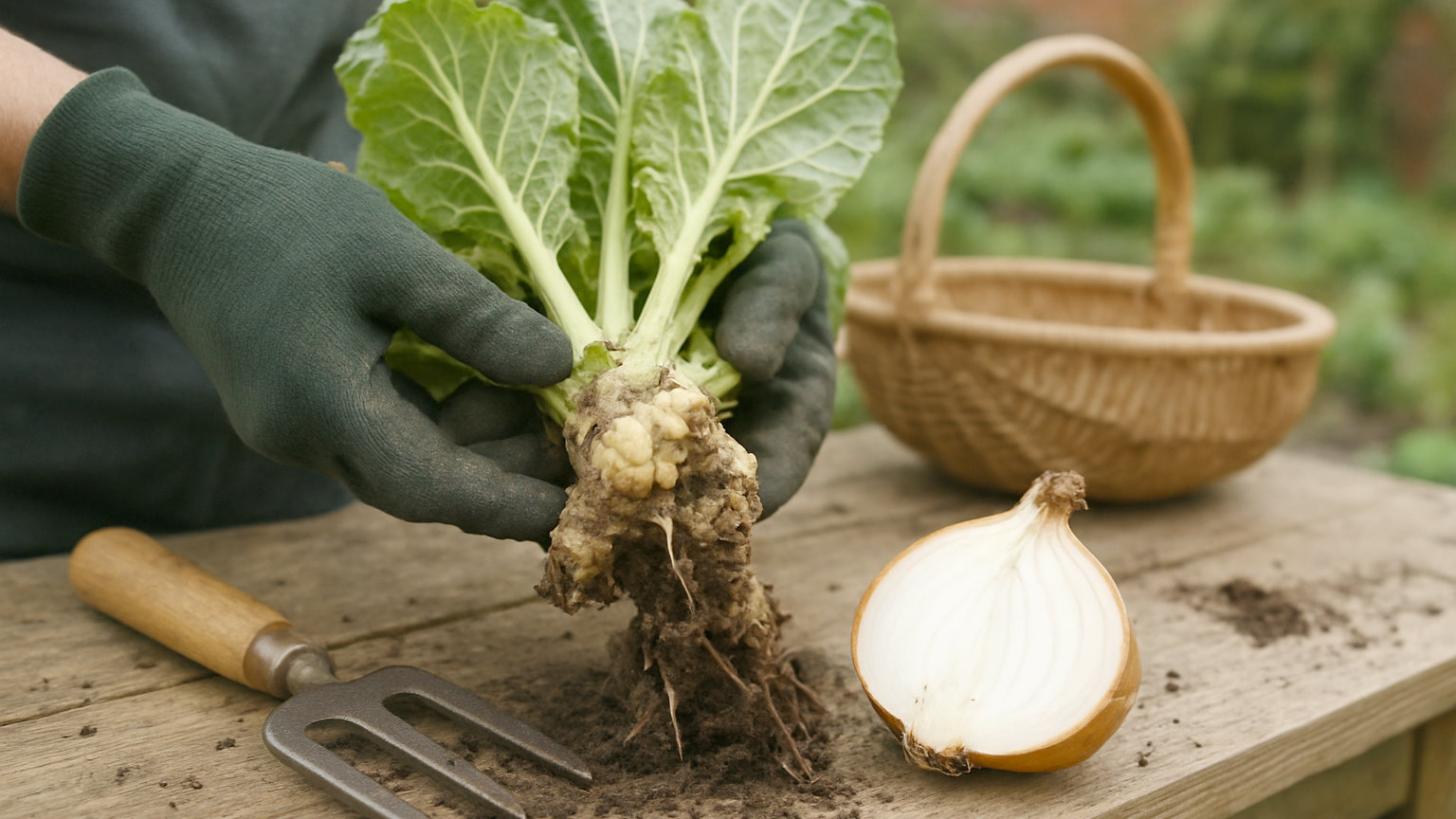
These two are worth treating together because they share the same unwelcome characteristic: once in a soil they remain for a very long time, and nothing removes them.
Clubroot
Affects all brassicas, including cabbage, sprouts, kale, broccoli, cauliflower, swede, turnip and radish, and also wallflowers, stocks and related ornamentals.
Symptoms: stunted growth, wilting in warm weather despite moist soil, and yellowing or purplish foliage.
The diagnosis is at the roots: swollen, distorted, club-shaped or knobbly roots, which later rot and smell foul.
Do not confuse it with the small round galls of cabbage root fly or with nitrogen-fixing nodules on legumes, which are quite different.
It persists in soil for up to about twenty years as resting spores.
Managing clubroot
There is no cure, and crops can still be grown with care.
Lime the soil to raise the pH towards neutral or slightly alkaline, around 7.0 to 7.5. The organism is far less active in alkaline conditions. Apply lime well in advance and test the pH rather than guessing.
Improve drainage, since the spores swim and wet soil favours them. Raised beds help considerably.
Raise plants in pots in fresh compost and plant out large well-rooted specimens. A plant with a substantial root system established before it meets the infected soil frequently crops adequately even where infection occurs.
Use progressively larger pots and plant out late.
Rotate as widely as possible, though rotation alone does not eliminate it given the persistence.
Remove and dispose of affected roots rather than digging them in or composting them.
Control brassica weeds such as shepherd's purse and charlock, which host it.
Use resistant varieties, which are now available for several brassicas and are the most useful development.
Grow in containers or raised beds with fresh compost where the ground is badly infected.
Onion white rot
Affects onions, garlic, leeks, shallots and chives.
Symptoms: yellowing and wilting foliage, plants lifting easily, and a white fluffy fungal growth on the base of the bulb with small black resting bodies within it.
These resting bodies are what make it so persistent.
It survives in soil for fifteen years or more, and possibly considerably longer.
Managing white rot
There is no cure and no treatment.
Remove and dispose of affected plants immediately, including the soil immediately around them, and do not compost them.
Rotate alliums as widely as the plot allows.
Grow alliums in containers or raised beds with fresh compost where the ground is infected, which is the practical answer.
Garlic and onions are more susceptible than leeks, which sometimes crop acceptably on infected ground.
Containment is the priority
For both diseases, keeping them out of clean ground matters more than anything.
They are spread on soil: on boots, tools, wheelbarrows, and on the rootballs of bought plants.
Buy brassica and allium plants from a reputable source, or better, raise your own from seed.
Never accept a gift of plants from a plot known to be infected.
Clean boots and tools when moving between an infected area and clean ground.
Work the clean areas first and the infected area last.
Do not move soil, compost or manure from an infected plot.
On an allotment
Both are common on allotment sites, where soil and plants move between plots readily.
Assume infection is present, raise your own plants, and use resistant varieties and container growing rather than relying on rotation.
The realistic position
Neither disease need mean giving up the crop.
Liming, drainage, large transplants and resistant varieties allow brassicas on infected ground, and container growing allows alliums.
What neither allows is business as usual.
Other persistent soil-borne problems
Several diseases share this characteristic of long survival in soil.
Verticillium and fusarium wilts persist for years and affect a wide range of plants.
Potato cyst nematode persists for many years and is a reason to rotate potatoes and buy certified seed.
In each case the response is the same: contain, rotate, use resistant varieties, and grow in fresh compost where the ground is unusable.
Testing the soil
Where clubroot is suspected, a simple pH test tells you whether liming is likely to help, and it is worth doing before applying anything.
Lime takes months to act, so apply it well in advance of planting rather than at the last moment.


