
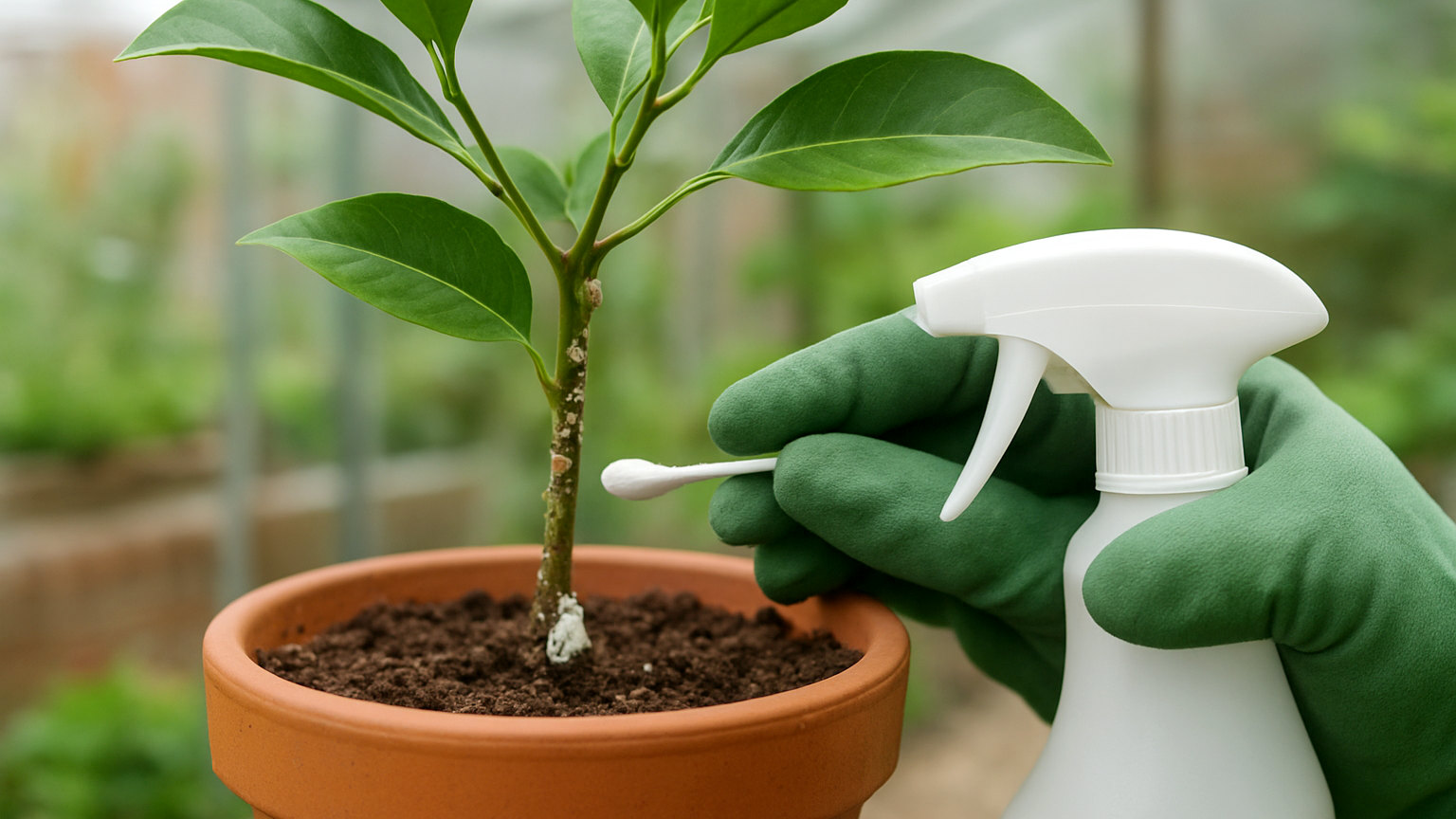
These two are among the most persistent pests on indoor plants, conservatory subjects and some outdoor shrubs, largely because both are physically protected from anything sprayed at them.
Scale insects
Small immobile bumps on stems and leaf undersides, brown, cream or grey, looking more like part of the plant than an insect.
Under the shell is a sap-sucking insect that stays put for most of its life.
Common on bay, citrus, camellia, ficus, orchids, ferns and many houseplants, and outdoors on some shrubs and fruit.
The usual first sign is stickiness: honeydew on the leaves below, on the floor, or on whatever the plant stands over, often with black sooty mould growing on it.
Heavy infestations cause yellowing, poor growth and leaf drop.
Mealybug
Soft insects covered in white waxy fluff, clustering in leaf axils, under leaves, in growing points and around the base of stems.
They look like small blobs of cotton wool and move slowly.
Root mealybug is a related pest living on roots in the compost, causing unexplained decline. Check the rootball when a plant fails for no visible reason.
Common on cacti and succulents, citrus, orchids and many houseplants.
Why sprays often fail
The scale's shell and the mealybug's waxy coating both repel water-based sprays.
Both also shelter in crevices, leaf axils and under leaf bases where spray does not reach.
The mobile juvenile stage, called a crawler, is vulnerable, and it is short and easily missed.
What works
Physical removal is the most reliable method on a plant of manageable size.
Wipe scale insects off with a fingernail, a soft brush or a cloth.
Dab mealybug with a cotton bud dipped in surgical spirit, which dissolves the waxy coating and kills them on contact. Test on a leaf first, since some plants are sensitive.
Repeat weekly. One treatment never clears either pest, and persistence over a month or two is what succeeds.
Wash the plant thoroughly afterwards to remove honeydew and sooty mould, which will not clear on its own.
Prune out badly infested growth entirely.
Sprays and oils
Fatty acid, soap and plant oil products work by contact and by smothering, and must be applied thoroughly to every surface including stems and leaf axils.
Repeat applications are essential, timed to catch successive crawler stages.
Follow the label, which is a legal document, and check the product is approved for the plant and situation.
Biological control
Available for both, and effective in a greenhouse or conservatory where the predators stay put.
Cryptolaemus, a predatory ladybird, controls mealybug. Parasitic wasps are available for some scale species.
Both need warmth, usually a minimum around twenty degrees.
Do not use insecticides before or during a biological control programme.
Root mealybug
Harder to deal with. Knock the plant out of its pot and look for white waxy deposits among the roots.
Wash the roots clean, discard the compost, and repot into fresh compost in a clean pot.
Isolate the plant, since root mealybug spreads readily between pots standing together.
Prevention
Inspect every new plant before it joins the others, checking leaf axils, stems and undersides. Almost every infestation arrives this way.
Isolate new plants for a few weeks.
Check plants regularly, since both are far easier to clear when caught early.
Keep plants growing well, since stressed and pot-bound plants are more susceptible.
Ants farm both pests for honeydew and protect them from predators, so dealing with an ant trail on a plant helps.
Outdoors
Scale on established shrubs and trees is usually tolerable and rarely worth treating, since natural predators keep it in check.
Ladybirds, parasitic wasps and birds all take scale insects, and a spray removes those along with the pest.
Treat only where a valued plant is visibly declining rather than because scale is present.
Sooty mould
The black film is harmless in itself and grows on the honeydew rather than the plant, though it blocks light and looks unpleasant.
It will not disappear when the pest is dealt with, and has to be washed off with soapy water and a soft cloth.
Its presence anywhere is a reliable sign that a sap-sucking insect is above it, so look upwards to find the cause rather than treating the mould.


