
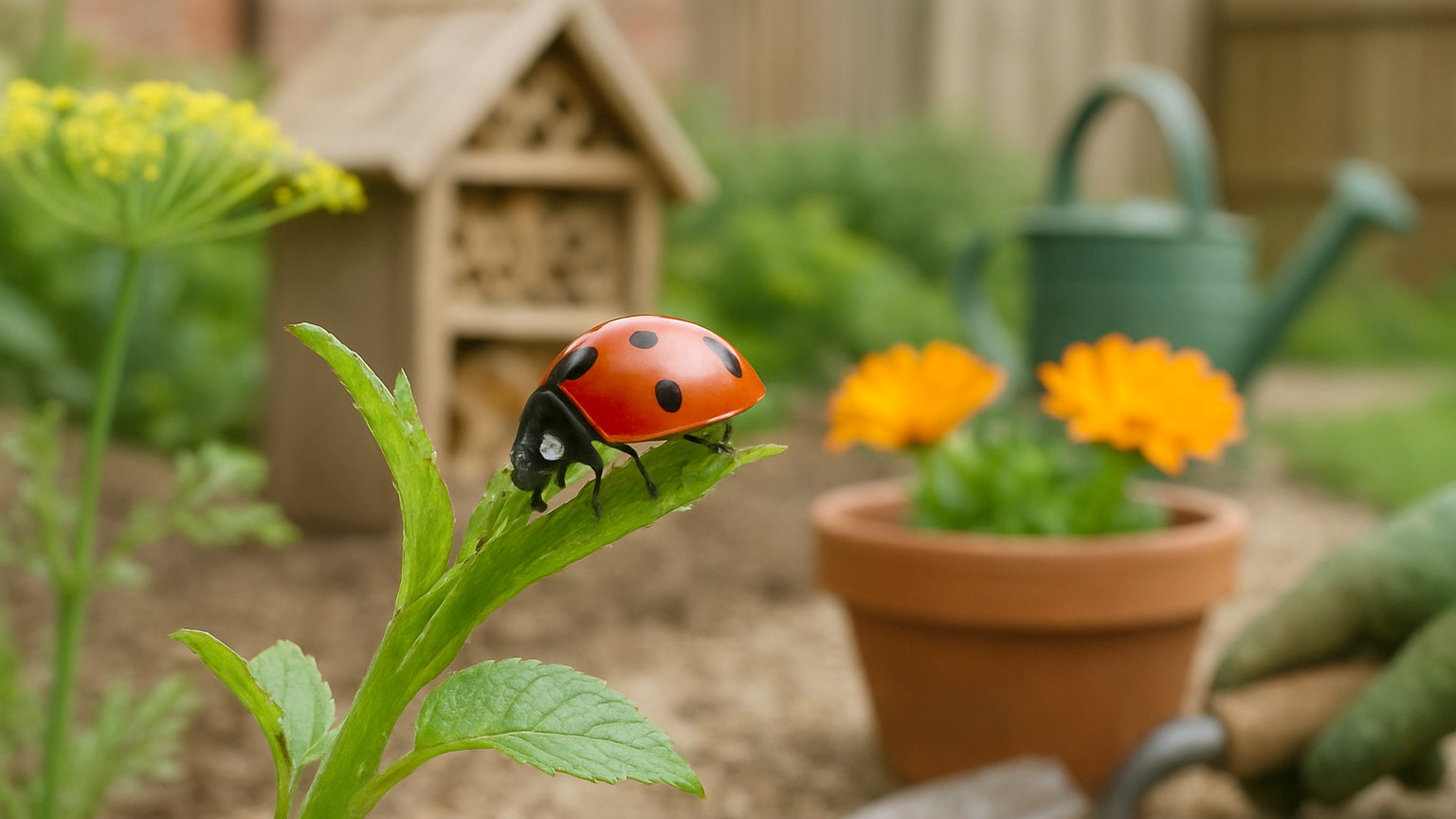
The most effective pest control in a garden is the population of predators already living in it, and the commonest way to lose it is to spray.
Ladybirds
Adults and larvae both eat aphids in large numbers.
The larvae are frequently killed by mistake, being long, grey-black with orange markings, rather like a small alligator and nothing like the adult.
Learn to recognise them, since a single larva eats hundreds of aphids before pupating.
The pupae are stationary orange and black cases attached to leaves and are also often destroyed in error.
Hoverflies
The adults look like small wasps and are harmless nectar feeders and useful pollinators.
The larvae are the real asset: small, legless, semi-transparent maggots that consume aphids at a considerable rate.
They are easily mistaken for something harmful. They are not.
Adults are attracted by open flat flowers with accessible nectar: fennel, dill, ammi, poached egg plant, calendula, achillea and other umbels and daisies.
Lacewings
Delicate green or brown insects with lace-like wings, whose larvae eat aphids, thrips, mites and small caterpillars.
The larvae are small and bristly and sometimes disguise themselves with the remains of their prey.
Adults overwinter in sheltered dry places, including insect shelters and hollow stems.
Ground beetles
Fast-moving black beetles found under stones, logs and mulch.
Significant predators of slug eggs, slugs, cutworms, root fly larvae and vine weevil.
They need undisturbed cover: a log pile, a stone, a mulched border, an uncut edge. Frequent digging and total tidiness removes them.
Parasitic wasps
Mostly tiny and rarely noticed, laying eggs inside aphids, caterpillars, whitefly and scale insects.
Aphid mummies, swollen bronze or papery aphid shells with a neat exit hole, show they are at work. Leave them.
Several are sold as biological controls and many more arrive unaided.
Others worth knowing
Centipedes are predators. Fast, flattened, with one pair of legs per segment. Millipedes are slower, rounded, with two pairs per segment, and feed mainly on decaying material.
Earwigs eat aphids and codling moth eggs while also chewing dahlia and clematis petals. On balance useful in a fruit tree, a nuisance on a show dahlia.
Spiders take very large numbers of flying insects.
Solitary bees and wasps pollinate and predate, and rarely sting.
Beetles, bugs and larvae generally: most of the invertebrates in a garden are harmless or useful, and only a small minority are pests.
Encouraging them
Stop spraying. Broad-spectrum insecticides kill predators along with pests, and predators recover more slowly, so numbers frequently rebound worse than before.
Plant flat open flowers for the adult stages of hoverflies, lacewings and parasitic wasps, which feed on nectar and pollen: umbels, daisies, poached egg plant, and herbs left to flower.
Flower over a long season, from early spring to late autumn, so there is food throughout.
Leave cover. A log pile, leaf litter, long grass, hollow stems left standing over winter and a mulched surface all shelter predators.
Cut back in late February rather than autumn, so overwintering insects in hollow stems survive.
Tolerate some aphids. Predators need prey to build up, and a garden with no aphids in May has no ladybirds in June.
The delay
Predators always lag behind an outbreak by a few weeks.
An aphid explosion in May is usually resolved by predators in June without intervention. Spraying at the peak removes the predators arriving to deal with it, and the aphids return unopposed.
Patience is frequently the most effective control available.
Recognising the larvae
Almost every useful predator has a larval stage that looks nothing like the adult and is regularly destroyed by mistake.
Ladybird larvae, hoverfly larvae, lacewing larvae and ladybird pupae are the four worth learning, and between them they account for an enormous quantity of aphids.
If you are not sure what something is, leave it. The odds are strongly that it is harmless or actively helpful.
Beyond insects
Birds, frogs, toads, hedgehogs, slow worms and bats all consume large quantities of garden pests.
A pond, a log pile, dense cover, a gap under the fence and no pesticides between them build a system that handles most problems unaided.
That takes two or three seasons to establish and then costs nothing at all to run.


