
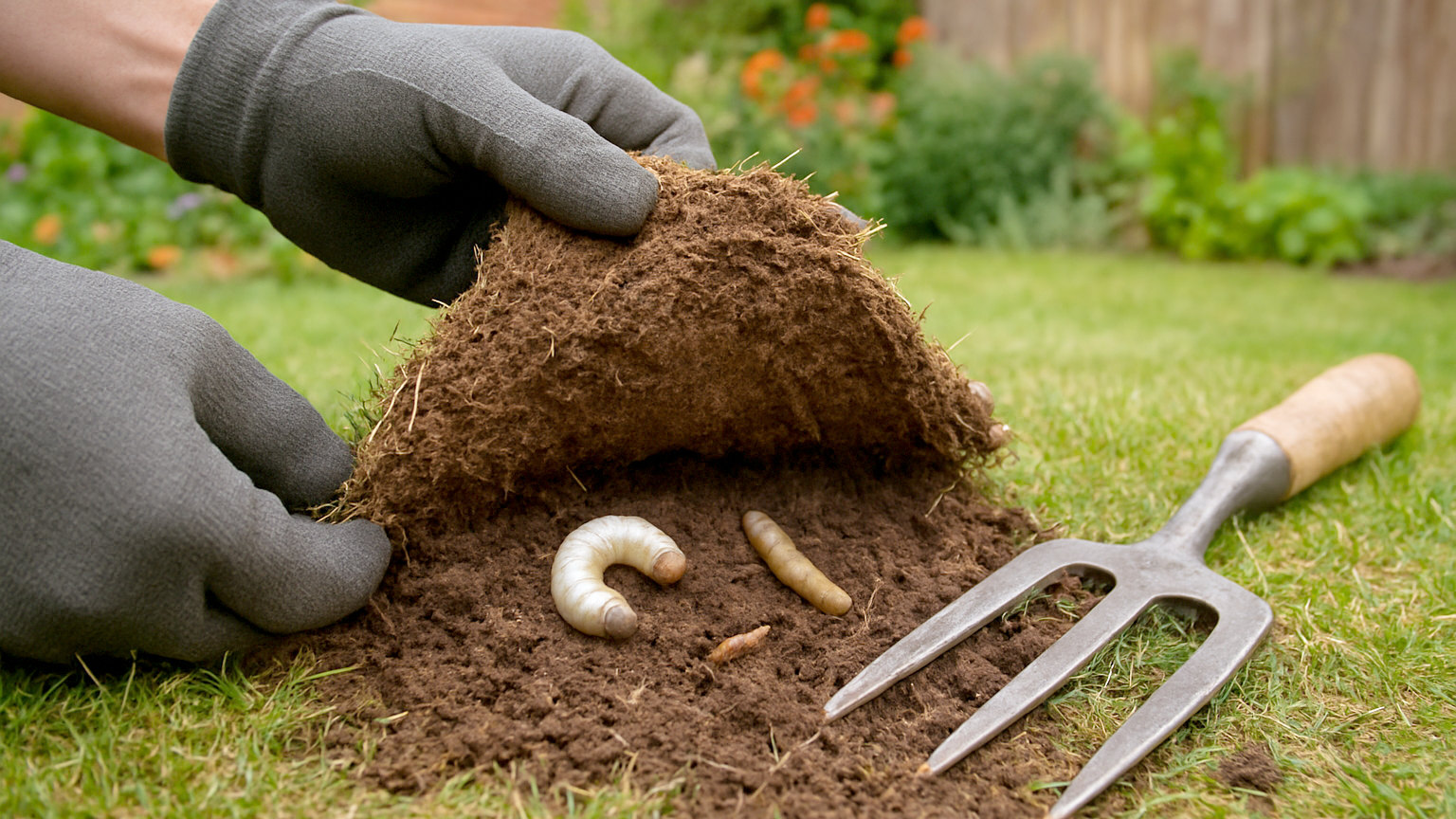
Both feed on grass roots beneath the surface, and in both cases the worst damage is usually done by the animals that come to eat them rather than by the grubs themselves.
Recognising the damage
Irregular patches of yellowing or brown grass, worst in late summer and autumn.
The turf lifts easily, like a loose carpet, because the roots have been eaten away. This is the diagnostic test.
Birds, particularly crows, magpies and starlings, tear at the surface. Badgers and foxes dig larger holes and can roll back substantial areas of turf overnight.
Peel back a patch and look at the grubs beneath.
Telling them apart
Chafer grubs are white, fat and C-shaped, with a distinct brown head and three pairs of legs at the front. Usually twelve to eighteen millimetres, and larger in some species.
Leatherjackets are the larvae of crane flies. Grey-brown, legless, tough-skinned and tubular, with no obvious head.
The legs are the quickest way to tell them apart.
Life cycle and timing
Chafer beetles lay in summer, and the grubs feed on roots through late summer, autumn and again in spring, pupating in early summer.
Crane flies lay in late summer, and leatherjackets feed through autumn, winter and spring.
In both cases the grubs are small and near the surface in late summer and early autumn, which is when treatment works.
Nematode treatment
The main control available to gardeners, and it is effective when applied properly.
Different nematode species are supplied for chafer grubs and for leatherjackets, so identify the pest first.
Timing is critical. Apply in late summer to early autumn, usually from about August to September for leatherjackets and September for chafers, while the grubs are young and near the surface.
Soil temperature must be within the range specified, usually above about twelve degrees, so treating too late in autumn fails.
The soil must be moist before and after application. Water thoroughly before applying, apply in the evening or on a dull day, and keep the lawn watered for a fortnight afterwards.
Nematodes are living organisms. Store them in a fridge, check the use-by date, and apply as soon as possible after delivery.
They are harmless to people, pets, wildlife and earthworms.
Other measures
Water and feed the lawn to help it recover and to build a stronger root system.
Firm down lifted turf and water it in, since it will re-root if the roots are not entirely gone.
Reseed bare patches in early autumn.
Avoid over-watering the lawn in midsummer, which attracts egg-laying adults to soft moist turf.
Keep the lawn growing well, since a vigorous lawn tolerates a level of grub activity that would ruin a weak one.
Badgers
Badgers, their setts and their access to setts are protected by law, and it is an offence to kill or injure them or to interfere with a sett.
Where badgers are digging a lawn, the answer is to reduce the grubs that attract them rather than to deter the badger.
Temporary electric fencing is used in some situations and needs care and appropriate advice.
Deciding whether to act
A small number of grubs in a lawn is normal and does no harm.
Treat where patches are dying, the turf is lifting, and animals are actively digging.
Where a lawn is under repeated heavy attack, consider whether that area should be a lawn at all, since planting, gravel or paving removes the problem entirely.
Adults
Chafer beetles are large brown beetles flying at dusk in early summer, and crane flies are the familiar long-legged daddy longlegs of late summer.
Neither adult damages the lawn, and seeing large numbers of crane flies in September indicates eggs being laid and a likely problem the following spring.
That is a useful signal to plan a nematode treatment for the following late summer.
Confirming the diagnosis
Before treating, cut a square of turf on three sides and peel it back, and count what you find in the top few centimetres.
A handful of grubs in a square of turf indicates a genuine infestation; one or two does not.
Replace and firm the turf and water it in afterwards, and it will re-root without difficulty.
Check two or three places rather than one, since grubs are distributed in patches.


