
Root crops are attacked by pests that are almost invisible until the crop is lifted, which makes prevention far more useful than any response after the event.
Carrot fly
A small fly whose larvae tunnel through carrot roots, leaving rusty brown channels that ruin the crop and let rot in.
Also attacks parsnip, celery, celeriac and parsley.
Foliage may show a reddish tinge and stunted growth, and the damage is usually only discovered on lifting.
There are typically two generations, the first from late spring and a larger second one from midsummer into autumn.
How it finds the crop
By scent. The smell of crushed carrot foliage attracts females from a considerable distance.
This has direct practical consequences.
Avoid thinning where you can, by sowing thinly in the first place. Thinning releases a great deal of scent.
Where thinning is necessary, do it on a still evening, remove all thinnings from the plot immediately rather than leaving them on the soil, and water afterwards to settle the disturbed ground.
Harvest carefully for the same reason.
Barriers
Carrot fly flies low, close to the ground. A barrier of fine mesh or polythene about sixty to seventy-five centimetres high around the bed intercepts a large proportion of them.
It must be continuous and taken right down to the ground.
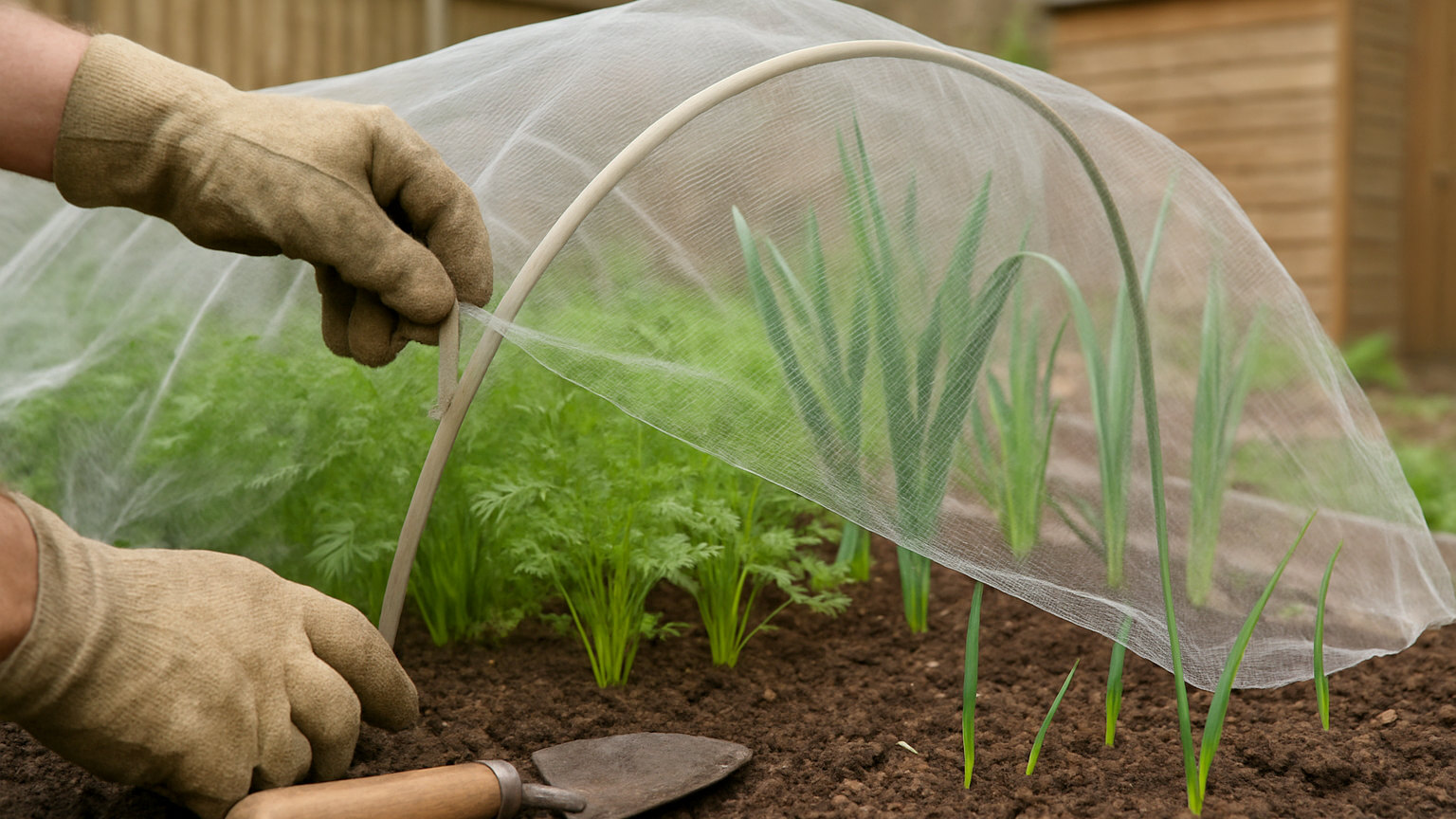
Fine mesh over the crop is more reliable still. Cover at sowing, support clear of the foliage, and seal the edges to the soil.
Do not cover ground that grew carrots last year, since the pupae overwinter in the soil and the flies emerge inside the mesh.
Timing
Sowing from about late May to early June misses the first generation entirely.
Early carrots sown under cover and lifted before midsummer often escape the worst of the second generation.
Late sowings are exposed to the larger second generation and need mesh.
Other measures
Resistant varieties are available and reduce damage substantially rather than eliminating it. They are worth using alongside mesh rather than instead of it.
Rotate, so carrots do not follow carrots, since pupae overwinter in the ground.
Growing in tall containers or raised beds above the flight height helps, though it is not a complete answer.
Companion planting with onions is often recommended and the evidence for it is weak. Mesh works.
Allium leaf miner
A more recent arrival that has spread widely and is now a serious problem on leeks, onions, garlic and chives.
The larvae tunnel into the stems and leave rows of small white pupae in the tissue, and the plants rot.
Two generations, roughly in spring and again in autumn.
Fine mesh is the only reliable control, put in place before the adults are active and left on.
Rotate, and remove and dispose of affected plants rather than composting them.
Leek moth
Larvae tunnel into leek and onion leaves and down into the stems, leaving pale windows on the foliage.
Also increasingly widespread.
Fine mesh again, and removal of affected material.
Onion white rot
Not a pest but the other major allium problem: a soil-borne fungus causing yellowing, wilting and white fluffy growth on rotting bulbs.
It persists in soil for many years and there is no cure.
Never move soil, tools or plants from an infected area, rotate as widely as possible, and consider growing alliums in containers on fresh compost where the ground is infected.
The general approach
Mesh at sowing, sealed to the ground, on ground that did not grow the same crop last year, combined with sensible timing.
That covers all of the above without any spraying, and nothing sprayed reaches larvae inside a root or a stem in any case.
Storing the crop
Lift carrots by autumn where carrot fly is bad, since damage continues while the roots stay in the ground.
Check each root as it is lifted and use damaged ones first, since the tunnels let rot in and one bad root spoils those stored beside it.
Parsnips and celery
Both are attacked by carrot fly and both benefit from the same mesh and timing measures.
Celery leaf miner also causes blistered brown patches on celery and celeriac foliage, and mesh excludes it as well.
Parsley is attacked by carrot fly too, which surprises people, and a pot of parsley under mesh crops far better.


