
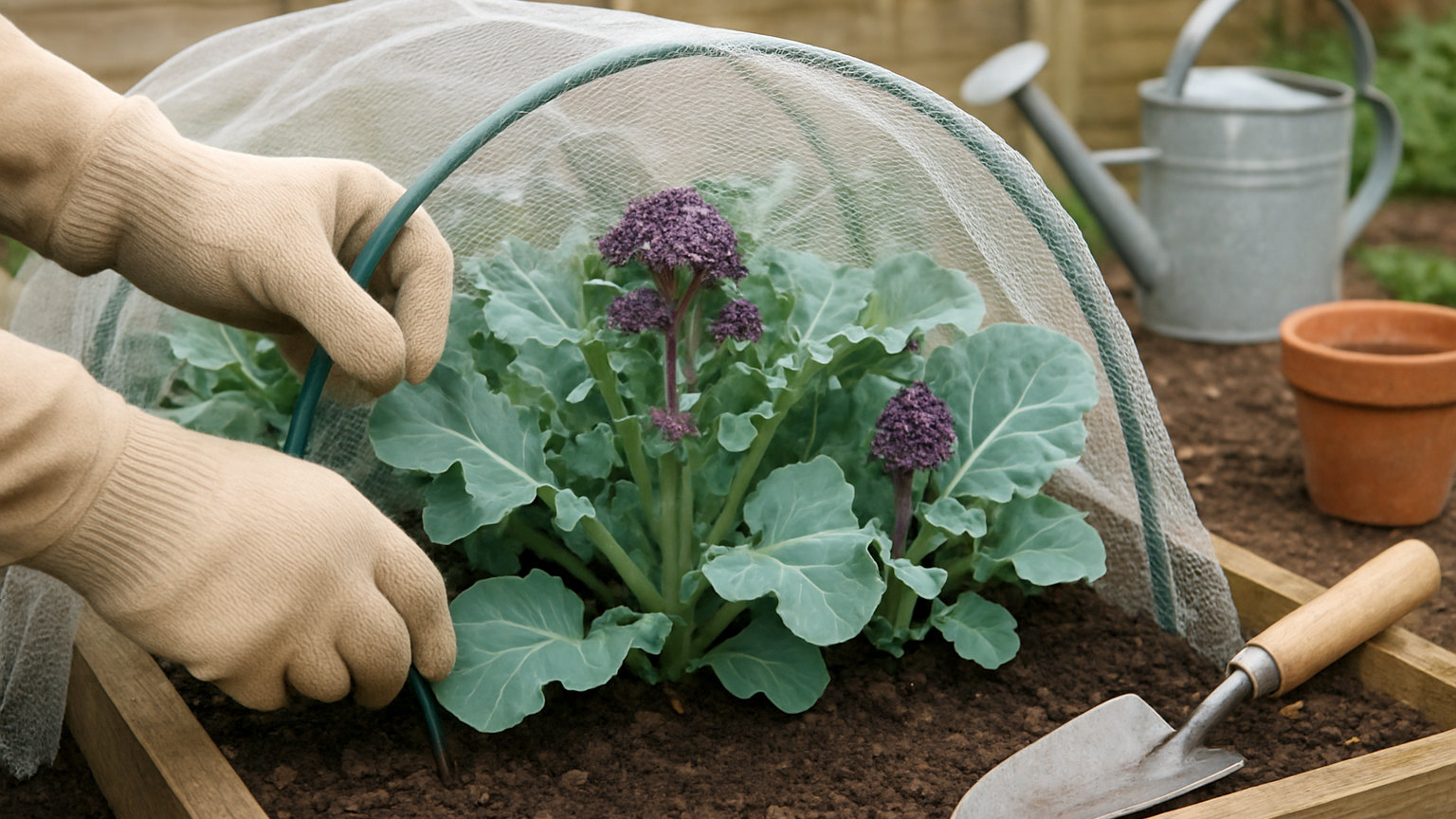
Brassicas attract more pests than any other group of vegetables, and the caterpillars are only the most visible of them. Exclusion is the whole strategy.
The three caterpillar species
Large white butterfly. Lays clusters of yellow eggs on leaf undersides. The caterpillars are yellow and black, hairy, feed in groups, and strip plants rapidly.
Small white butterfly. Lays single eggs. The caterpillars are pale green, well camouflaged along the leaf midrib, and bore into hearts.
Cabbage moth. Flies at night, and the caterpillars are green or brown and tunnel into the heart of the plant, where they are hard to reach and foul it with droppings.
All three are active from late spring, with the heaviest attacks from midsummer into early autumn.
Mesh is the answer
Fine mesh, put up before the butterflies arrive, prevents eggs being laid at all.
Use insect-proof mesh rather than bird netting. A mesh size of around seven millimetres excludes the butterflies; finer mesh is needed to exclude flea beetle and root fly as well.
Support it clear of the foliage on hoops or a frame. Butterflies lay through mesh resting on leaves, and caterpillars then hatch inside.
Seal the edges to the ground with soil, pegs or timber, since anything that can walk or fly under it will.
Check underneath regularly, because a single butterfly that gets in lays a great many eggs.
Where mesh is not used
Inspect the undersides of leaves weekly from May.
Squashing egg clusters is far quicker than dealing with caterpillars, and one inspection a week keeps a small plot clear.
Pick off caterpillars by hand and check the hearts of hearting plants, where cabbage moth larvae hide.
Nasturtiums are also a host and can be used as a sacrificial planting, though they will be stripped.
Other brassica pests
Cabbage root fly lays at the base of the stem and the larvae eat the roots, causing wilting and collapse in young plants. A collar of card or membrane around the stem at soil level prevents egg laying, and fine mesh excludes the fly.
Flea beetle makes small round shot holes in the leaves of young plants, rocket and radish. Damaging only to seedlings. Keep plants growing fast and well watered, and use fine mesh.
Whitefly on brassicas is largely cosmetic and produces sticky honeydew and sooty mould.
Mealy cabbage aphid forms grey colonies on shoot tips and distorts growth. Squash small colonies and remove badly affected tips.
Pigeons strip brassicas completely in winter and are frequently the worst pest of all. Netting is the only reliable answer.
Clubroot
Not a pest but the other major brassica problem: a soil-borne disease causing swollen distorted roots and stunted plants.
It persists in soil for many years. Rotate brassicas, improve drainage, lime to raise the pH, and raise plants in pots so they go out with a good root system. Never move soil from an infected area.
Practical routine
Raise plants in modules and plant out sturdy specimens rather than sowing in situ.
Put mesh over them at planting, before any pest arrives.
Firm brassicas in well, since they are top heavy and rock in wind, which damages the roots.
Water and feed to keep them growing steadily, since a checked plant suffers more from everything.
Rotate so brassicas do not follow brassicas.
Remove and dispose of old plants and roots at the end of the season rather than leaving them to harbour problems over winter.
Timing the mesh
Cover from planting rather than waiting for the first butterfly, since by the time they are noticed eggs have usually been laid.
Leave the mesh on all season. Brassicas are self-pollinating for cropping purposes and do not need insect access.
Lift it only to weed, water and inspect, and put it back the same day rather than leaving it off overnight.
Companion planting
Widely recommended and the evidence is mixed at best. Nasturtiums attract cabbage whites and can be used as a sacrificial crop, which is the clearest case.
Mesh is what actually works, and it is worth spending on good insect-proof material that will last several seasons rather than one.
Store it dry and folded at the end of the year and it will do many years' service.


