
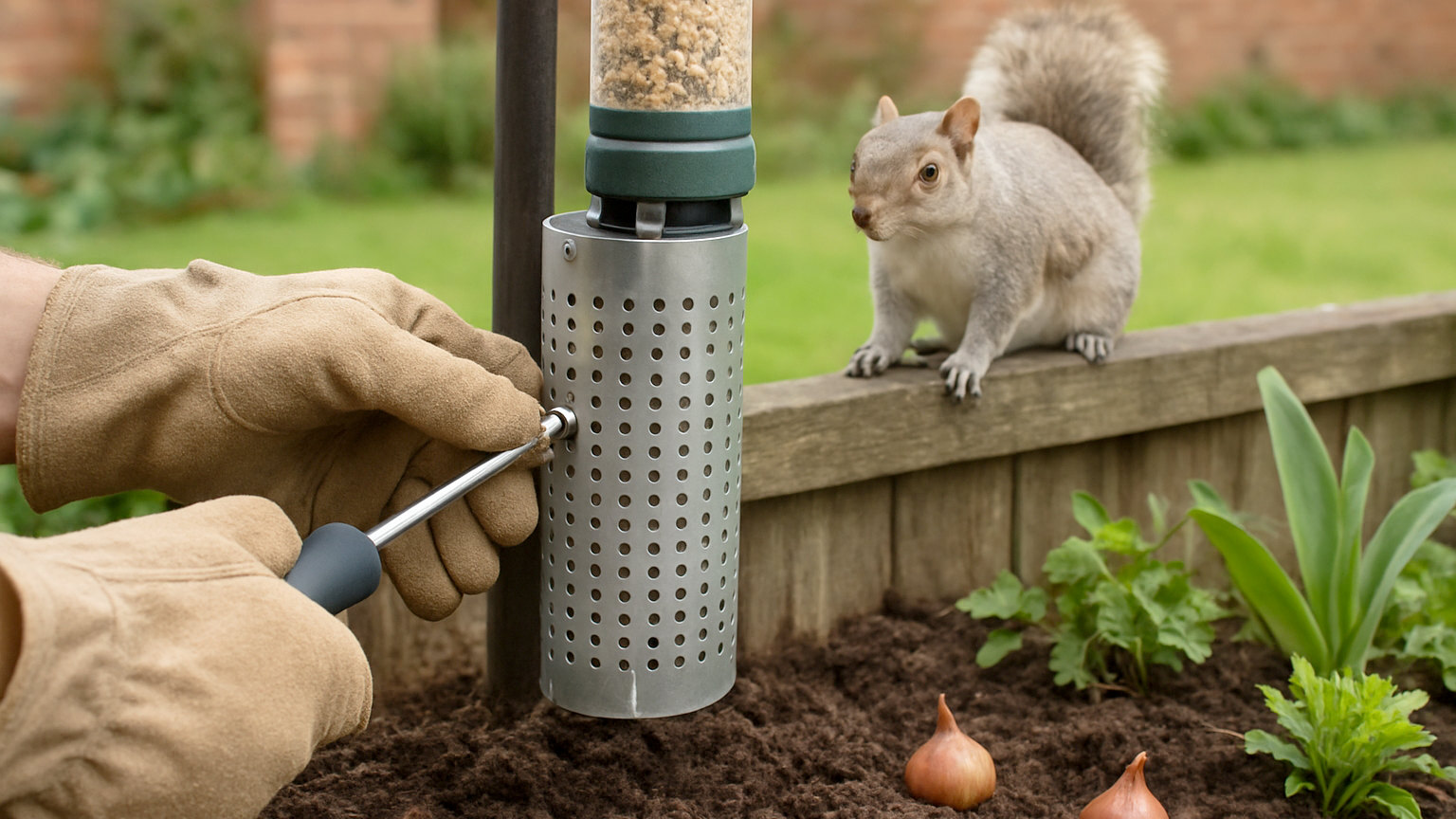
Grey squirrels are intelligent, persistent, agile and remarkably difficult to exclude. Most of what they do in a garden is a nuisance rather than serious, with one significant exception.
What they do
Dig up newly planted bulbs, particularly crocus and tulips, both to eat and to cache food. Freshly disturbed soil attracts them.
Empty bird feeders, and destroy the feeders in the process.
Strip bark from trees, usually in late spring and summer, on the trunk and upper branches. This is the serious damage, since ring-barking kills a branch or a whole tree, and young trees of beech, sycamore, oak and maple are particularly affected.
Take fruit, nuts and sweetcorn, often before ripening.
Dig in containers and lawns.
Enter lofts and outbuildings.
Protecting bulbs
Lay chicken wire or fine mesh over the planted area, pegged down, and remove it once shoots appear. This is the most reliable method.
Plant deeper than the minimum recommended, which makes bulbs harder to find.
Firm the soil well and remove all traces of disturbance, including papery bulb skins, which advertise what is beneath.
Water the area after planting to settle it.
Consider planting bulbs they dislike: daffodils, alliums, fritillaries, muscari and snowdrops are largely ignored, being toxic or unpalatable.
In containers, a layer of mesh just below the surface, or a gravel mulch, both help.
Bird feeders
Use a purpose-made squirrel-proof feeder with a weight-activated cage or shroud. The good ones work.
Site feeders well away from anything a squirrel can jump from, which is further than most people expect, commonly two metres or more horizontally and a similar distance vertically.
A baffle above and below a pole helps.
Accept that a determined squirrel will defeat most improvised measures.
Bark stripping
The damage that matters, and the hardest to prevent.
Tree guards protect the lower trunk and not the upper branches, where much of the damage occurs.
Damage tends to be worst on trees between about ten and forty years old.
Where a valued young tree is being stripped, seek advice, since options in a garden are limited.
Deterrents
Most do not work. Squirrels habituate to noise, movement and visual scarers within days.
Repellent products have limited and short-lived effect.
Physical exclusion is the only consistently effective approach.
The legal position
This is important and frequently misunderstood.
Grey squirrels are a non-native invasive species and are not protected in the way native mammals are.
It is an offence to release a grey squirrel back into the wild, or to allow one to escape, once it has been caught. Live-trapping and relocating a squirrel to a park or a wood is therefore unlawful.
Anyone trapping a grey squirrel is required to dispatch it humanely, and there are legal requirements about the traps that may be used and how they must be checked.
The Wild Mammals Protection Act makes causing unnecessary suffering an offence.
Given all of that, trapping is not a sensible route for most gardeners, and exclusion is both simpler and lawful.
Red squirrels are fully protected and must not be disturbed or harmed.
Living with them
In most gardens the damage is limited to bulbs, feeders and some fruit, all of which can be protected physically.
Removing one squirrel simply creates a vacancy that another fills within days, so exclusion is more durable than removal in any case.
Protect what matters, plant bulbs they dislike, buy a proper feeder, and accept the rest.
Fruit and vegetables
Squirrels take apples, pears, plums, nuts, strawberries and sweetcorn, frequently taking a bite and discarding the rest.
Netting on a frame protects soft fruit and sweetcorn, and a full fruit cage is the only reliable protection for a tree crop.
Picking slightly early and ripening indoors avoids some losses, particularly with apples and pears.
In lofts and buildings
Squirrels in a roof space cause real damage, gnawing timber and electrical cables, and are a fire risk.
Block access points once you are certain nothing is inside, and take professional advice, since this is a building problem rather than a gardening one.
Never block an access point during the breeding season without checking for young, which would be both cruel and an offence under the Wild Mammals Protection Act.


