
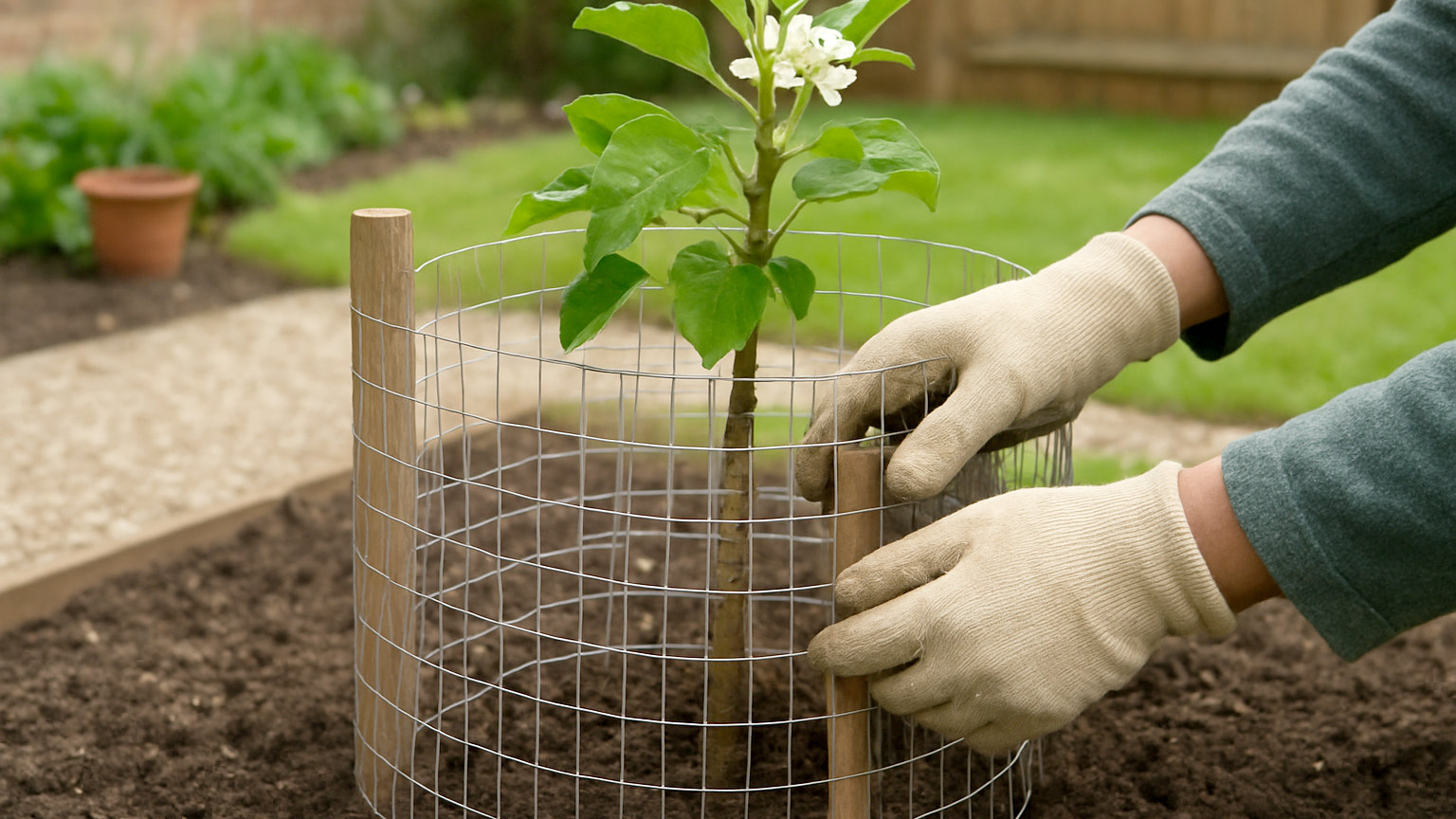
With mammals, exclusion is the only approach that reliably works. Deterrents based on smell, noise or taste all fade as the animal habituates, and most garden mammals are persistent, intelligent and hungry. The specification of the barrier is what matters, and it differs for each.
Rabbits
Rabbit fencing has to be built to a specification or it achieves nothing. Use wire mesh of about thirty-one millimetres, at least one metre high above ground.
Critically, bury the bottom thirty centimetres and turn it outwards in an L shape away from the garden. Rabbits dig at the base of a barrier, and a fence that simply stops at ground level is dug under within a week.
Individual tree guards or spiral protectors are essential for young trees and shrubs, since rabbits ring-bark them in winter and a ring-barked tree dies.
Deer
Deer need height, and the height depends on the species. Roe deer clear surprisingly high fences; muntjac are small and go underneath.
A fence of at least one and a half metres deters muntjac and roe in most situations, and one point eight to two metres is needed where deer pressure is high. The bottom must be close to the ground for muntjac.
Deer will not usually jump into a space they cannot see is clear, so a solid fence can be effective at a lower height than a wire one. Tree guards and tubes protect individual plants where fencing the whole garden is impractical.
No plant is genuinely deer-proof, though they tend to avoid strongly aromatic, hairy and toxic plants such as lavender, rosemary, euphorbia, foxglove and ferns.
Squirrels
Grey squirrels dig up bulbs, strip bark, take fruit and nuts, and raid bird feeders. They are agile enough that fencing is not a realistic answer.
Protect newly planted bulbs by laying wire mesh over the bed, pegged down, until growth appears, or by planting in mesh baskets. Daffodils and alliums are largely left alone, so choosing those over tulips and crocus avoids the problem.
Use squirrel-proof bird feeders with a weighted cage. Netting fruit trees helps, though squirrels will chew through light netting.
Note that it is illegal to release a grey squirrel once trapped, or to allow it to escape. Live trapping therefore commits you to killing it humanely, which is not something to embark on without thinking it through, and the legal position is worth checking before you buy a trap.
Cats
Cats dig in freshly cultivated soil and use bare beds as a litter tray, which is a hygiene concern in a vegetable garden.
The effective measures are physical: netting or twiggy prunings laid over freshly sown beds, mulching with sharp gravel or pine cones, and keeping the soil surface covered with planting so there is no bare ground.
Scent deterrents work briefly. Motion-activated water sprinklers are more effective and reasonably kind. Ultrasonic devices have mixed results.
Cats are not trespassing in law and cannot be excluded by any legal complaint against the owner, so the practical route is the only one.
Moles
Moles damage lawns with hills and tunnels rather than eating plants, and they eat leatherjackets and other soil pests, so the harm is cosmetic.
They are difficult to remove and quickly replaced by another from surrounding land. Scattering the molehills and rolling the lawn, and accepting occasional hills, is often the least frustrating approach. Deterrents based on sonic devices have little evidence behind them.
What generally does not work
Scent-based repellents, ultrasonic devices, lion dung pellets and mothballs all show poor results in practice, mostly because animals habituate quickly once nothing unpleasant follows. They are worth trying only alongside physical exclusion, never instead of it.
Badgers, which are protected
Badgers and their setts are protected by law in the UK. It is an offence to kill, injure or take a badger, or to damage, destroy or obstruct a sett, including by blocking an entrance.
Badgers dig for grubs and can do substantial damage to a lawn, particularly where leatherjackets are present. Treating the grubs with nematodes removes the attraction, which is the practical approach. Electric fencing may be used but any work near a sett requires care and possibly a licence.
If badgers are causing serious damage, take advice from the local wildlife trust or a licensed professional rather than acting.


