
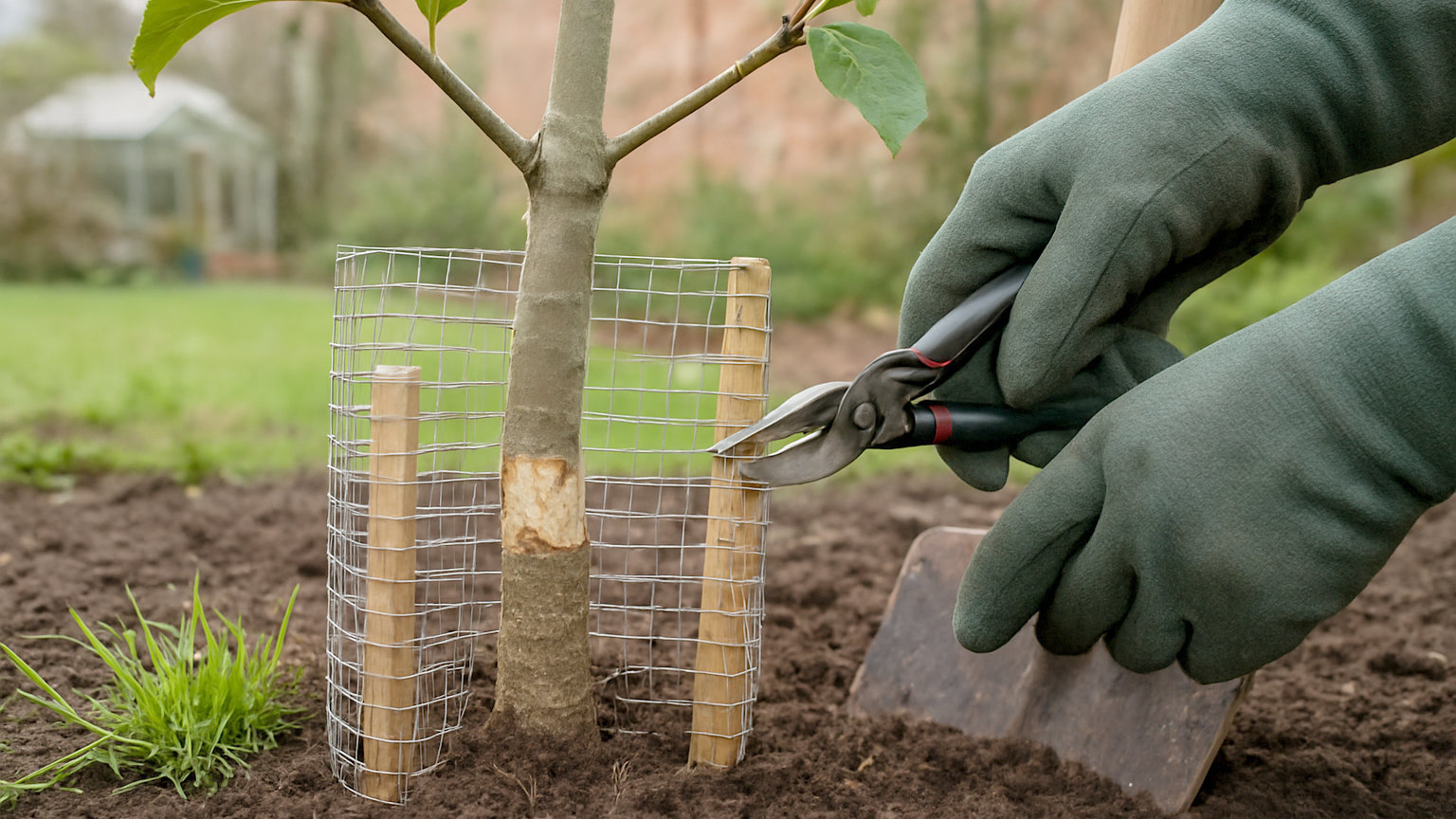
Rabbits do a great deal of damage in a short time, and in a garden bordering fields or rough ground the population can be substantial. Fencing is the only measure that genuinely works.
Recognising rabbit damage
A clean angled cut, as if made with secateurs, is the signature. Rabbits have sharp incisors and slice through stems neatly.
Deer, by contrast, tear and leave a ragged end, since they have no upper incisors.
Grazing is close to the ground, generally below about fifty centimetres, which is the limit of their reach.
Bark stripped from the base of young trees and shrubs in winter, often up to snow height.
Scrapes and small round droppings.
Damage appearing overnight, since they feed mainly at dusk and dawn.
Fencing specification
This is where most rabbit fencing fails, and the details matter.
Wire mesh of no more than thirty-one millimetres, since young rabbits pass through anything larger.
At least ninety centimetres to a metre above ground, since rabbits can jump.
The base buried or turned out. Either bury the bottom thirty centimetres, or turn a skirt of at least thirty centimetres outwards along the surface, pegged down and allowed to grass over.
Turning the skirt outwards is the important part. Rabbits dig at the base of a barrier, meet the horizontal mesh and give up.
Support the mesh on posts at regular intervals with a straining wire along the top.
Any gate must have the same specification and no gap beneath it.
Check the whole run regularly for scrapes, gaps and damage, since one route in undoes the entire fence.
Protecting individual plants
Where fencing the whole garden is impractical.
Tree guards or spiral guards on the trunks of young trees and shrubs, which prevents ring-barking. This kills a young tree, so it is worth doing on anything newly planted.
Wire netting cylinders around individual specimens, held clear of the plant on canes.
Fencing a vegetable plot or a specific bed rather than the whole garden.
Plants rabbits usually avoid
No plant is entirely rabbit proof, particularly in a hard winter or with a hungry population, and some are far less attractive.
Aromatic and strongly flavoured: lavender, rosemary, sage, thyme, artemisia, santolina.
Toxic or irritant: euphorbia, foxglove, aconitum, hellebore, daffodils.
Tough and leathery: bergenia, hebe, viburnum, mahonia, box, yew.
Hairy or spiny: stachys, berberis, pyracantha.
Also usually left: hardy geraniums, alchemilla, nepeta, peonies, ferns, grasses, agapanthus.
Newly planted specimens of any species are more vulnerable, since soft young growth is attractive and the plant has no reserves.
What does not work
Repellent sprays, which wash off and need constant reapplication, and which rabbits habituate to.
Ultrasonic devices, for which there is no good evidence.
Human hair, blood meal and similar remedies, which have brief effects at best.
Scarers, which rabbits ignore within days.
Other measures
Remove cover close to the garden: brambles, log piles, long grass and scrub where they shelter, though this conflicts with encouraging other wildlife.
Plant larger specimens, which survive some grazing.
Protect new planting for the first two or three years, after which many plants are large enough to tolerate damage.
The legal position
Rabbits are not protected in the way many other mammals are, and there are legal restrictions on the methods that may be used to control them.
Trapping and shooting are governed by legislation, including rules on approved traps and firearms law, and are not realistic in a domestic garden.
Fencing is the practical answer, and once done properly it is permanent.
Where rabbits are already inside
Fencing a garden that already contains rabbits simply encloses them.
Check for existing burrows before completing a fence, and make sure any animals inside have left before the last section goes up.
Vegetable plots
Rabbits take almost every vegetable crop, and lettuce, beans, peas, carrot tops and brassicas particularly.
Fencing the plot to the specification above is far more practical than fencing an entire garden, and it protects against pigeons at the same time if mesh is used over the top.
A single well-built enclosure handles rabbits, pigeons, cabbage whites and root flies together, which is why a fixed cage over a vegetable bed is such a good investment.
Recognising which animal
Clean angled cut below fifty centimetres means rabbit. Ragged torn stems above that height mean deer.
Both leave droppings, and rabbit droppings are small round pellets scattered in groups.


