
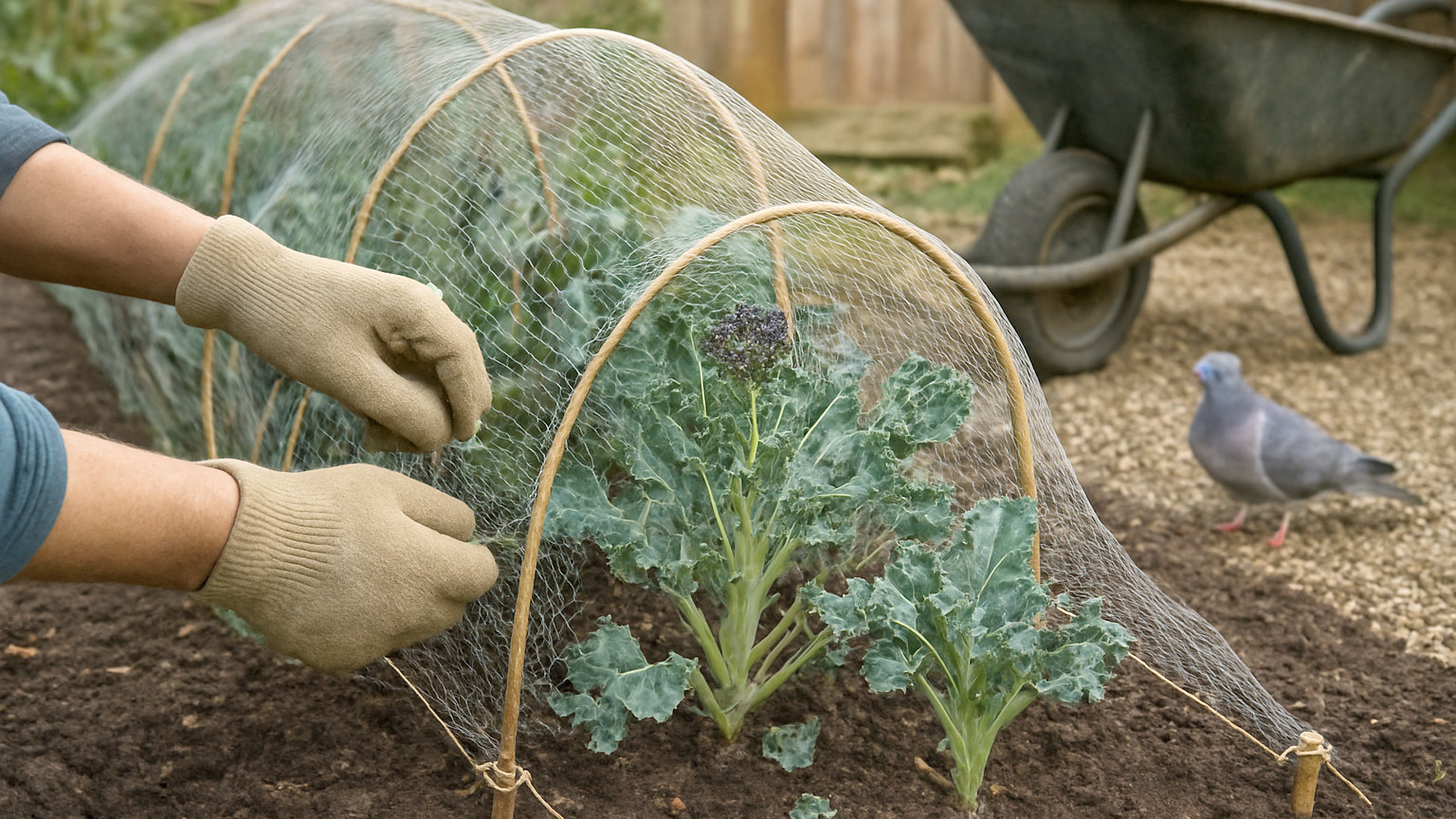
Woodpigeons are the most destructive bird in a British vegetable garden, and brassicas in winter are their preferred target. A row can go from healthy to bare ribs in a single morning.
Recognising the damage
Leaves stripped down to the midribs and stalks, leaving a ragged skeleton.
Damage appearing suddenly, over hours rather than days.
Worst in winter and early spring, when other food is scarce, and on young transplants at any time.
Droppings on the plants and the ground, and often visible birds.
Slug damage is ragged holes within the leaf; pigeon damage removes whole areas of leaf tissue between the veins.
What they attack
All brassicas: cabbage, kale, sprouts, broccoli, cauliflower, swede and turnip tops.
Peas and beans, particularly seedlings and pods.
Lettuce and other soft leaves.
Fruit buds and blossom on some trees.
Newly sown seed and emerging seedlings of many kinds.
Netting is the answer
Nothing else reliably works. Pigeons are intelligent, persistent and quickly learn that scarers are harmless.
Use netting on a frame, stretched taut and clear of the foliage.
Pigeons feed through netting resting on leaves, so the net must be held well above the plants.
Peg the edges to the ground so nothing gets underneath.
A mesh of around two centimetres excludes them. Finer insect mesh does the same job and also excludes cabbage whites, root fly and flea beetle, which makes it the better choice for brassicas.
Check daily and keep the net taut, since loose netting traps birds and hedgehogs.
Cages and permanent structures
For a plot with regular problems, a walk-in cage or a run of hoops with fixed mesh is a better investment than annual netting.
It allows access for weeding and picking, stays taut, and lasts many seasons.
Fine mesh over hoops on a vegetable bed is the standard arrangement and handles birds and insects together.
Why scarers disappoint
Pigeons habituate rapidly to anything that does not actually threaten them.
Scarecrows, hanging discs, foil strips, plastic hawks and glittering tape all work for a few days and then become perches.
Moving them regularly extends the effect somewhat, and none of them protects a crop reliably.
They may be worth using to bridge a gap while netting is arranged, and not as a strategy.
The legal position
All wild birds are protected under the Wildlife and Countryside Act, and it is an offence to kill or injure them, or to damage or destroy an active nest, except under specific legal authority.
Some species may be controlled under general licences by authorised persons, and only where the licence conditions are met, which include showing that non-lethal methods have been tried and are ineffective.
These licences change and their conditions are specific. Check the current position rather than assuming, and note that for a domestic garden the practical answer is exclusion in any case.
Practical measures
Net from the moment plants go out rather than after damage begins.
Protect through winter, which is when brassicas are most at risk and most valuable.
Raise plants in modules and plant out sturdy specimens, which recover better from any damage.
Firm brassicas in well, since pigeons landing on them rock the plants and loosen the roots.
Remove old plants at the end of the season rather than leaving them as a food source that keeps birds visiting the plot.
Recovering damaged plants
Brassicas stripped in winter frequently recover if the growing point survives.
Net them immediately, water and feed in spring, and be patient.
Plants with the growing point removed will not recover and should be replaced.
Living with them
Pigeons are part of the landscape and are not going anywhere.
Protect what matters with mesh on a frame and ignore them elsewhere, since they do no harm to ornamental planting or to a lawn.
Other birds worth knowing about
Bullfinches strip fruit buds from apples, pears, plums and gooseberries in late winter, removing the crop before it forms. Netting is the answer.
Blackbirds take soft fruit and scatter mulch while searching for insects, which is untidy rather than damaging.
Jays bury acorns in lawns and borders and dig up newly planted material while caching and retrieving them.
All are protected, and all are dealt with by netting where they matter.


