
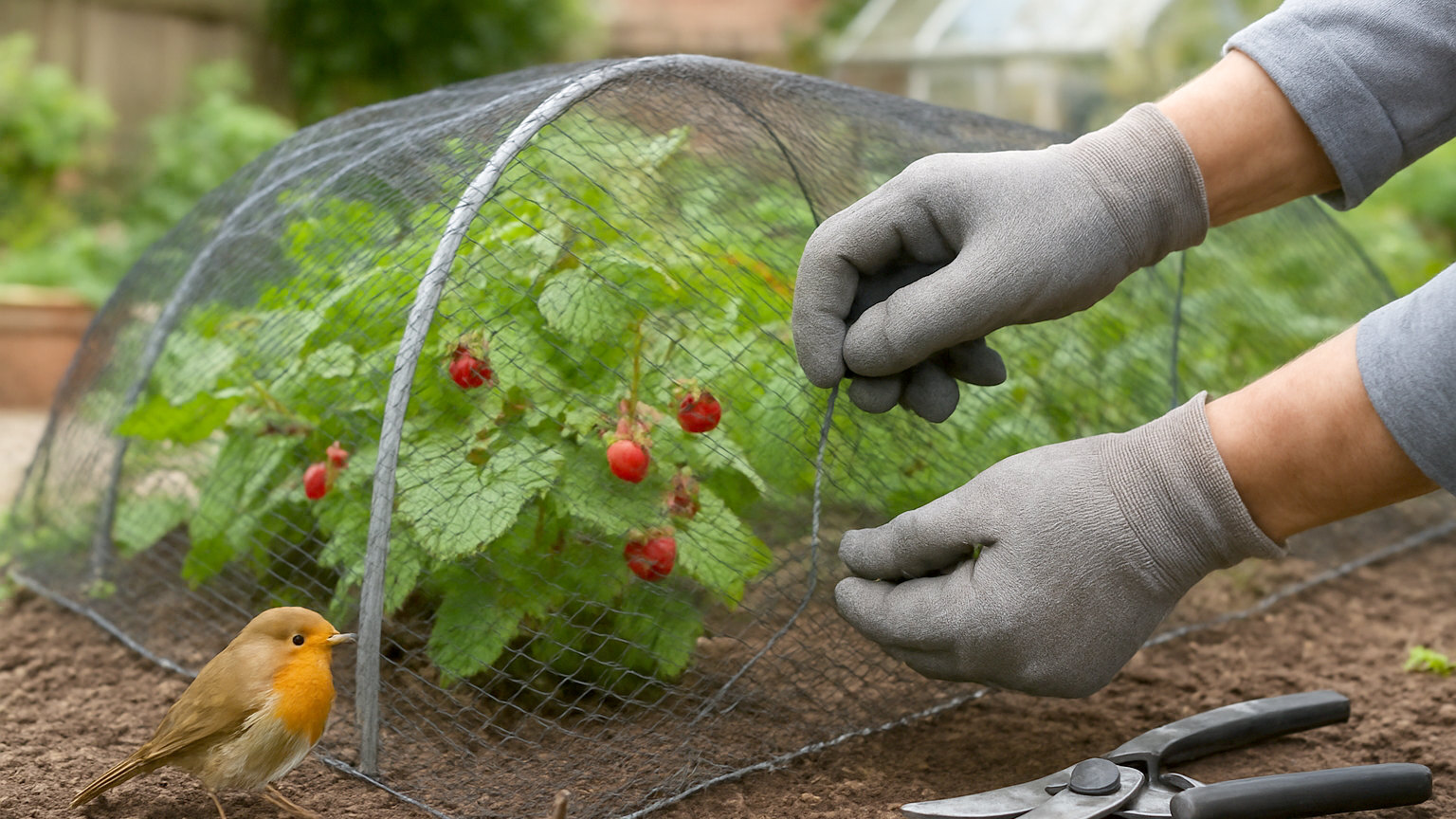
Netting excludes birds and mammals more reliably than any deterrent. Badly fitted netting kills birds, hedgehogs, grass snakes and slow worms every year, and almost all of it is avoidable.
The problem with loose netting
Slack netting draped over plants is the worst arrangement.
Birds land on it, push through and become entangled, and struggle until they exhaust themselves or are taken by a predator.
Hedgehogs push into loose netting at ground level and the mesh tightens as they turn, cutting into them. Injuries of this kind are frequently fatal.
Grass snakes and slow worms become caught in the same way.
Netting left lying about after use, or forgotten in a corner, causes just as many injuries.
Fitting it properly
Stretch the netting taut over a frame rather than draping it over the plants.
Use hoops, canes with bottle tops, or a proper fruit cage structure, and keep the net clear of the foliage.
Secure the edges to the ground with pegs, timber or soil so nothing can get underneath.
Keep the bottom edge either firmly pegged down or raised well clear, never loose and trailing at ground level, which is exactly what catches hedgehogs.
Use netting in good condition and replace anything torn or perished.
Mesh size
Choose the smallest mesh that does the job.
Very fine insect mesh excludes butterflies and root flies and is safest of all for wildlife, since nothing can get a limb through it.
Bird netting with a mesh of around two centimetres excludes pigeons and blackbirds. Larger mesh is more likely to entangle.
Avoid the thin loose plastic netting sold cheaply on rolls, which tangles readily and is the material most often involved in injuries.
Rigid mesh, chicken wire and fine woven mesh are all safer than knitted plastic netting.
Check it daily
This is not optional where netting is used.
Walk round every morning, looking along the base and the corners.
A bird found quickly can usually be freed; one found the next day rarely can.
Check before and after windy weather, which loosens fixings.
Freeing a trapped animal
Work calmly and cut the netting rather than trying to untangle it, since the mesh tightens as the animal struggles.
Cover a bird's head with a cloth, which usually calms it.
Wear gloves for a hedgehog, and be aware that cuts from netting may be deep and infected even where they look minor.
Take any injured animal to a vet or a wildlife rescue centre. Vets do not charge for treating wildlife.
Do not attempt to handle a badger, a fox or a deer.
Alternatives to netting
Fine mesh on a frame for vegetables, which excludes insects as well and is far safer.
Rigid cages and cloches for individual plants.
Chicken wire for bulbs and newly seeded areas.
Fleece, which excludes some pests and offers no entanglement risk.
A permanent fruit cage with a proper frame and tensioned netting, which is the safest long-term arrangement for soft fruit.
Storing it
Take netting down at the end of the season rather than leaving it up unattended.
Fold and store it in a bag or a box, off the ground and inside a shed.
Never leave a roll of netting lying in a border or against a fence, which is a trap in itself.
Nesting season
It is an offence to intentionally damage or destroy an active bird's nest.
Check hedges, dense shrubs and climbers before netting or covering them, and leave anything with a nest in it entirely alone until the young have fledged.
Getting it right
Taut, on a frame, pegged at the edges, fine mesh, checked daily, taken down and stored at the end of the season.
That protects the crop completely and harms nothing, and it takes very little more effort than doing it badly.
Fruit cages
Worth the investment where soft fruit is grown, since blackbirds take a crop of currants or raspberries with remarkable efficiency.
Use a proper frame with tensioned netting, and a door rather than lifting the net each time.
Take the roof netting off in winter in snowy areas, since the weight collapses the frame, and to let birds in to clear overwintering pests from the bushes.


