
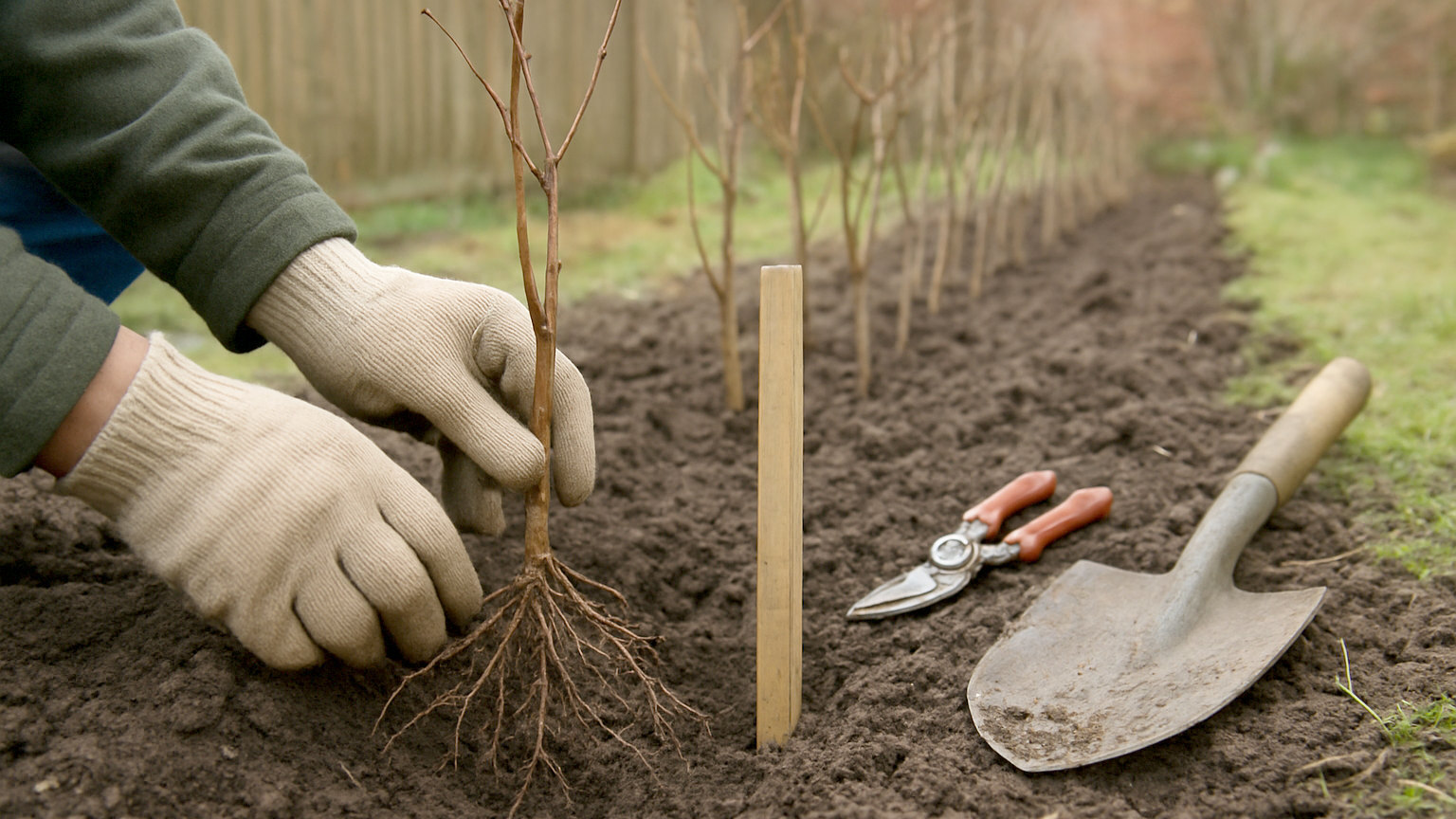
A hedge is cheaper, better for wildlife and longer lasting than a fence, and planting one is straightforward if it is done in winter with bare-root plants. The two things that decide whether it succeeds are ground preparation and the pruning in the first two years.
Buy bare-root whips in winter
Bare-root hedging, sold as whips between November and March, costs a fraction of container-grown plants and establishes faster. A metre of native hedging bought this way costs less than a single potted shrub.
Order early, since good suppliers sell out. Plant as soon as they arrive, and if you cannot, heel them into a trench of soil. The roots must never dry out.
Choosing what to plant
For a native mixed hedge, hawthorn is the backbone, typically at around sixty per cent, with blackthorn, hazel, field maple, dog rose, holly and guelder rose making up the rest. It is thorny, stock-proof, and supports an enormous range of wildlife.
For a formal deciduous hedge, beech holds its russet leaves through winter on drier soils, and hornbeam does the same job on heavy or wet ground where beech struggles.
For evergreen, yew is slow, dense and long-lived and tolerates hard renovation. Holly is tough and good for security. Avoid Leyland cypress, which grows faster than anyone wants and cannot be cut back into old wood.
Box has been badly affected by box blight and box tree caterpillar, so for low formal hedging consider small-leaved holly or Japanese holly instead.
Spacing
Plant closer than instinct suggests. For most hedging, three plants per metre in a single row, or five per metre in a staggered double row with the rows about forty centimetres apart, produces a dense hedge quickly.
Larger plants such as yew and beech can go at two or three per metre. A double staggered row costs more and gives a noticeably thicker hedge, which is worth it for a boundary.
Preparing the ground
Clear a strip at least a metre wide of grass and perennial weeds, because grass competing at the base is one of the main reasons young hedges grow slowly. Do this in advance if you need to deal with couch or bindweed.
Dig a trench about forty-five centimetres wide and a spade deep along the line, fork the base, and mix compost or well-rotted manure into the excavated soil. A trench is far better than individual holes for a hedge, since roots spread along it freely.
Planting
Set the plants at the same depth they grew in the nursery, which is visible as a dark mark on the stem. Spread the roots, backfill in stages and firm with your heel as you go.
Water in thoroughly even in winter. Mulch the whole strip with bark or compost to at least five centimetres, keeping it off the stems, which suppresses weeds and holds moisture.
On an exposed or rabbit-prone site, spiral guards or a temporary mesh fence pay for themselves. Rabbits will strip a new hedge in a night.
The pruning that makes the difference
Cut the whips back hard after planting. Reducing deciduous hedging by about a third, or even a half for hawthorn and blackthorn, feels like vandalism and is the single thing that produces a hedge thick at the base rather than leggy with gaps.
Repeat a hard trim in each of the first two or three winters, always cutting the sides as well as the top. Conifers and evergreens are treated more gently, trimming sides only until the desired height is nearly reached.
Once established, shape the hedge so it is wider at the base than the top. That batter lets light reach the bottom, keeps it furnished to the ground and sheds snow.
Trimming an established hedge
Formal hedges are usually cut twice a year, in early summer and again in late summer. Informal and native hedges need only one cut, in winter, and flowering or berrying hedges should be trimmed after the berries have gone rather than before.
Watering and the law
Water through the first two summers, thoroughly and weekly in dry spells. A hedge that dries out in its first year develops gaps that take years to close.
Do not cut hedges between March and August if you can avoid it. It is an offence in the UK to damage or destroy an active bird's nest, and hedges are full of them through those months. Check thoroughly before any trim in that period.


