
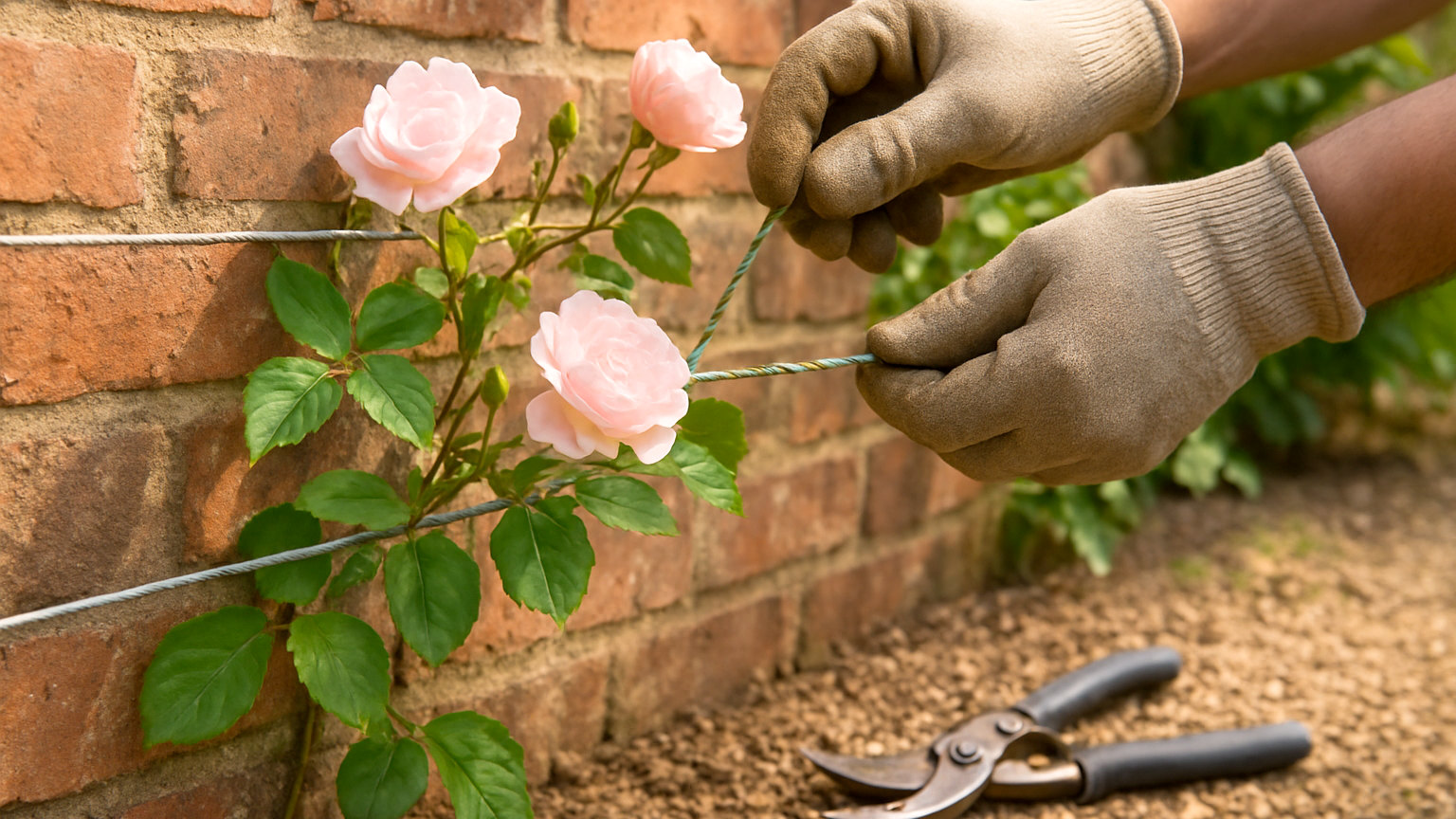
The commonest complaint about a climbing rose is that it flowers only at the top, leaving a bare stem below. That is not a fault of the plant. It is a consequence of how it was trained, and it is entirely correctable.
Horizontal is the whole principle
A rose stem trained horizontally produces flowering shoots along its entire length. The same stem left vertical produces flowers only at the tip.
The cause is apical dominance: the bud at the top of an upright stem suppresses the buds below it. Bend the stem towards the horizontal and that suppression breaks down, and buds all along it break into growth.
Everything about training a climbing rose follows from this. The aim is to get as much of the main growth as close to horizontal as the structure allows.
Fitting the support
Use heavy-gauge galvanised wire on vine eyes screwed into the wall, with horizontal wires spaced about forty-five centimetres apart vertically.
Hold the wires ten centimetres clear of the wall so air can circulate behind the plant, which reduces mildew considerably, and so stems can be tied without being pressed against the brickwork.
Trellis works too and is easier to fit, though it needs battens behind it to give the same air gap. Fix it so it can be taken down with the rose attached if the wall ever needs painting.
Get the support up before planting. Retrofitting wires behind an established climber is an unpleasant job.
Building the framework
In the first two or three years, concentrate on establishing a permanent framework of main stems rather than on flowers.
As each strong new stem grows, tie it in as horizontally as the space allows, fanning the growth outwards and downwards from the base rather than letting everything head for the top.
Cover the lowest part of the wall first. A climber trained upwards before the base is furnished will always have a bare bottom.
On a pillar, obelisk or arch, spiral the stems around the structure rather than running them straight up. The spiral achieves the same effect as horizontal training in a narrow space.
Tying in
Use soft twine or proprietary ties, tied in a figure of eight so the stem is not pressed against the wire and cannot chafe.
Never tie tightly. Check ties annually and loosen any that are cutting in, since a forgotten tie will strangle a stem as it thickens.
Tie in new growth as it appears through summer, while it is still flexible. A stem left until winter has hardened in the wrong position and may snap when bent.
Annual maintenance
Prune in winter, between November and February. Shorten the side shoots coming off the main framework to two or three buds, which is where the flowers come from.
Remove one or two of the oldest main stems entirely every few years, cutting them to the base, and tie in a strong new shoot to replace each one. This keeps the framework young and prevents the whole thing becoming a woody tangle.
Retie anything that has come loose and check the wires and vine eyes are sound.
Rescuing a bare-bottomed climber
If a climber is bare below and flowering only at the top, the fix is to bring stems down.
Untie the main stems, lower them and retie them horizontally or arching downwards. It feels drastic and it works, and flowering shoots will break along the length within a season.
Where the base is genuinely bare wood with no buds left, cut one or two of the oldest stems right down to about thirty centimetres to force new growth from the base, accepting a reduced display for a year.
Underplanting with a low shrub or perennials disguises the bare section while the rose recovers, and is worth doing permanently since most climbers go somewhat bare at the base with age.
Position
South and west-facing walls give the best flowering. East is acceptable for many varieties. North is possible for a specific short list of tolerant climbers, which flower less freely.
Plant at least forty-five centimetres out from the wall, leaning the plant inwards, since the ground immediately against a wall is dry, sheltered from rain by the eaves and often full of builders' rubble.


