
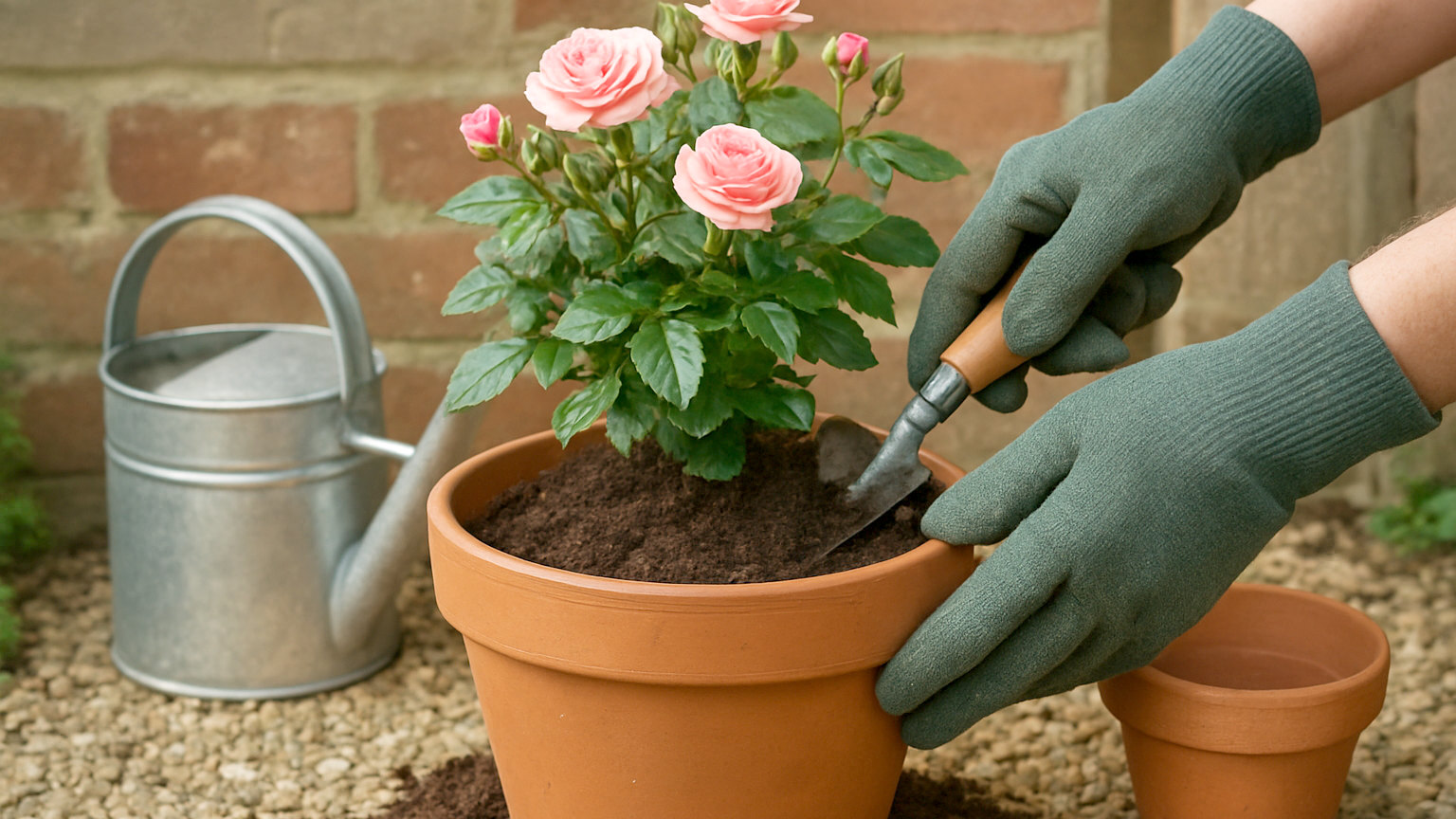
Roses grow perfectly well in containers, which makes them possible on a patio, a balcony or over paving. They are less forgiving than in open ground, since everything the plant needs has to be supplied, but the result is entirely worthwhile.
Pot size
Bigger than instinct suggests. A patio or miniature rose needs at least thirty centimetres across and deep. A shrub or floribunda wants forty-five, and a climber or a larger shrub wants fifty or more.
Depth matters as much as width, since roses are deep-rooted plants. A wide shallow bowl is the wrong shape.
Undersized pots dry out within hours in summer, exhaust their nutrients quickly and produce a permanently stressed plant.
Compost
Use a soil-based compost such as John Innes No. 3, not multipurpose.
It holds water and nutrients far better, does not break down and collapse over a season, and its weight keeps a top-heavy rose stable in wind. Multipurpose compost in a rose pot is exhausted and structureless within a year.
Mixing in about a quarter well-rotted manure or garden compost improves it further. Ensure the pot has good drainage holes and stand it on feet.
Which roses suit pots
Patio and miniature roses are bred for the purpose and are the safest choice, staying compact and flowering freely.
Many compact English and shrub roses do well in a large container, and several breeders now list varieties specifically recommended for pots.
Climbers can be grown in a large container against a wall, given a big enough pot and reliable watering.
Vigorous shrub roses, ramblers and anything reaching over about a metre and a half are better in the ground.
Watering
This is where container roses fail. A rose in a pot in summer may need water daily, and twice on hot days.
Water thoroughly until it runs from the base rather than sprinkling the surface. Check by pushing a finger into the compost rather than judging by the top.
Irregular watering causes bud drop, poor flowering and increased mildew. Mulch the compost surface with gravel or bark, group pots together, and consider a drip system on a timer if you are out all day.
Feeding
Compost is exhausted within about six weeks, after which the plant depends entirely on you.
Feed fortnightly through the growing season with a liquid rose or tomato feed, starting in spring and stopping by mid-August so late soft growth does not get caught by frost.
Top dress each spring: scrape off the top five centimetres of compost and replace with fresh, mixed with a slow-release rose fertiliser.
Repotting
Every two or three years, in winter while dormant, tip the plant out and inspect the roots.
Either move up a pot size, or if it is at its final size, root prune by trimming the outer few centimetres all round and replanting into the same pot with fresh compost. Prune the top growth lightly at the same time to balance it.
A rose left in the same exhausted compost for five years will decline steadily whatever you feed it.
Winter
Roots in a pot are far more exposed to freezing than roots in the ground.
Move containers against a house wall, wrap the pot rather than the plant in bubble wrap or hessian during a hard spell, and raise it on feet so it is not standing in freezing water.
Do not bring roses indoors. They need a cold dormant period, and a warm room produces weak growth and disease.
Waterlogging over winter kills more container roses than cold does, so check the drainage holes are clear and remove any saucer.
Pruning
The same as for the equivalent type in the ground. Patio roses are pruned like small floribundas, reduced by about a third in late winter, and shrub types more lightly.
Container roses often benefit from slightly harder pruning than the same variety in a border, since keeping the plant in proportion to the pot matters both visually and practically.
Problems to watch for
Vine weevil grubs eat the roots of container roses and cause sudden collapse despite adequate watering. Apply nematodes in late summer and check the rootball of any new plant.
Blackspot and mildew are both more likely in a pot, since a container rose is more often short of water and frequently sited against a sheltered wall with poor airflow.


