
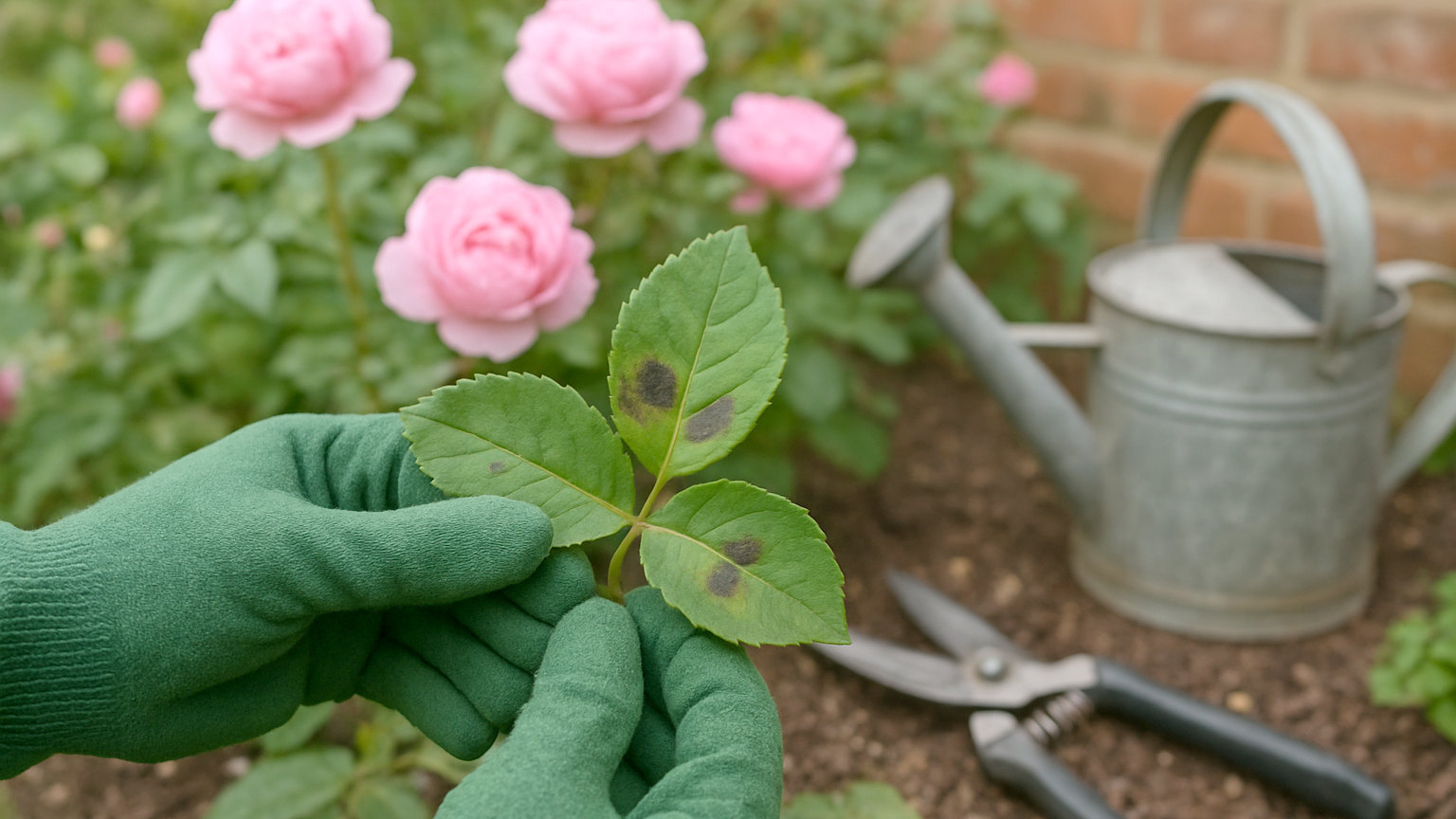
Three diseases account for almost all rose trouble, and the most effective response to all of them is made at the point of purchase. Modern breeding has improved disease resistance enormously, and a resistant variety saves years of effort.
Blackspot
Black or dark purple blotches with fringed, irregular edges, usually starting on the lower leaves. The surrounding leaf yellows and drops, and a bad case defoliates a rose by late summer.
Repeated defoliation weakens the plant considerably, since it is being asked to produce leaves twice in a season.
It overwinters on fallen leaves and on the stems, which is why it returns to the same plant every year and why hygiene matters more than anything.
Dealing with blackspot
Clear and bin every fallen leaf from beneath the plant. Do not compost them, since a home heap rarely reaches a temperature that kills the spores.
Prune out affected stems in late winter, since the fungus overwinters in lesions on the wood.
Mulch in spring, which covers any spores remaining on the soil surface and physically prevents them splashing up onto new foliage.
Water at the base rather than over the leaves, and prune for an open centre so foliage dries quickly after rain.
Avoid high-nitrogen feeds, which produce the soft sappy growth the fungus prefers.
Powdery mildew
A white dusty coating on young leaves, shoots and buds, with affected growth distorted and stunted.
It is caused by dry roots combined with humid air, which is the opposite of what most people assume. Roses against a wall, where the soil is dry and air movement poor, suffer most.
Water thoroughly and consistently, mulch to hold moisture, and improve airflow by pruning to an open shape and spacing plants properly.
Remove affected shoot tips, since the fungus overwinters in the buds.
Rust
Small orange pustules on the undersides of leaves, turning black later in the season, with corresponding yellow spots on the upper surface.
Less common than blackspot but more damaging when severe. It thrives in warm humid conditions.
Remove and bin affected leaves promptly, clear fallen material in autumn, and improve airflow. Some varieties are markedly more susceptible than others.
Dieback and canker
Stems dying back from the tip, turning brown or black, sometimes with sunken discoloured patches on the wood.
It usually follows damage: a poor pruning cut, frost injury, or a wound. Cut back well into clean healthy wood, where the pith is white rather than brown, and disinfect secateurs between cuts.
Prevent it with clean sharp tools, cuts made just above an outward-facing bud, and by not leaving stubs that die back into the stem.
Choose resistant varieties
This is the single most effective measure available. Rose varieties differ enormously in susceptibility, and the difference between a resistant modern variety and a susceptible older one is the difference between a healthy plant and an annual battle.
Many breeders now select specifically for disease resistance, and reputable nurseries describe it honestly. Be more cautious with older varieties in a wet part of the country.
Where a rose fails repeatedly despite good treatment, replacing it with a resistant variety is a better use of effort than continuing to fight.
On spraying
The fungicides available to amateur gardeners have been substantially reduced, and those remaining are protective rather than curative, meaning they prevent new infection rather than clearing what is present.
That requires repeated application from early in the season, which is a considerable commitment. For most gardens, hygiene, airflow, watering and variety choice give a better result for less effort.
If you do use a product, read the label and follow it, since it is a legal document. Never spray open flowers or when bees are active.
Living with some damage
A rose that loses some lower leaves in August will be perfectly fine next year provided you clear the debris. Not every spot needs treating.
The autumn clear-up
The most useful thirty minutes of the rose year is spent in November, raking up every fallen leaf from beneath the plants and binning it, then mulching over the cleared soil in spring.
Blackspot, rust and mildew all overwinter in that debris, and removing it breaks the cycle more effectively than anything applied during the growing season.


