
Ramblers and climbers are frequently confused and they behave quite differently. Getting them mixed up leads to two specific disappointments: a rose pruned in winter that never flowers, and a rose that swallows a fence.
How they differ from climbers
Ramblers flower once, in a single spectacular flush in June or early July, usually in large trusses of small flowers. Climbers repeat through the season with larger individual blooms.
Ramblers flower on wood grown the previous year. Climbers flower on side shoots from a permanent framework.
Ramblers are far more vigorous, frequently reaching five to ten metres, with flexible pliable stems. Climbers are stiffer and more manageable, usually three to five metres.
If you are unsure which you have, watch it for a season. One enormous flush in June on a very vigorous plant means rambler. Repeat flowering on a moderate plant means climber.
Prune after flowering, not in winter
This is the critical difference. Prune a rambler in February and you remove every flower it was going to produce.
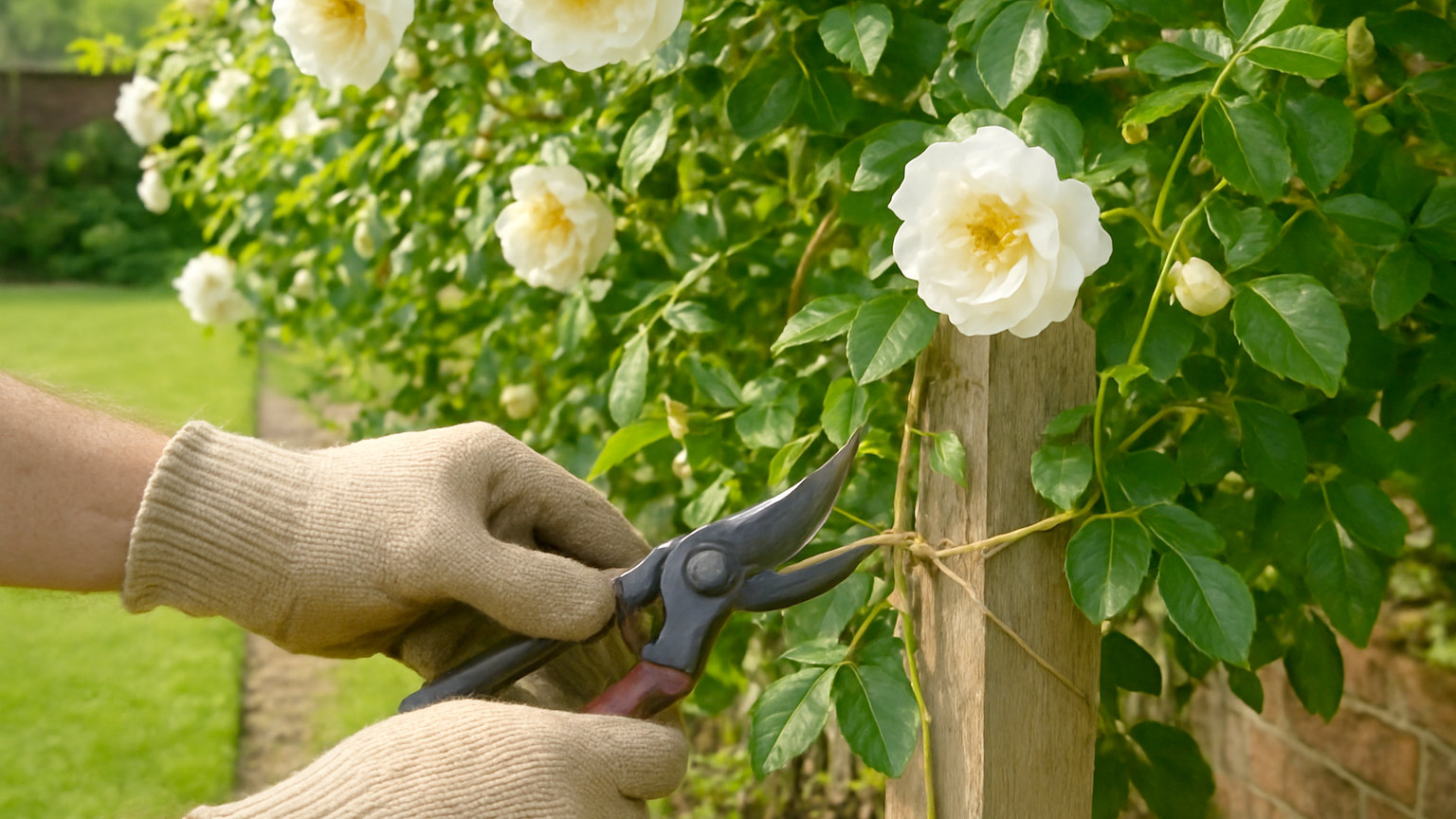
Prune immediately after flowering finishes, in late summer. Cut out a proportion of the stems that have just flowered, right down to the base, and tie in the vigorous new growth that has appeared, which will flower the following year.
On an established plant, removing about a third of the old stems each year keeps it renewed without a drastic overhaul.
A rambler grown informally into a tree needs no pruning at all beyond removing dead wood within reach, which is much of its appeal and the main argument for growing one that way.
Check the eventual size
This is where ramblers cause the most trouble. The vigour varies enormously between varieties and the labels do not always make it obvious.
Rosa filipes Kiftsgate is the extreme case, capable of reaching ten metres or more and swamping a mature tree. It is a magnificent plant in the right setting and a serious mistake on a garden fence.
Rambling Rector, Wedding Day and Paul's Himalayan Musk are all in the same very vigorous category.
For a fence, an arch or any modest structure, choose a more restrained variety. Albertine, Félicité Perpétue, Goldfinch and Malvern Hills are all manageable at three to five metres, and Malvern Hills is unusual among ramblers in repeat flowering.
Growing them into trees
This is what the large ramblers are for, and it is one of the finest things you can do in a garden.
Choose a sturdy mature tree, ideally an old apple or a similar spreading form, and one you do not mind losing the appearance of. Do not use a small or newly planted tree.
Plant the rose at least a metre from the trunk, on the side the prevailing weather comes from, and improve the ground generously since it will be competing with tree roots.
Train the initial growth up a rope or a stout cane angled towards the lowest branches. Once it reaches them it will find its own way.
Water and feed generously for the first three years while it establishes against the competition.
Other uses
Ramblers suit long pergolas, high walls, outbuildings, banks and anywhere they can be allowed to run. They also make excellent informal hedging, and the long flexible stems can be pegged down to root as ground cover on a bank.
They are less suited to a small garden, a single arch or a low fence, where a climber is almost always the better choice.
Health and hips
Many ramblers are notably healthy, particularly the species-derived ones, and need less attention to disease than modern bush roses.
Because they are not deadheaded, most produce a heavy crop of hips in autumn, which extends their season considerably and feeds birds through the winter months.
Thorns and access
Most ramblers are extremely thorny and the stems are long and whippy, which makes pruning at height genuinely hazardous. Wear gauntlets and a long-sleeved jacket, and use eye protection when working overhead.
Think about access before planting one. A rambler over a window, a gutter, a path or a door becomes a problem within three years, and anything requiring a ladder to prune is a job to plan carefully rather than tackle casually.


