
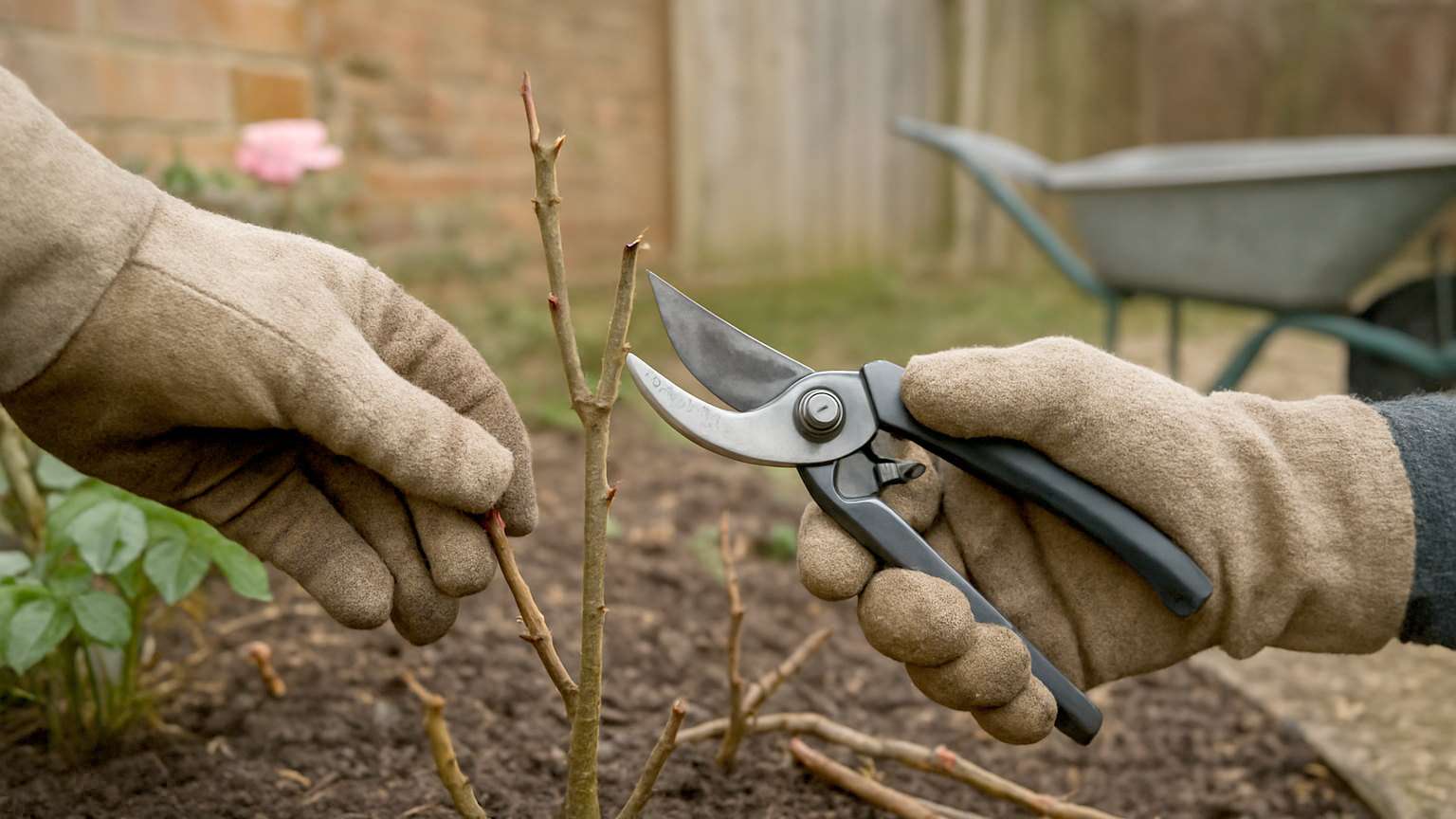
Rose pruning has a reputation for difficulty it does not deserve. Roses are extremely tolerant plants and a rough prune is far better than none. What genuinely matters is knowing which type you have, because ramblers and climbers are pruned at opposite ends of the year, and getting that wrong loses a season of flowers.
The three cuts that apply to everything
Whatever the type, start by removing the three Ds: dead wood, damaged wood and diseased wood. Then take out any stems crossing and rubbing, and anything thinner than a pencil, which will not support flowers.
Cut about five millimetres above an outward-facing bud, sloping the cut away from the bud so water runs off. Aim for an open goblet shape with air through the middle, which reduces blackspot and mildew considerably.
Use sharp, clean secateurs and a pruning saw for anything thick. Torn cuts from blunt blades invite disease.
Bush roses: hybrid tea and floribunda
Prune in late winter, from February into early March, when the worst frosts have passed but before growth is well away.
Hybrid teas, with one large flower per stem, are pruned hardest. Reduce the remaining healthy stems to about four or five buds from the base, roughly twenty centimetres. This produces fewer, larger blooms on strong new wood.
Floribundas, which flower in clusters, are pruned more moderately, to around six or eight buds, roughly thirty centimetres, which gives more flowers of a slightly smaller size.
In autumn, shorten very long stems by about a third on both types. This is not pruning proper; it stops wind rocking the plant loose over winter, which opens the roots to frost.
Shrub and old garden roses
These need much less. Many flower on older wood, so hard pruning removes the display.
Reduce the whole plant by about a third in late winter, removing a couple of the oldest stems at the base each year to encourage renewal. Once-flowering old varieties are better pruned lightly straight after they flower in summer.
Climbing roses
Prune in winter, between November and February. Climbers repeat-flower on side shoots from a permanent framework, so the framework is what you keep.
Tie the main stems in as horizontally as you can, because a horizontal stem produces flowering shoots along its whole length while a vertical one flowers only at the top. Then shorten the side shoots coming off that framework to two or three buds.
Remove one or two of the oldest main stems entirely every few years to bring new growth through from the base.
Rambling roses
This is where the timing matters most. Ramblers flower once, in early summer, on wood grown the previous year. Prune one in February and you cut off every flower it was going to produce.
Prune ramblers immediately after flowering, in late summer. Cut out a proportion of the stems that have just flowered, right to the base, and tie in the vigorous new growth that has appeared, which will flower next year.
If you are unsure whether a rose is a climber or a rambler, watch it for a season. Flowers once in June, usually in big trusses of small blooms, and grows enormously vigorously means rambler. Repeat flowering through summer on a more manageable frame means climber.
Ground cover and patio roses
Ground cover roses need little more than a trim to keep them in bounds and the removal of dead wood. Patio and miniature roses are pruned like small floribundas, reduced by about a third in late winter.
Suckers
Most roses are grafted, and shoots appearing from below the graft union are suckers from the rootstock. They usually have different foliage, often paler with seven leaflets rather than five.
Do not cut suckers off at ground level, which encourages more. Trace them back to where they emerge from the root and pull them off sharply, which removes the dormant buds with them.
Afterwards
Clear away all prunings and fallen leaves rather than leaving them beneath the plant, since blackspot overwinters on debris. Do not compost diseased material.
Mulch with well-rotted manure or compost in early spring, keeping it clear of the stems, and feed with a rose fertiliser as growth begins and again after the first flush of flowers.


