
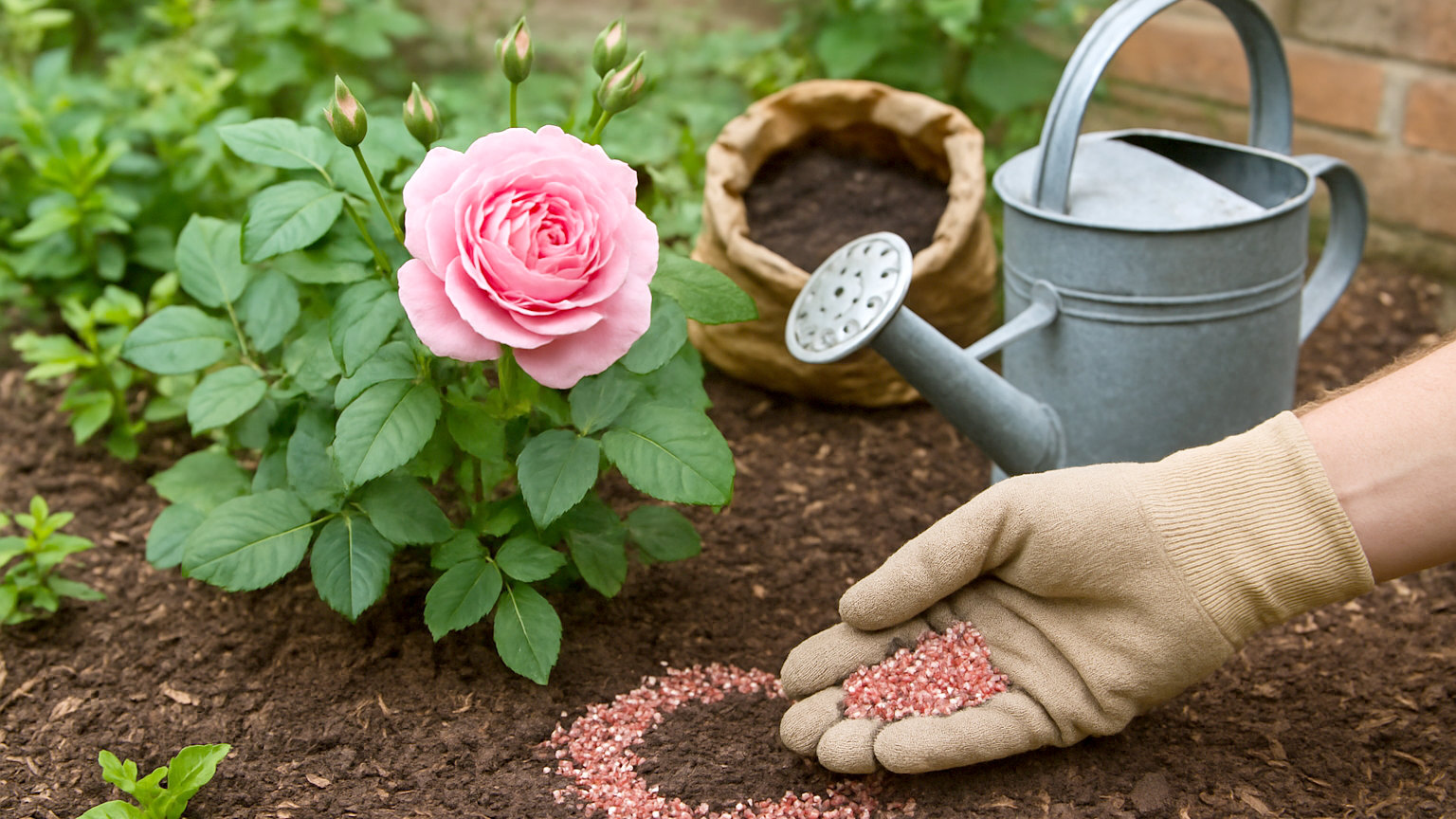
Roses are among the hungriest plants in a garden. They are producing a great deal of growth and repeat flushes of flowers across six months, and a fed rose looks obviously different from an unfed one by July.
The two feeds that matter
The first goes on in early spring, as growth begins, usually March or early April. Use a proprietary rose fertiliser, which is formulated with the right balance and usually contains magnesium.
Scatter it over the root area, not against the stems, and lightly work it into the surface. Water it in if rain is not expected.
The second goes on after the first flush of flowers finishes, usually late June or early July. This supports the second flush on repeat-flowering varieties, and it is the feed most often skipped.
Two applications is enough for most gardens. A third in early August is only worthwhile on very poor soil.
Stop by mid-August
Do not feed after about the middle of August. Late nitrogen produces soft new growth that has no time to harden before the frosts, and that growth is damaged by cold and admits dieback and canker.
If a rose needs support late in the season, use sulphate of potash rather than a general fertiliser, which toughens growth rather than pushing it.
Mulching does more than feeding
An annual mulch of well-rotted manure or garden compost is worth more to a rose than anything in a bag.
Apply five to seven centimetres in early spring after the first feed, over moist soil, keeping it a few centimetres clear of the stems themselves since material piled against bark causes rot.
It conserves moisture, suppresses weeds, feeds slowly all season and improves soil structure year on year. Roses do particularly well on heavy soil that has been mulched annually for a decade.
Well-rotted horse or farmyard manure is traditional and excellent. Mushroom compost is alkaline and better avoided on already chalky ground.
Magnesium shortage
Yellowing between the veins of older leaves, with the veins themselves staying green, is magnesium deficiency. It is common on light and sandy soils and after heavy rain.
Correct it with Epsom salts, magnesium sulphate, either as a foliar spray at about twenty grams per litre or as a soil drench. It works quickly and the improvement is visible within a fortnight.
Most proprietary rose feeds include magnesium, which is one reason they outperform general fertiliser.
Other shortages
Uniform pale yellowing with weak growth is nitrogen, and is corrected by the spring feed and mulch.
Brown scorching around leaf margins is potassium, corrected with sulphate of potash.
Yellowing between the veins on the youngest leaves is iron, and on chalky soil it means the pH is locking the iron up. Sequestered iron gives a short-term correction.
Watering
Roses are deep rooted and reasonably drought tolerant once established, but they flower far better with consistent moisture.
Water thoroughly and weekly in dry spells rather than lightly and often, aiming at the base rather than over the foliage, since wet leaves spread blackspot.
Newly planted roses need watching for their first two growing seasons regardless of rainfall.
Roses in containers
Container roses genuinely depend on feeding, since the compost is exhausted within about six weeks.
Feed fortnightly through the growing season with a liquid rose or tomato feed, and top dress each spring by replacing the top five centimetres of compost with fresh, mixed with slow-release fertiliser.
What not to do
Do not feed a newly planted rose in its first few weeks, and do not feed a plant that is struggling from drought, waterlogging or root damage. Fertiliser makes those worse rather than better.
Do not apply lawn feed near roses, since the high nitrogen produces leaf at the expense of flowers and softens the plant against disease.
Coffee grounds, banana skins and the rest
A great deal is written about household materials as rose feeds. Coffee grounds add a little organic matter and very little else, and banana skins release potassium extremely slowly as they rot.
Neither does harm in moderation and neither substitutes for a proper feed and a mulch. Adding them to the compost heap and mulching with the result is a more effective use of both.


