
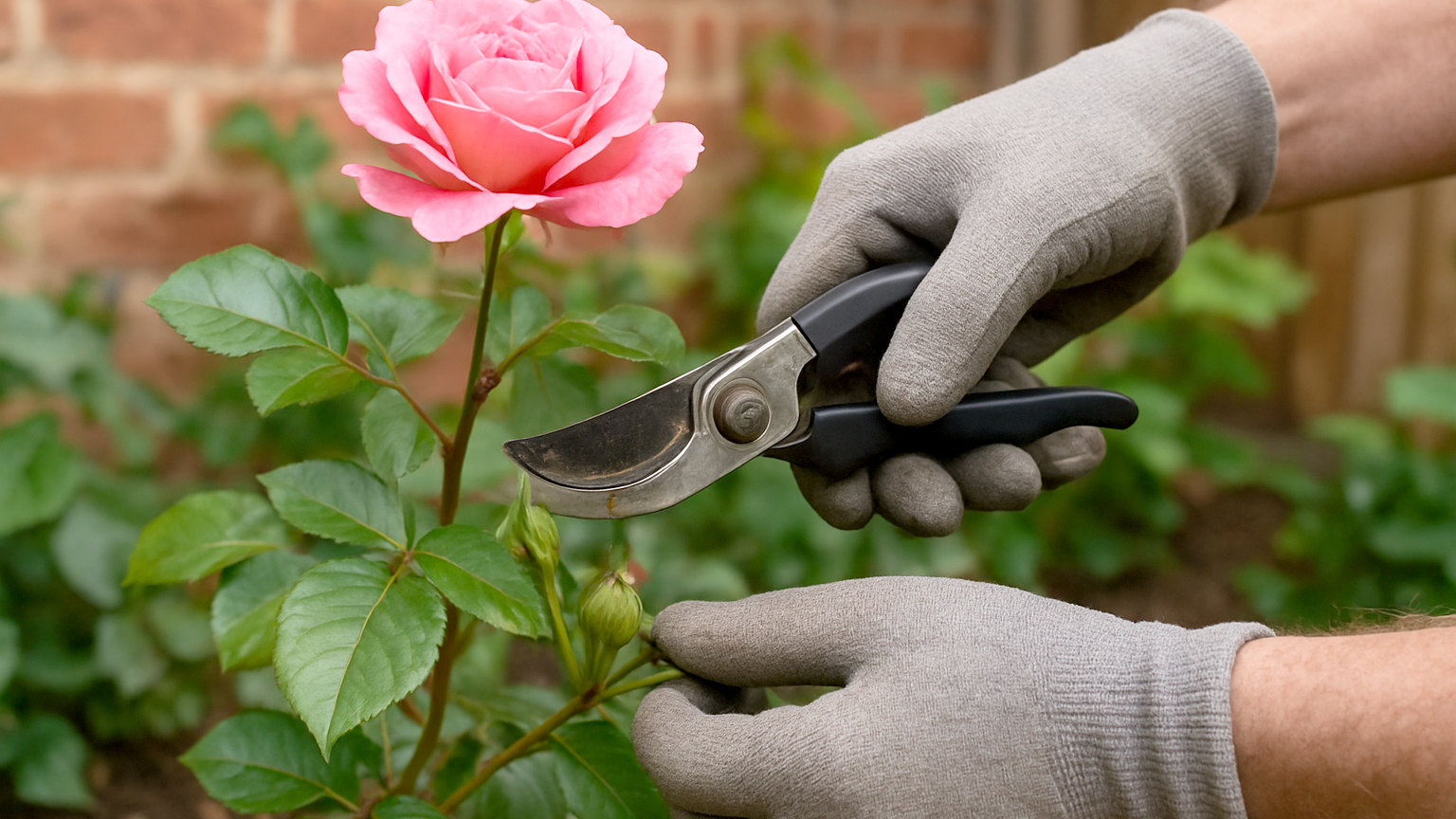
Deadheading a repeat-flowering rose is what produces the second and third flushes. Done properly it extends flowering from a fortnight in June to a season running into November.
Why it works
A rose flowers in order to set seed. Once hips begin forming, the plant considers the job done and slows or stops producing new flowers.
Removing the spent bloom before the hip develops keeps the plant trying, and it redirects energy from seed production into new growth and buds.
Where to cut
Do not simply snap the dead head off. That leaves a bare stalk that dies back, and the new shoot that follows is often weak.
Cut back to a strong outward-facing bud, which usually means going down the stem to the first or second leaf with five leaflets. The small three-leaflet leaves near the flower produce weaker shoots.
Make the cut about five millimetres above the bud, sloping away from it so water runs off.
Cutting a little further down than feels necessary produces a stronger stem and a better flower next time, at the cost of a few days' delay.
Which roses to deadhead
Repeat-flowering roses, meaning most hybrid teas, floribundas, modern shrub and English roses, patio roses and repeat-flowering climbers. These are the ones where deadheading makes a real difference.
Once-flowering roses, including most ramblers, species roses and many old garden roses, produce one flush and will not repeat however you treat them. Deadheading these is optional and often counterproductive, since it removes the hips.
If you are unsure, watch the plant for a season. A rose still producing new buds in August is a repeat flowerer.
Doing it efficiently
Go over the plants every few days through the season rather than tackling it as a monthly job. Little and often is quicker in total and keeps the plant producing continuously.
Carry a bucket and secateurs, and drop the spent heads straight in rather than onto the soil beneath, where fallen material harbours blackspot.
On floribundas and cluster-flowered roses, remove individual spent blooms from the truss as they fade, then cut the whole truss back once most of it has gone over.
Stop in autumn
Stop deadheading around the end of September or early October.
Two reasons. Letting hips form signals the plant to stop producing soft new growth, which would be damaged by frost. And the hips themselves are worth having.
Rose hips provide colour through autumn and winter and are eaten by birds when little else is available. On species roses and ramblers they can be the best thing the plant does.
Autumn shortening
In November, shorten any very long stems on bush roses by about a third. This is not pruning proper, which happens in late winter.
The purpose is to stop wind rocking the plant loose in the ground over winter, which opens the roots to frost and can loosen a plant badly.
What deadheading will not fix
A rose that has stopped flowering because it is in too much shade, is short of water, is being overfed with nitrogen or is a once-flowering variety will not respond.
Check those before assuming more deadheading is the answer. A rose needs at least four to six hours of sun to flower well.
Cutting for the vase
Cutting roses for the house is deadheading in advance, and it has the same effect on the plant.
Cut in the early morning, above a five-leaflet leaf as you would when deadheading, and put the stems straight into water. Take no more than about a third of the plant at once, so the remainder can keep the plant fed.
The first year
On a newly planted rose, some growers remove the first few flower buds entirely to push energy into establishing roots and framework.
It is a genuine trade rather than a rule. A rose allowed to flower in its first summer will still establish perfectly well; one that is disbudded builds a stronger plant and rewards you from the second year onwards.
Blind shoots
A stem that grows strongly and produces no bud at the tip is a blind shoot, usually caused by a cold spring or by damage to the growing point.
Cut it back by about half to a strong bud and it will normally produce a flowering shoot within a few weeks.


