
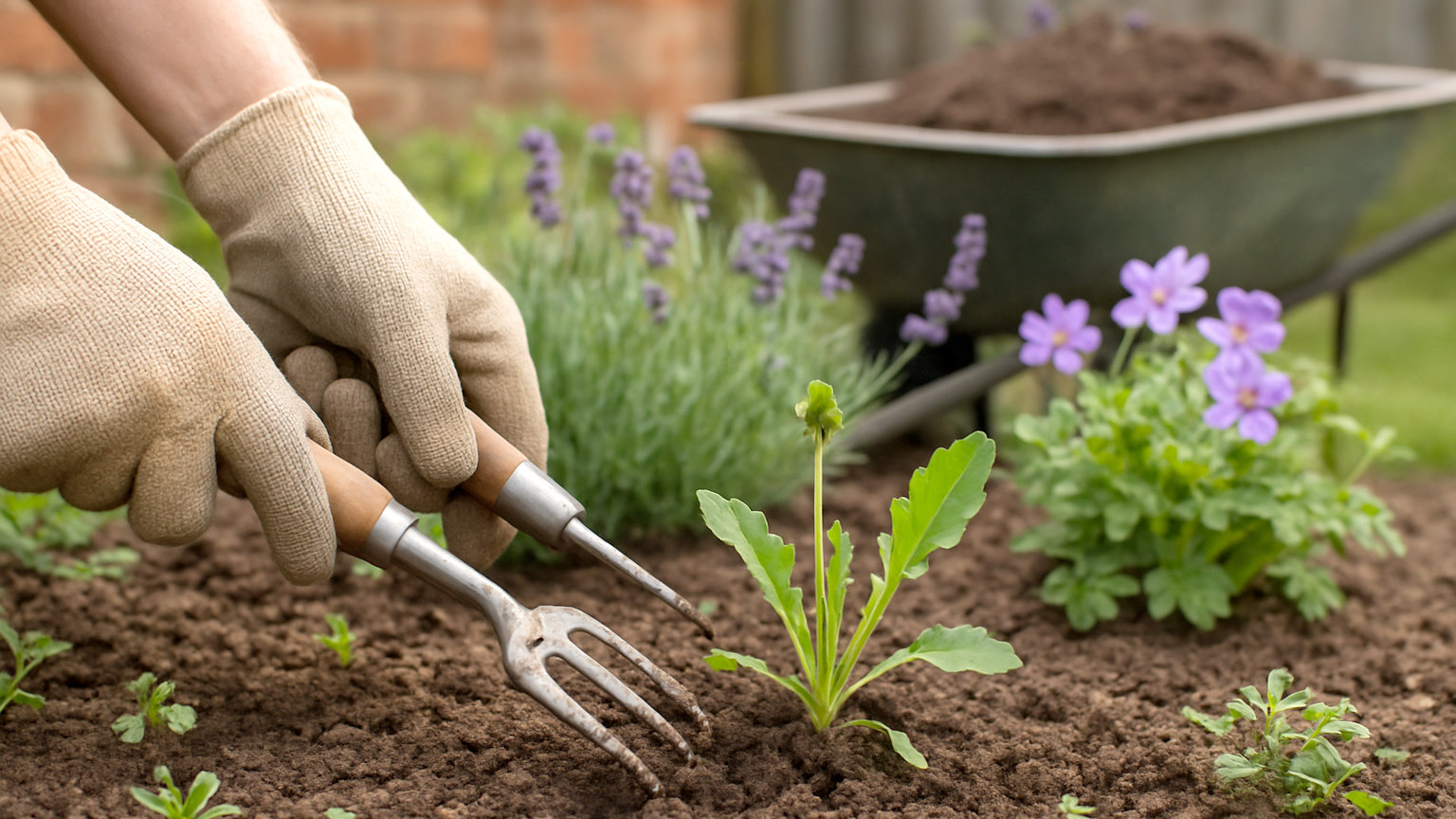
Weeding is far easier once you separate weeds into two groups. Annual weeds are dealt with in minutes and perennial ones take seasons, and the mistake is treating them the same way.
Annual weeds
Chickweed, groundsel, hairy bittercress, annual meadow grass, fat hen and speedwell. They germinate, flower, set seed and die within a season.
They are individually trivial and collectively relentless, because they produce enormous quantities of seed. Hairy bittercress fires its seed several feet when touched.
The rule is to get them before they seed. One season's seeding produces seven years' weeding, and the saying is close to accurate.
Hoe them off on a dry sunny day, cutting just below the surface. They wither within hours and can be left where they fall.
Hoe when they are tiny, before you can properly identify them. Weeding a bed of established annual weeds takes ten times as long as hoeing the same bed a fortnight earlier.
Perennial weeds
Bindweed, ground elder, couch grass, dock, dandelion, creeping buttercup and horsetail. These persist from year to year and regrow from roots.
Hoeing does not touch them. Cutting the tops off simply prunes them, and many regenerate from the smallest root fragment.
Never rotavate ground containing perennial weeds, which chops the roots into hundreds of pieces and plants every one.
The options are digging out every fragment with a fork, working slowly and repeatedly, or excluding light with heavy sheeting or thick cardboard and mulch for a full growing season.
Both work with persistence. Every regrowth is a fragment you missed, and removing each one as it appears steadily exhausts the reserves.
Clear before you plant
This is the single most useful piece of advice about weeds. Perennial weeds growing up through an established clump of perennials cannot realistically be removed without lifting everything.
Clear the ground completely before planting, even if it costs a season. A border planted over bindweed is a permanent battle.
Mulching
A mulch of five to seven centimetres suppresses annual weed seedlings by excluding light, and it is the most effective long-term control there is.
It does nothing to established perennial weeds, which push straight through, so clear those first.
Weed seed also blows onto the surface of a mulch and germinates in it, so occasional weeding continues. The advantage is that seedlings in loose mulch pull out with two fingers.
Ground cover
Dense planting is the other long-term answer. Weeds establish in gaps, and a border where the plants have knitted together leaves nowhere for a seedling to germinate.
This is one of the few arguments for closer spacing, and it works better with ground cover plants than with anything else.
Hand weeding
For anything with a taproot, and for weeds growing among plants where a hoe cannot be used safely.
Do it when the soil is damp, ideally after rain, so roots come out whole. Use a long-bladed weeding knife for dandelions and docks, working down alongside the root.
Any fragment of dandelion or dock root left behind will regrow, so get the full length.
Weedkillers
If you use one, read the label and follow it, since it is a legal document rather than guidance.
Systemic products are absorbed by the leaves and moved to the roots, which is what makes them effective against deep-rooted perennials. Apply when the plant is growing strongly with plenty of leaf.
Never apply near a pond, watercourse or drain. Do not spray in wind, since drift kills what you wanted to keep. Observe any interval before replanting or before children and pets use the area.
Composting weeds
Annual weeds without seedheads can go on the heap. Anything in seed, and all perennial weed roots, should go in the council green bin, since a home heap rarely gets hot enough to kill either.
What weeds tell you
The weeds you get describe the conditions. Creeping buttercup and moss indicate compaction and poor drainage. Nettles and fat hen indicate rich fertile soil. Horsetail indicates poor drainage and is almost impossible to eliminate.
Fixing the underlying condition is often more useful than repeatedly removing the symptom.
Leaving some
Not every weed needs removing. Dandelions, clover and self-heal in a lawn are among the most valuable nectar sources most gardens have, and a corner left uncultivated supports a great deal.


