
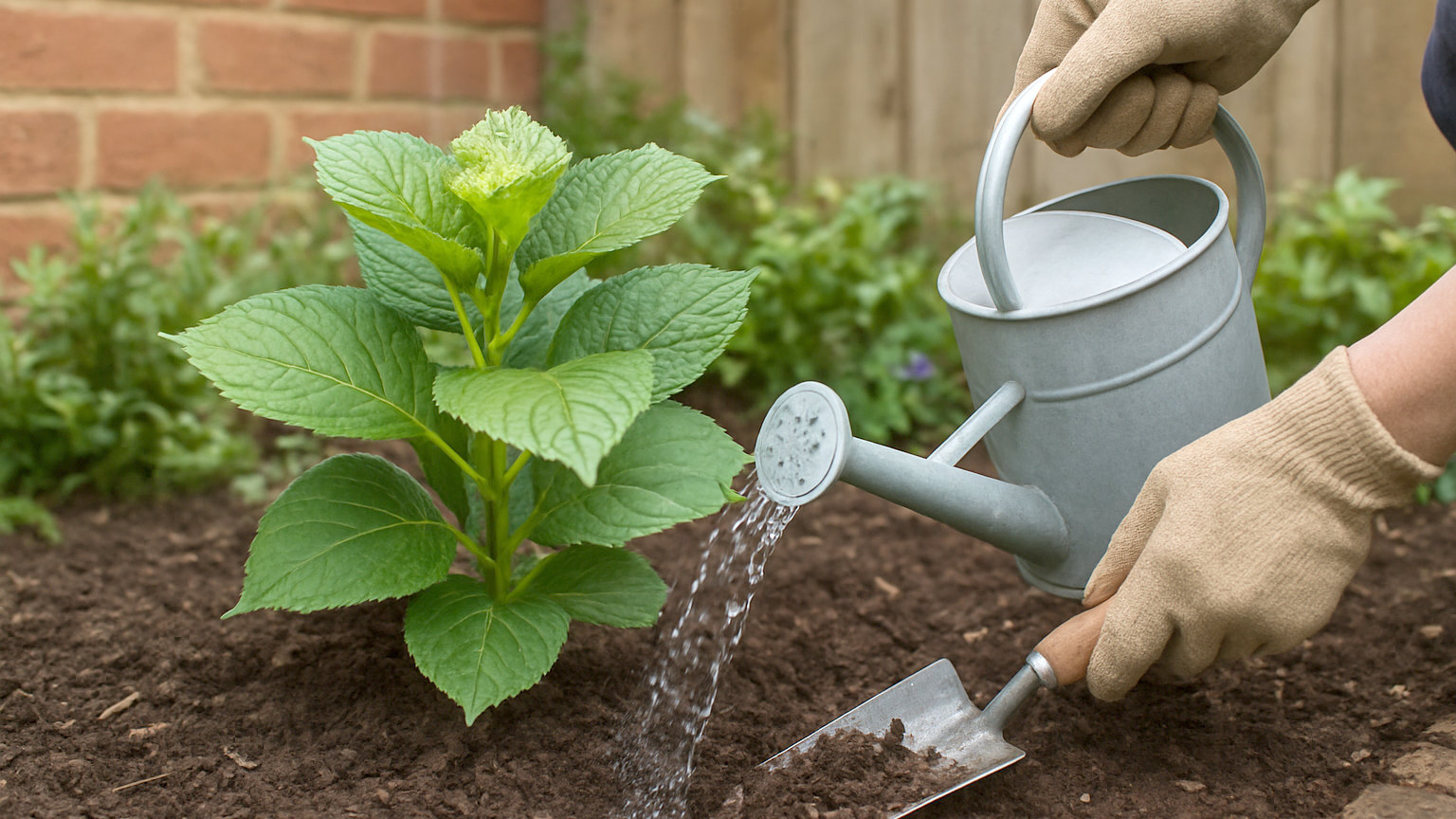
More new plants are lost to poor watering than to anything else, and usually not through neglect. They are lost because someone watered them a little every day, which wets the top few centimetres, encourages roots to stay near the surface, and leaves the plant helpless the first time a hot week arrives.
Soak, do not sprinkle
One thorough soak a week does more good than a light watering every day. Deep watering draws roots downwards into soil that stays moist for longer, and a deep-rooted plant looks after itself far sooner.
Frequent shallow watering does the reverse. Roots concentrate in the top few centimetres, which is exactly the layer that dries first, so the plant becomes permanently dependent on the next watering.
As a rough guide, a newly planted shrub wants ten to twenty litres at a time, which is one or two full watering cans. A new tree wants twenty to forty. Deliver it slowly so it soaks in rather than running off.
How long to keep it up
Two full growing seasons is the working answer for trees and shrubs, and one for perennials.
Autumn-planted stock needs less in its first months because the ground is wet and growth is slow, but it still needs watching from the following April. Spring and summer planting needs attention from the moment it goes in.
Do not assume rain has done the job. A summer shower that wets the surface often delivers very little to a rootball fifteen centimetres down, particularly under a tree canopy or against a wall.
Where to put the water
Aim at the base of the plant and over the original rootball, not across a wide area of surrounding soil. In the first year the roots are still largely within the rootball, and water spread widely mostly feeds the weeds.
A shallow saucer-shaped depression around the plant holds water while it soaks in. On slopes or very free-draining ground, a length of pipe pushed in beside the rootball at planting delivers water straight to depth.
Checking whether it worked
Push a finger, or better a trowel, into the soil beside the rootball to a depth of ten centimetres. If it is dry down there, the watering is not reaching the roots however wet the surface looks.
Do this a few times in the first weeks and you will quickly calibrate how much water your soil actually needs, which varies enormously between sand and clay.
When to water
Early morning is best, since the plant has the whole day to use it and foliage dries quickly. Evening is second best, though wet foliage overnight encourages mildew and gives slugs a comfortable time of it.
Avoid the middle of a hot day, when much of it evaporates before reaching the roots.
Signs of too much and too little
Both look similar, which catches people out. Wilting, yellowing leaves and general collapse occur in waterlogged soil as well as dry soil, because roots deprived of oxygen cannot take up water.
The way to tell them apart is to feel the soil. Dry and dusty means water. Wet and sour-smelling means stop watering and improve drainage. Persistent waterlogging kills more plants on clay than drought does.
Mulch does half the work
Five to seven centimetres of compost or bark over damp soil dramatically reduces evaporation and keeps roots cooler. Mulch after watering, never onto dry ground, and keep it clear of the stems.
Keeping a circle around new plants free of grass and weeds matters as much as watering, since grass takes water aggressively and is the reason many young trees grow slowly for years.
Containers are a different case
Everything above concerns plants in open ground. A plant in a pot has no reserve to draw on and may need water daily in summer, or twice daily in a heatwave, whatever its age. The weekly soak rule does not apply, and the finger test in the top few centimetres is the reliable guide.
Getting through a hosepipe ban
Newly planted stock is what to prioritise if water is restricted. Established plants can generally look after themselves for a season; a first-year shrub cannot.
Water butts on every downpipe are worth installing, and household grey water from washing up or a bath is fine on ornamentals if it is free of bleach and strong detergent. Use it promptly rather than storing it.


