
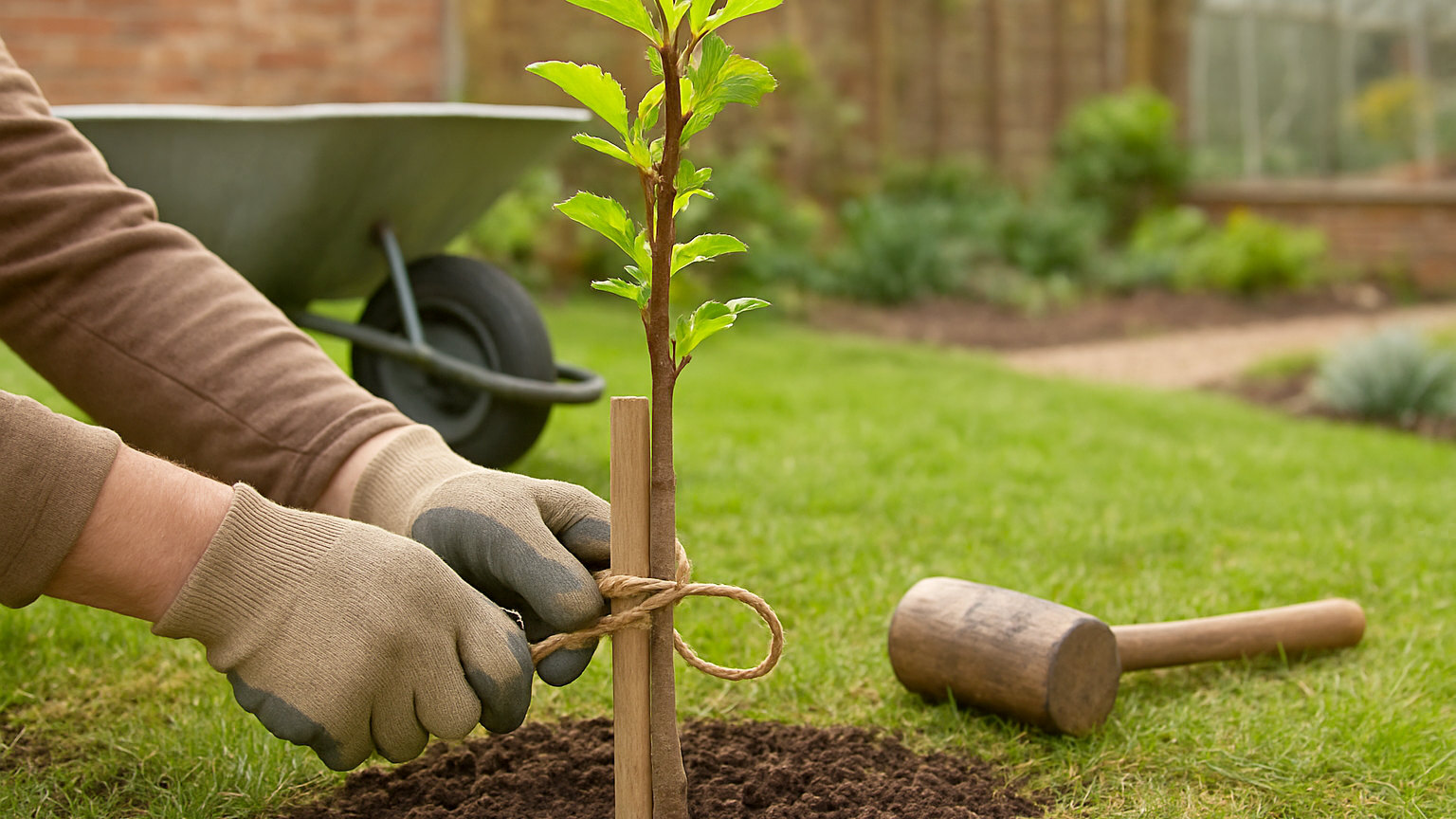
Staking is one of the few garden jobs where doing more is actively harmful. A tree tied firmly to a tall stake grows a weak trunk and frequently snaps the moment the support is removed.
What a stake is for
The purpose is to hold the roots steady while they establish, not to hold the tree upright.
A young tree needs to move in the wind. That flexing triggers the trunk to thicken and strengthen, which is how a tree builds the ability to support itself.
Prevent the movement and the trunk never develops that strength. A tree staked high and tight for five years has a thin weak trunk and falls over when untied.
Low and short
The stake should reach no more than about a third of the way up the trunk, and often less. It should be driven at least sixty centimetres into the ground so it is genuinely firm.
The tie goes near the top of the stake, low on the trunk. The head of the tree is left completely free to move.
This looks inadequate and is correct. The roots are held, the top flexes, and the trunk thickens.
Angled or vertical
A short vertical stake driven in before planting, on the side of the prevailing wind, works well and is the simplest arrangement.
An angled stake driven in at about forty-five degrees, crossing the trunk low down, is useful where the tree is already planted and you do not want to spear the rootball. Angle it into the prevailing wind.
Two stakes with a crossbar suit larger trees and root-balled stock, spreading the load and keeping the stakes clear of the rootball entirely.
Ties
Use a proper adjustable tree tie with a spacer that holds the trunk clear of the stake, so the two cannot rub.
Never use wire, string or anything that will cut in. A tie left unchecked will girdle a trunk and kill the tree above it, which is a slow and entirely avoidable death.
Check ties every six months and loosen them as the trunk thickens. This is the single most neglected aftercare job in gardens.
When to remove the stake
Most trees need staking for two or three years only, by which point the roots are anchored.
Test by loosening the tie and pushing the trunk gently. If the base stays firm in the ground and only the top moves, the stake can come out.
Remove it entirely rather than leaving it in place, and fill the hole. A redundant stake chafes the trunk and encourages the tree to keep depending on it.
The exception is fruit trees on very dwarfing rootstocks such as M27 and M9, which have weak root systems and need staking permanently.
When staking is not needed
Most shrubs do not need staking at all, and are better without it.
Small trees, whips and anything under about a metre and a half generally establish perfectly well unsupported, and flex their way into strength.
Staking is worth doing for anything tall and top-heavy, for trees in exposed positions, for bare-root stock in its first year, and for anything with a large head relative to its root system.
Wind rock
The problem staking is meant to prevent. Wind rocking a newly planted tree opens a hollow around the base, which fills with water and freezes, damaging the roots.
Check after gales and refirm the soil around the base of anything that has loosened.
Shortening long stems on tall shrubs and roses by about a third in November reduces wind rock without any staking at all, and is standard practice on bush roses.
Alternatives
Underground guying systems anchor the rootball without any visible stake, which suits specimen trees in prominent positions. They cost more and are worth it where appearance matters.
For a shrub in an exposed position, a temporary windbreak of mesh on stakes for the first winter is often more useful than staking the plant itself.
Materials
Use a treated softwood stake of a decent thickness rather than a thin cane, which snaps. Drive it in before planting where possible, on the side the prevailing wind comes from, so it is not driven through the rootball afterwards.


