
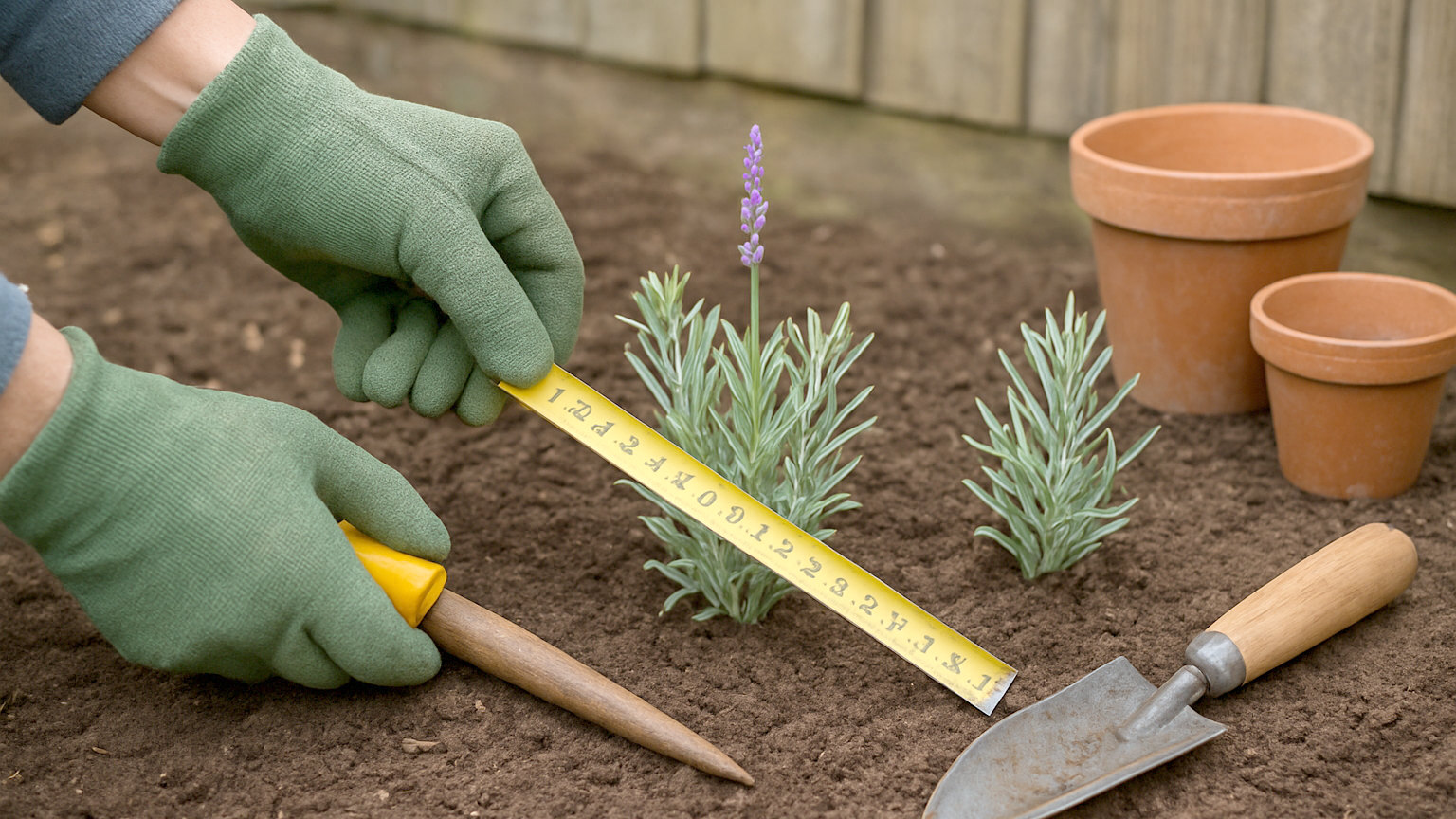
Spacing is where a new planting is decided. Set plants at their mature spread and the border looks sparse for two years and right for the next ten. Set them close and it looks good for two years and becomes a fight thereafter.
Work from the mature spread
The label gives an eventual height and spread. The spread is the number to plan from, not the size of the plant in the pot.
For two plants side by side, the spacing between them is roughly the average of their two mature spreads. Two shrubs each reaching a metre wide go a metre apart, centre to centre.
Be sceptical of vague labels. Specialist nurseries state eventual size honestly; general retail often does not, and the same variety name can cover plants of very different vigour.
Rough densities
- Herbaceous perennials - three to seven per square metre depending on size
- Ground cover - five to nine per square metre for reasonably quick coverage
- Small shrubs - sixty centimetres to a metre apart
- Medium shrubs - one to two metres apart
- Bedding - fifteen to thirty centimetres, following the packet
- Hedging - three per metre in a single row, five per metre in a staggered double row
Why overplanting fails
Plants set too close compete for light, water and nutrients. Growth becomes drawn and weak, airflow drops so mildew and blackspot increase, and within three years you are removing plants or watching the vigorous ones smother the rest.
The plants that suffer most are usually the ones you paid most for, since the cheap vigorous fillers win.
Thinning a congested border later is harder than it sounds, because by then the plants have grown into one another and removing one damages its neighbours.
Plant in odd-numbered groups
Three, five or seven of one plant reads as a block of colour and texture. A single plant disappears.
Odd numbers work because they do not resolve into obvious pairs, so the group looks natural rather than arranged. Above about seven the number stops mattering.
Plant in elongated drifts running through the border rather than circular clumps, so the groups interlock.
This means buying fewer varieties in larger quantities, which is usually cheaper and always more effective than one each of many.
Repetition
Repeating two or three plants at intervals along a border ties the whole thing together and is the single technique that most distinguishes a designed planting from an accumulated one.
Budget for it. A border with five varieties repeated looks considered; the same money spent on twenty varieties looks like a collection.
Filling the gaps meanwhile
There is no need to look at bare soil for two years.
Annuals sown in the spaces give a full border in the first summer and disappear afterwards. Cosmos, nigella, calendula and cornflower cost very little.
Bulbs occupy space that later perennials will fill, flowering and dying back before the gap closes.
Temporary containers dropped into the spaces work well and can be moved as the planting fills in.
Mulching bare soil between plants suppresses weeds, retains moisture and looks far better than bare earth while you wait.
Calculating what to buy
Measure the bed and sketch it to scale. Draw the plants as circles at their mature spread, which shows immediately how many will fit.
This is quicker than it sounds and prevents the usual pattern of buying whatever looks good at the garden centre and then finding room for it afterwards.
It also gives you a shopping list, which stops the impulse purchases that leave a border with one of everything.
Order structure plants first, then the perennials to fill between them, and finally the bulbs and annuals that will occupy the gaps in the early years.
Where closer planting is right
Containers, where the compost is refreshed and the display is temporary. Bedding, which is replaced twice a year. Ground cover intended to knit together quickly. And cut-flower rows, where the plants are picked hard rather than displayed.
Distance from walls and hedges
Plant at least forty-five centimetres out from a wall, since the ground immediately against one is dry and often full of rubble.
Leave a similar gap in front of a hedge, which competes aggressively for water and nutrients and will out-compete anything planted tight against it.


