
Every garden has a corner that defeats things. The reliable approach is almost always to plant for the conditions rather than to change them, since soil and aspect reassert themselves within a few years whatever you do.
Dry shade
The hardest condition, found under mature trees and along the base of walls. The difficulty is rarely the darkness; it is that established roots take every drop of moisture first.
Plant epimedium, hardy geraniums such as macrorrhizum and phaeum, bergenia, lamium, pulmonaria, Euphorbia amygdaloides var. robbiae, and dryopteris ferns.
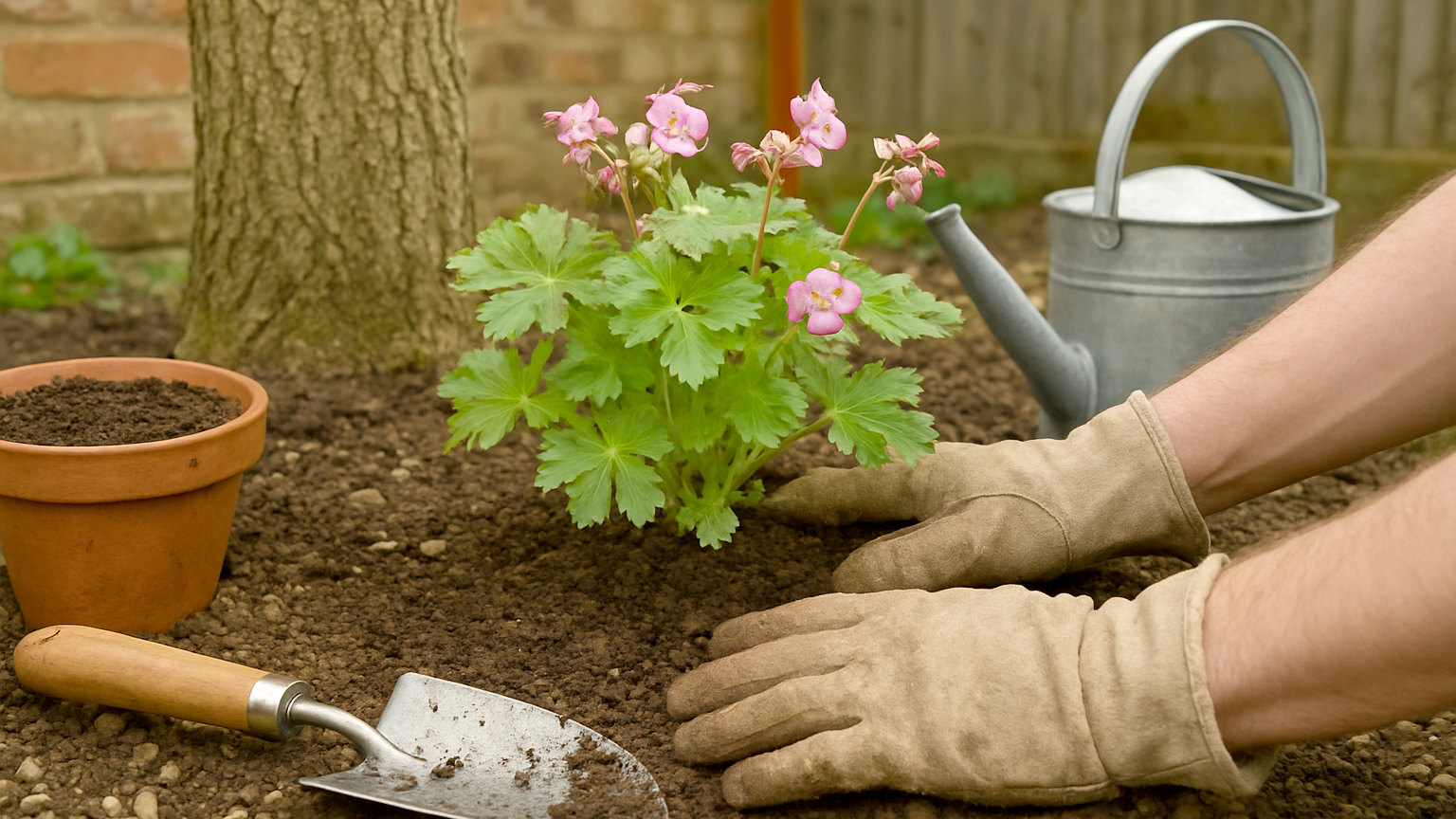
Do not dig over the area under a mature tree, which damages the tree and is heavy work. Plant into gaps between roots with compost added to each pocket, and mulch the whole area with leaf mould every autumn.
Water thoroughly through the first two seasons. A new plant competing with a mature tree will otherwise simply lose.
Waterlogged ground
Where water stands for days after rain, drainage work is expensive and often only partly effective.
The alternative is to plant for it. Ligularia, rodgersia, filipendula, astilbe, hostas, primula and iris ensata all thrive in damp ground. Willows, alders and dogwoods among shrubs.
Where planting must happen in wet ground, a raised bed or a planting mound lifts the roots above the problem, which is far cheaper than draining the site.
Chalk and alkaline soil
Free-draining, often shallow over rock, low in nutrients and high in pH, which locks up iron and manganese.
Many excellent plants suit it: clematis, lilac, buddleja, hellebores, dianthus, scabious, verbascum, and most Mediterranean herbs.
Do not attempt to grow acid-lovers on chalk. Rhododendrons, camellias, pieris and blueberries yellow steadily and decline. Grow them in containers of ericaceous compost watered with rainwater.
Add organic matter generously, since chalk soils are usually thin and hungry.
Sandy soil
Easy to work, warms early, and loses water and nutrients almost as fast as you supply them.
Add organic matter repeatedly, mulch heavily, and feed little and often rather than in large doses that wash straight through.
It suits Mediterranean planting, bulbs, root vegetables and anything that resents winter wet.
Coastal gardens
Salt-laden wind is the limiting factor rather than cold, since coastal areas are usually milder.
Plant escallonia, griselinia, elaeagnus, hebe, tamarisk, rosa rugosa, eryngium, sea buckthorn and ornamental grasses. Many have tough, waxy, silver or leathery leaves, which is the adaptation to look for.
Establish a windbreak first and plant behind it. A tough outer hedge of escallonia or griselinia makes everything inside it possible.
Exposed and windy sites
Wind does more damage than most people credit, scorching foliage, breaking stems and dramatically increasing water loss.
Filter wind rather than blocking it. A solid fence or wall creates damaging turbulence on the sheltered side, sometimes worse than the open wind. A hedge or an open-slatted screen slows the wind through it and gives real shelter for a distance of several times its height.
Plant small rather than large, since small plants establish better and are less battered, and stake anything that needs it.
Frost pockets
Cold air flows downhill and collects at the bottom of a slope or behind a solid barrier, producing a pocket several degrees colder than the surrounding garden.
Avoid planting early-flowering fruit and tender plants there. Where a hedge or fence at the bottom of a slope is trapping the cold, opening a gap lets it drain away.
The general principle
Observe the site through a full year before making decisions. Note where water stands, where wind funnels, where frost lingers and where shade falls in different months.
Then choose plants that want those conditions. A plant suited to its position needs almost no help; one fighting its position needs help forever.
Where improvement is worth it
Some things are worth changing. Adding organic matter improves every soil type and is always worthwhile. Clearing perennial weeds is essential. Relieving compaction and improving drainage in a small area is achievable.
What is rarely worth attempting is changing pH across a whole garden, draining a genuinely wet site cheaply, or creating shade-free conditions beneath a mature tree.
In each of those cases, containers and careful plant selection achieve far more for far less than any amount of earthworks or soil amendment would.


