
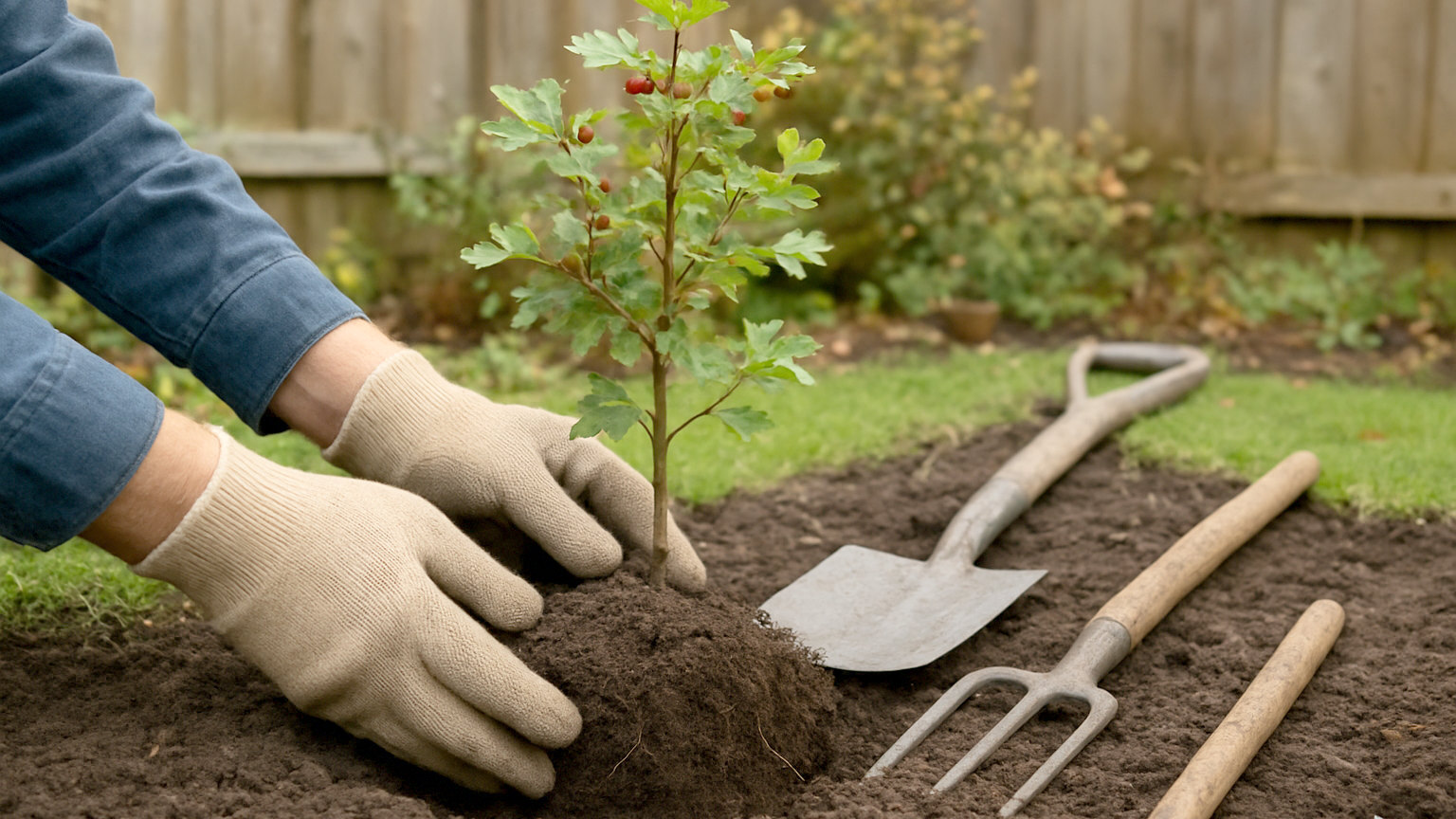
Trees are the longest-lived thing most people plant and the decisions take effect for decades. The planting itself takes half an hour, and almost all of what matters is decided before the spade comes out.
Check before you dig
Consider the eventual height and spread, not the size in the pot. A tree that fits now may overhang a neighbour, block light or reach a building in twenty years.
As a general guide, keep trees well away from buildings, drains and boundaries, and check the eventual spread against the distance available. On shrinkable clay soils, tree roots can affect building foundations, and professional advice is worth taking near a house.
Check for underground services before digging, and look up for overhead cables.
If there is any chance the site is covered by a Tree Preservation Order or lies in a conservation area, that affects existing trees rather than new planting, but it is worth knowing the position before removing anything to make space.
When to plant
Bare-root trees are planted between November and March while dormant, and they are cheaper, offer more choice and establish better.
Container-grown trees can go in whenever the ground is not frozen or waterlogged, though autumn and spring are far better than summer.
Autumn planting on free-draining soil gives the longest establishment period. Spring is safer on cold wet clay.
Dig a wide shallow hole
Make it square rather than round, and considerably wider than it is deep. Roots meeting the smooth curve of a round hole tend to follow it round; the corners of a square hole guide them outwards.
Aim for around three times the width of the rootball and no deeper than the rootball itself.
Fork the sides and base to break up any smooth compacted surface, particularly on clay, where a glazed hole acts as a sump.
Do not enrich the hole
Backfill with the soil you dug out, improved with no more than about a quarter compost.
A hole filled with rich compost creates a pot in the ground. The roots stay in the comfortable material and never venture into the surrounding soil, leaving a tree that is small, unstable and permanently dependent on watering.
Planting depth and the root flare
The root flare, where the trunk widens into the roots, must remain visible at the surface. Planting too deep is the commonest fatal error with trees and it kills slowly, over several years.
On container-grown stock the flare is sometimes buried in the pot, so scrape the compost back until you find it and plant to that level rather than to the top of the rootball.
Lay a cane across the hole to check the level before backfilling.
Roots
Tease out any circling roots on a container-grown tree, and cut through the outer layer in three or four places if they are tightly matted. Roots left circling continue to circle.
On bare-root stock, spread the roots out and downwards, and trim any damaged ones back to clean tissue.
Backfill, firm and water
Fill in stages, working soil around the roots and firming gently with your heel to remove air pockets without compacting the ground to concrete.
Water in thoroughly, even in winter, which settles the soil into contact with the roots.
Stake low and short
Use a short stake reaching about a third of the way up the trunk, with a proper adjustable tie. The top of the tree must be free to flex, since that is what thickens the trunk.
Check the tie every six months and loosen it as the trunk grows. Remove the stake after two or three years.
Mulch and keep grass off
Mulch a circle at least a metre across, keeping it a few centimetres clear of the trunk.
Keep that circle free of grass for the first four or five years. Grass competes aggressively for water and nitrogen and is a major reason young trees grow slowly.
It also keeps mowers and strimmers away from the bark, and damage at the base is frequently fatal.
Water for two years
Twenty to forty litres at a time, weekly through dry spells in the first two growing seasons. A daily sprinkle achieves nothing at all.
A watering bag or a length of pipe sunk beside the rootball at planting delivers water straight to depth and is worth fitting on anything valuable.


