
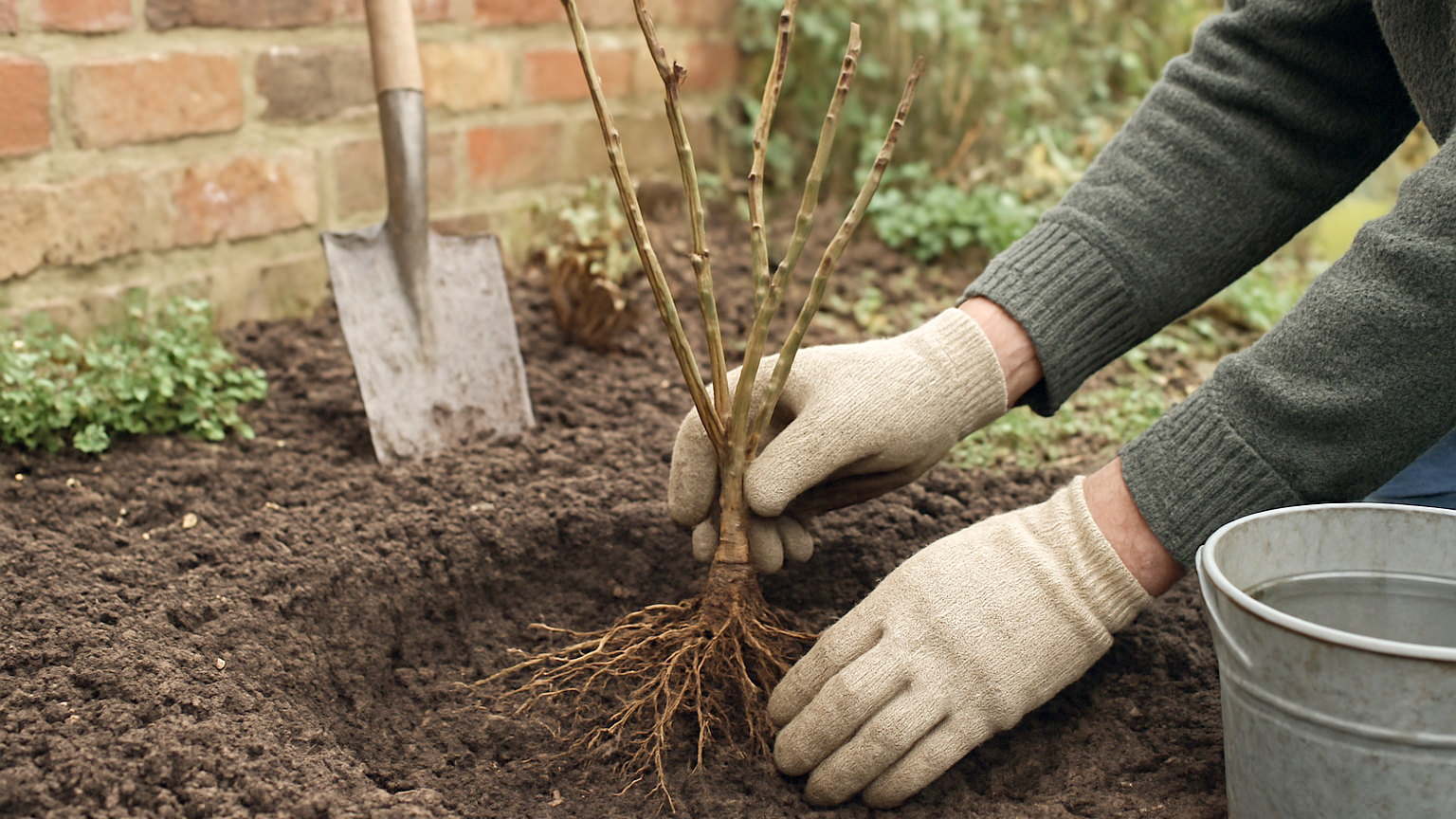
Bare-root plants are lifted from the field while dormant and sold without any soil. They cost a fraction of the container-grown equivalent, the range available is far wider, and they generally establish better. The one requirement is that the roots must never dry out.
The season
Bare-root stock is available from November to March, while plants are fully dormant and have no leaves to support.
Order early, since good nurseries sell out of popular varieties by December. Delivery is usually timed to when you want to plant.
Nothing is available bare root in summer, so if you are planting in June the choice is container-grown.
Why it establishes better
A bare-root plant sends its roots directly into your soil from the day it goes in.
A container-grown plant arrives with a rootball shaped by the pot, often with roots circling the outside, and it has to be persuaded to grow out of that shape into the surrounding ground. Many never fully do.
Bare-root plants also spend the whole winter making roots before they have to support any leaves, which is exactly the right order.
What is available
Roses, fruit trees, ornamental trees, hedging, soft fruit bushes, and a good range of shrubs and perennials.
Hedging in particular is transformed by buying bare root. A metre of native hedging whips costs less than a single potted shrub.
The roots must not dry out
This is the whole of the difficulty and the whole of the risk. Fine roots die within minutes of being exposed to sun or wind, and a plant whose roots have dried will not recover.
Open the package as soon as it arrives and check the roots are moist. Keep them covered at all times, in the bag, under damp sacking or in a bucket of damp compost.
Carry plants to the planting hole covered, and plant one at a time rather than laying a row out on the ground while you dig.
Heeling in
If you cannot plant immediately, heel them in. Dig a shallow trench in a spare corner, lay the plants in at an angle, cover the roots with soil and firm gently.
They will keep like this for weeks, and considerably longer if necessary. It is far better than leaving them in a bag in a shed.
Alternatively, plunge the roots into a bucket or tub of damp compost.
Do not plant into frozen or waterlogged ground. Heel in and wait for conditions to improve.
Preparing to plant
Soak the roots in a bucket of water for an hour or two before planting, but no longer, since prolonged soaking drowns them.
Trim any damaged or broken roots back to clean tissue with secateurs, and shorten any that are excessively long.
Dig the hole wide rather than deep, wide enough that the roots can be spread out fully without bending or curling round.
Planting
Plant at the same depth the plant grew in the nursery, which is visible as a dark soil mark on the stem.
Roses are the exception: in the UK, set the graft union about five centimetres below the finished soil level. Blackcurrants are also planted deep, about five centimetres lower than they grew.
Spread the roots out and downwards in the hole, backfill in stages with the excavated soil, and firm gently with your heel as you go to remove air pockets.
Water in thoroughly even in winter, which settles the soil around the roots rather than supplying moisture.
After planting
Mulch a circle around the plant, keeping it clear of the stem, and keep grass and weeds off that area.
Check after frost, which lifts newly planted stock out of the ground. Refirm anything that has been raised.
Prune as appropriate for the plant at planting time. Hedging whips are cut back by about a third, blackcurrants to two buds, and roses in late winter.
Water through the first two growing seasons, which is when a bare-root plant is at its most vulnerable.
What to expect
A bare-root plant looks like a bundle of sticks when it arrives and gives no clue what it will become. That is normal.
Growth begins in spring, and by the second season a bare-root plant frequently overtakes a container-grown one planted at the same time, which is the whole argument for the method.


