
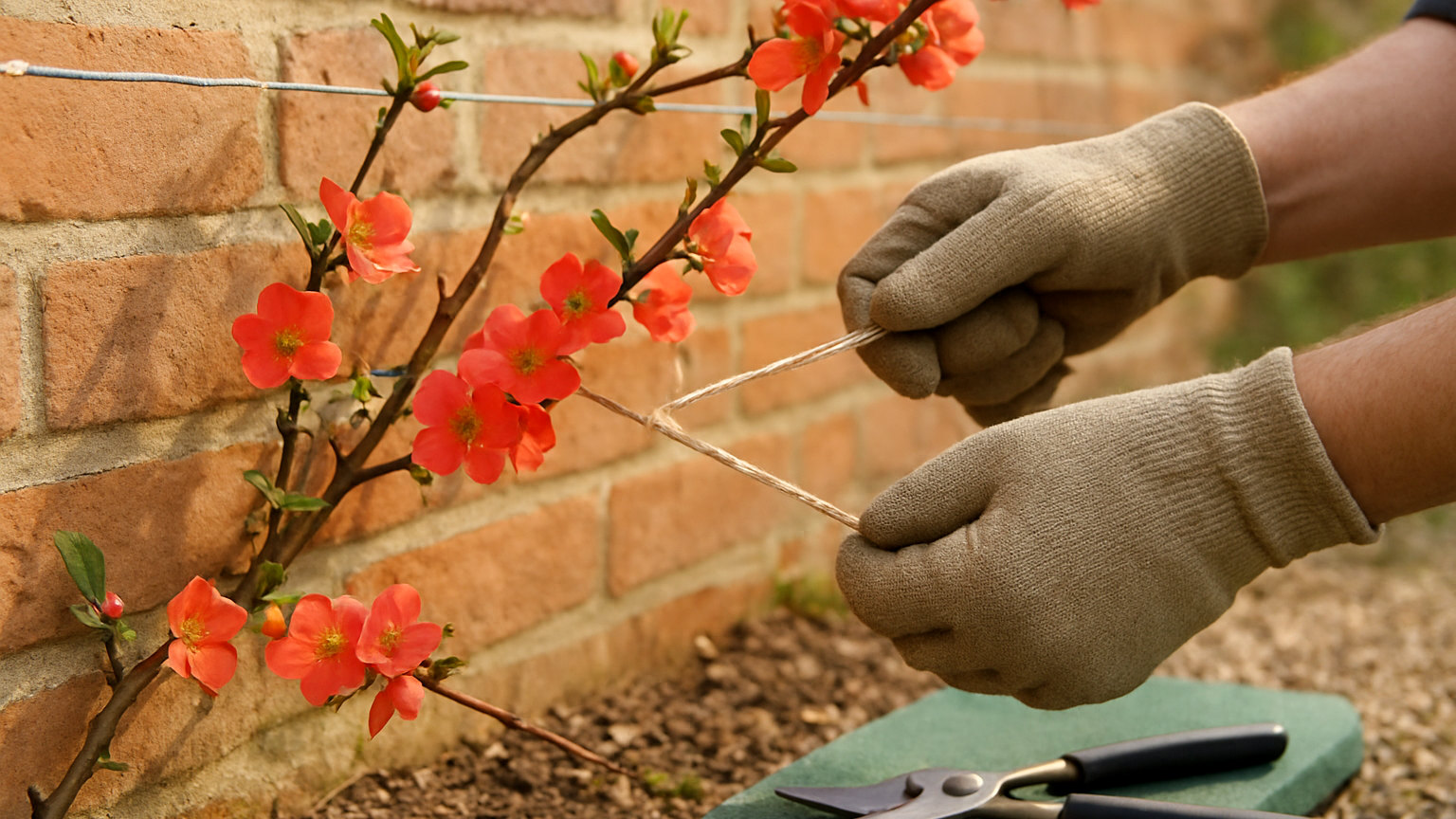
A wall shrub is not a climber. It is a shrub grown flat against a wall, tied to wires, which takes up almost no ground and benefits from the shelter and warmth the wall provides.
Why grow a shrub this way
Three reasons. It occupies a fraction of the depth a free-standing shrub would, which matters in a narrow border.
A wall stores heat and releases it overnight, raising the local minimum temperature by several degrees, which makes borderline plants possible that would not survive in the open.
And the shelter from wind reduces damage to foliage and flowers considerably.
The reliable subjects
Pyracantha is the classic wall shrub: evergreen, thorny, with masses of white flowers followed by red, orange or yellow berries. It tolerates any aspect including north, trains readily and makes an effective security planting beneath a vulnerable window.
Chaenomeles, the Japanese quince, flowers on bare stems from February in red, pink or white, followed by aromatic fruit. It tolerates shade and is entirely hardy.
Ceanothus gives intense blue flowers in spring or late summer depending on species. It needs a warm sheltered wall, free-draining soil, and is short-lived. Evergreen forms resent hard pruning.
Garrya elliptica is evergreen with long grey catkins from January, tolerating shade and exposure. James Roof has the longest catkins.
Winter jasmine, Jasminum nudiflorum, is a scrambling wall shrub rather than a climber, flowering on bare stems all winter and tolerating a north wall.
Fremontodendron produces large yellow flowers over a long season on a warm wall, and is borderline hardy and short-lived. The foliage and stems carry irritant hairs, so wear gloves and long sleeves when pruning.
Abutilon and Solanum both suit a warm wall and both are borderline in a cold garden.
Fruit trained on walls
Apples, pears, plums, cherries, figs, peaches and apricots can all be trained flat against a wall as fans, espaliers or cordons.
The warmth substantially improves ripening, which for figs, peaches and apricots is what makes them possible in Britain at all.
Trained fruit is also far easier to net, prune and pick than a free-standing tree, since everything is at eye level and reachable from the ground.
Training them
Fit horizontal wires on vine eyes before planting, spaced about forty-five centimetres apart and held ten centimetres clear of the wall for airflow.
Plant at least forty-five centimetres out from the wall, leaning the plant inwards, since the ground immediately against a wall is dry and often full of rubble.
Select the main branches you want to keep and tie them to the wires, spreading them fanwise. Remove any shoot growing directly towards or away from the wall, since neither can be trained flat.
Tie in with soft twine in a figure of eight, checking annually and loosening ties as stems thicken.
Pruning
The timing follows the same rule as any shrub: those flowering before midsummer are pruned after flowering, and those flowering later in late winter or early spring.
Chaenomeles and ceanothus that flower in spring are pruned after flowering. Late-flowering ceanothus is pruned in spring.
In every case, remove growth pointing outwards from the wall and shorten side shoots to keep the plant flat and close.
Pyracantha is pruned in summer, shortening the current season's growth while leaving the flowered wood that carries the berries. Cutting it in winter removes the berries entirely.
Evergreen ceanothus must not be cut back into old bare wood, since it will not reshoot from it.
The dry soil problem
The ground at the base of a wall is the driest in the garden. The eaves shed rain away from it and the masonry draws moisture out.
Improve it generously with compost before planting, mulch every spring, and water thoroughly for the first two years and in every dry spell afterwards.
This is a bigger cause of failure than aspect, cold or anything else.
What the wall gives back
Beyond warmth and shelter, a wall provides a support that costs nothing in ground space, which in a narrow border is the whole point.
A trained pyracantha occupies perhaps thirty centimetres of depth where the same plant free-standing would take two metres, and it still flowers, berries and provides nesting cover.


