
The commonest mistake with climber supports is sizing them for the plant in your hand rather than the plant in ten years. A mature wisteria, rambling rose or vigorous honeysuckle is heavy, and it exerts real force in wind.
Wires and vine eyes
The best solution for most walls: unobtrusive, long-lasting, cheap and strong.
Use heavy-gauge galvanised or plastic-coated wire. Vine eyes are screwed or driven into the wall and the wire is threaded through and tensioned, usually with a straining bolt at one end.
Space horizontal wires about forty-five centimetres apart vertically. For wisteria and other heavy climbers, use the strongest gauge available and space vine eyes no more than a metre and a half apart along each wire.
Screw-in vine eyes into wall plugs are more secure than the drive-in type in most masonry.
The air gap
Hold supports at least five to ten centimetres clear of the wall. This matters for two reasons.
Air circulating behind the plant dramatically reduces mildew and other fungal problems, particularly on roses and honeysuckle in a sheltered corner.
It also gives twining stems room to pass behind the wire and grip it, rather than being pressed flat against brickwork.
Trellis fixed directly onto a wall provides neither, which is why trellis on battens performs so much better than trellis screwed flat.
Trellis
Easier to fit than wires and more visible, which can be an advantage or not.
Mount it on battens of at least twenty-five millimetres to create the air gap. Fix the battens into the masonry and the trellis to the battens.
Consider hinging the bottom edge so the whole panel, with the plant attached, can be lowered away from the wall when it needs painting or repointing. This is a small amount of extra work at installation and saves a great deal later.
Check the batten thickness if you are growing clematis, since its leaf stalks need something thin to grip and cannot wrap around a broad batten.
Netting
Cheap and effective for annual climbers, sweet peas and anything with tendrils. Plastic-coated wire mesh lasts longer than plastic netting.
Fix it taut and clear of the wall. It is less suitable for permanent woody climbers, which quickly grow through and around it in a way that makes later removal impossible.
Fixings
Fix into masonry rather than mortar joints where possible, using appropriate wall plugs. On soft or old brickwork, resin anchors hold far better.
Never fix substantial supports to a fence panel, which is not designed to carry weight. Fix to the posts instead, and remember you cannot attach anything to a fence you do not own without permission.
Check fixings annually, and particularly after gales, since a support that has started to pull away will fail entirely under the next one.
Free-standing structures
Obelisks give height in a border with almost no footprint, and suit clematis, annual climbers and shorter roses. Spiralling stems around them produces far more flower than running straight up.
Arches need to be tall enough to walk through once the plant is on them, which means at least two metres twenty at the apex, and set into the ground properly since they catch wind.
Pergolas need substantial posts, ideally set in concrete or on metal post supports, since a mature planting is very heavy.
Wigwams of canes or hazel poles suit annual climbers and sweet peas, cost almost nothing and can be dismantled at the end of the season.
Tying in
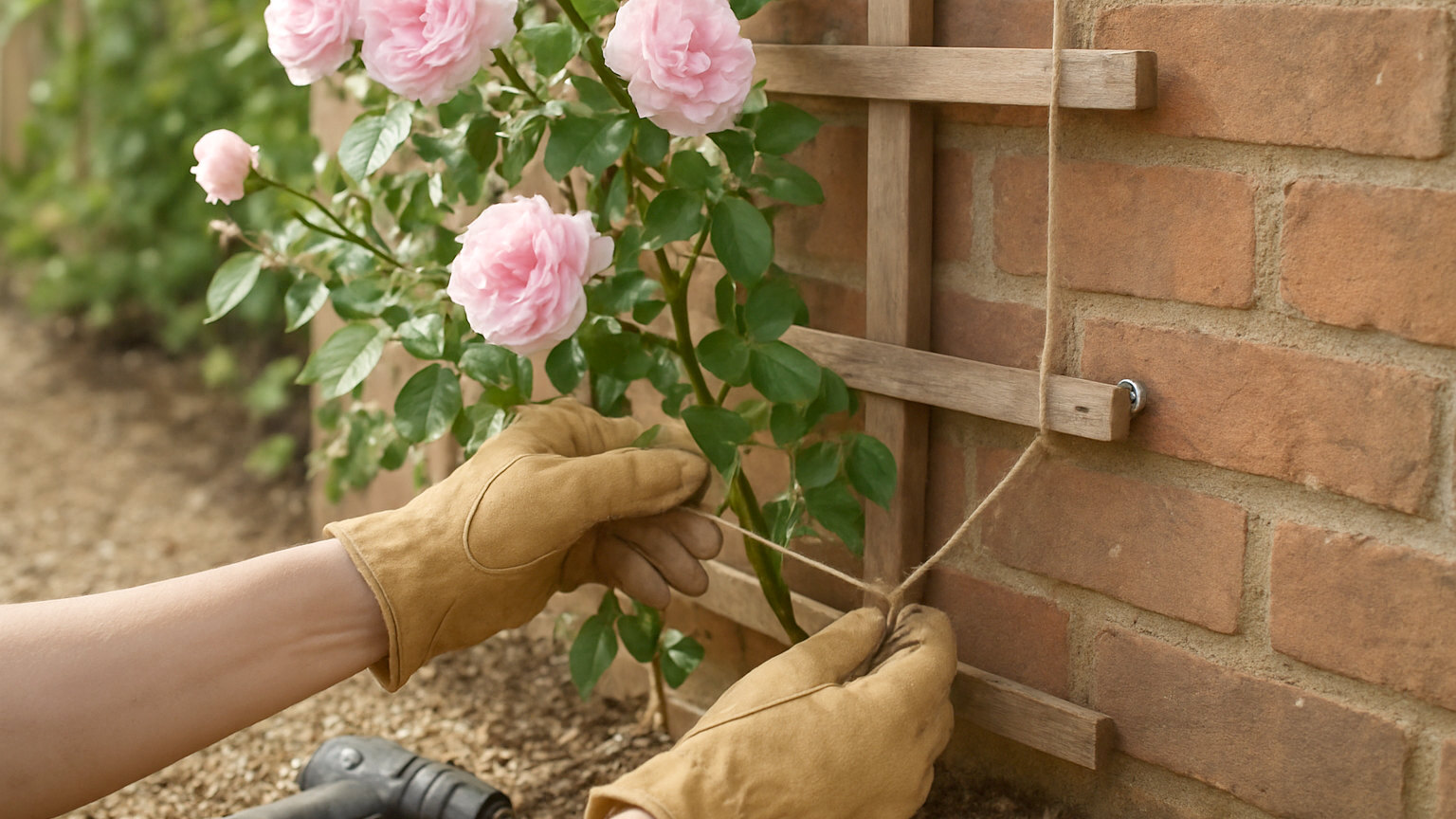
Use soft twine or proprietary ties, in a figure of eight so the stem is not pressed against the support and cannot chafe.
Never tie tightly, and check ties annually, loosening any that are cutting in. A forgotten tie will strangle a stem as it thickens.
Tie in new growth while it is still flexible, through the growing season, rather than trying to reposition hardened stems in winter, which snap rather than bend.
Match the support to the plant
Self-clinging climbers need nothing at all. Twiners and tendril climbers need something thin to grip. Scramblers, including all roses, must be tied in and cannot attach themselves to anything.
Getting this wrong is why a clematis on wide trellis battens falls off, and why a climbing rose left untied ends up lying across the border by August.


