
A warm, sheltered, south or west-facing wall creates a microclimate several degrees warmer than the open garden, and it makes a group of borderline climbers possible that would not survive elsewhere in the plot.
Passion flower
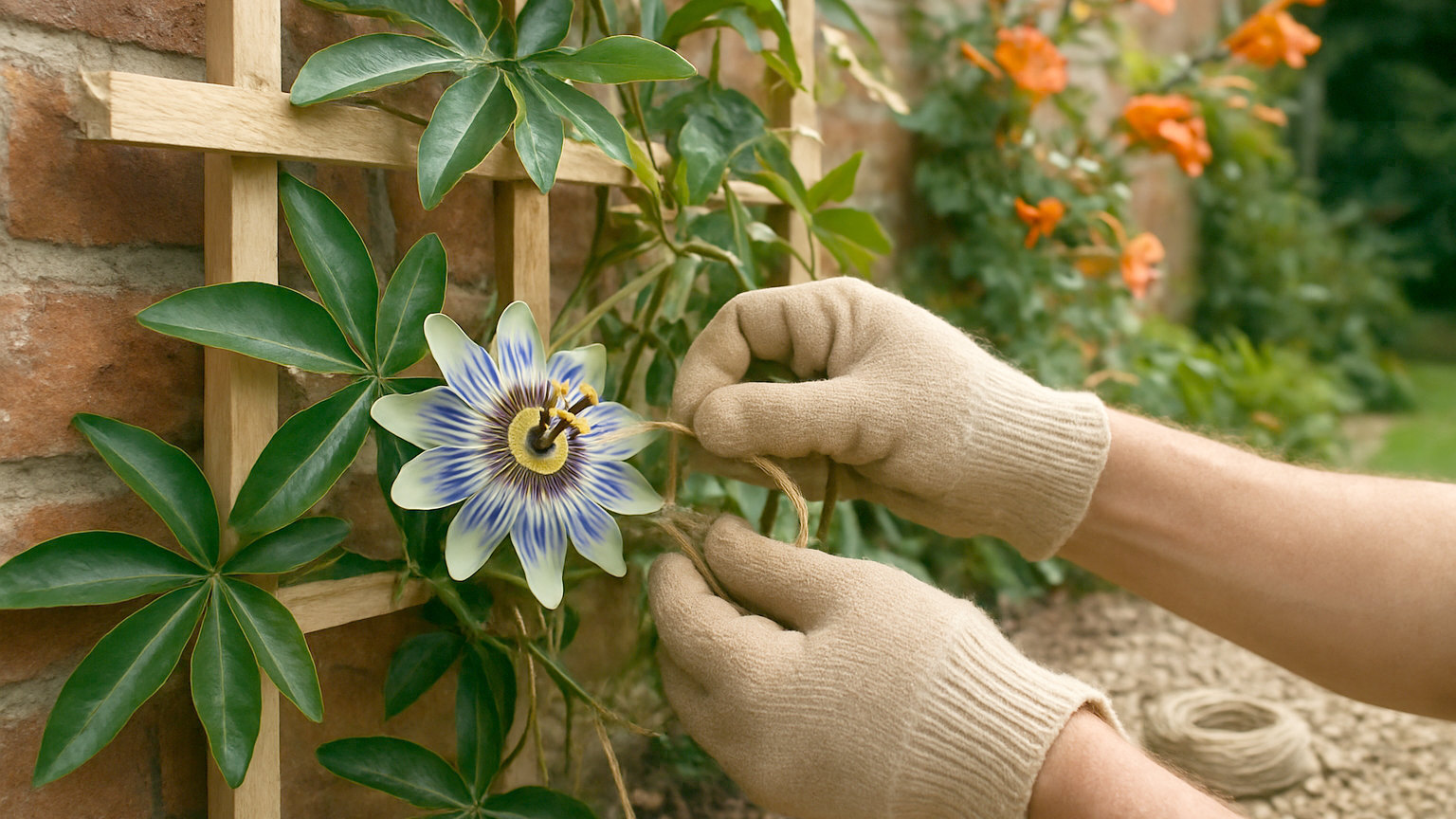
Passiflora caerulea is the hardiest species and the one usually sold. It produces extraordinary blue and white flowers from July to October on a vigorous tendril climber reaching four metres or more.
It needs a warm sheltered wall, full sun and free-draining soil. In a mild area it is reliably hardy; in a cold one it may be cut to the ground by frost and reshoot from the base, or may be killed outright in a hard winter.
Prune in early spring, cutting back to a permanent framework and removing frost-damaged growth. It flowers on the current season's growth, so hard pruning does not cost you the display.
It climbs by tendrils and needs wires or netting.
The orange fruits of Passiflora caerulea are edible but insipid and not worth eating. The commercially grown passion fruit is a different and tender species, Passiflora edulis, which needs a heated greenhouse in Britain. Unripe fruits of some passiflora species may cause stomach upset, so they are best left alone.
Campsis
The trumpet vine, with large orange or red trumpet flowers in late summer. Vigorous, self-clinging by aerial roots, and it needs real heat to flower well.
It performs best against a south-facing wall in a warm part of the country and frequently produces plenty of growth and few flowers in cooler areas.
Prune hard in early spring to a permanent framework, since it flowers on new growth.
Solanum
Solanum crispum Glasnevin, the Chilean potato vine, produces clusters of purple-blue flowers over a very long season from June to October.
It is a scrambler rather than a true climber and must be tied in. It is reasonably hardy against a warm wall and is fast-growing.
Solanum laxum Album is the white form, more tender still and needing greater shelter than the purple one.
All parts of solanum are toxic if eaten, which is worth knowing.
Others worth trying
Trachelospermum jasminoides, star jasmine, is evergreen and powerfully scented, borderline hardy and slow to establish.
Bougainvillea and plumbago are conservatory plants in Britain rather than outdoor climbers, though both can spend the summer outside in a pot and be brought back under cover in autumn.
Abutilon, fremontodendron and ceanothus are wall shrubs rather than true climbers, trained flat against a warm wall with wires, and all are borderline in a cold garden.
Making the most of a warm wall
A south-facing wall stores heat during the day and releases it overnight, which is what lifts the local minimum temperature.
The effect is strongest close to the wall, so plant near it, and strongest on brick or stone rather than timber fencing.
Shelter from wind matters as much as the aspect, since wind chill does much of the damage to borderline plants.
Winter protection
Mulch the root area thickly with compost, bark or straw in late autumn, which is what protects the crown even if the top growth is lost.
Wrap the base and lower stems with horticultural fleece or hessian in a cold spell, and fleece the whole plant if a severe frost is forecast and it is small enough.
Do not cut frost-damaged growth back in autumn or winter. Leave it in place, since it protects what is beneath, and cut back in spring once you can see clearly what has survived and what has not.
Realistic expectations
Borderline plants are a calculated risk. In most winters they come through; in a severe one some will be lost.
Take cuttings in late summer as insurance, keep a rooted plant under cover, and treat any loss as the cost of growing something interesting rather than as a failure.
Feeding and watering
These are hungry plants producing a great deal of growth in a short season. Mulch in spring and feed with a high-potassium fertiliser once flowering starts, avoiding high nitrogen, which produces soft growth vulnerable to frost.
The ground at the base of a warm sunny wall is the driest in the garden, so water thoroughly through summer and mulch to hold what moisture there is.


