
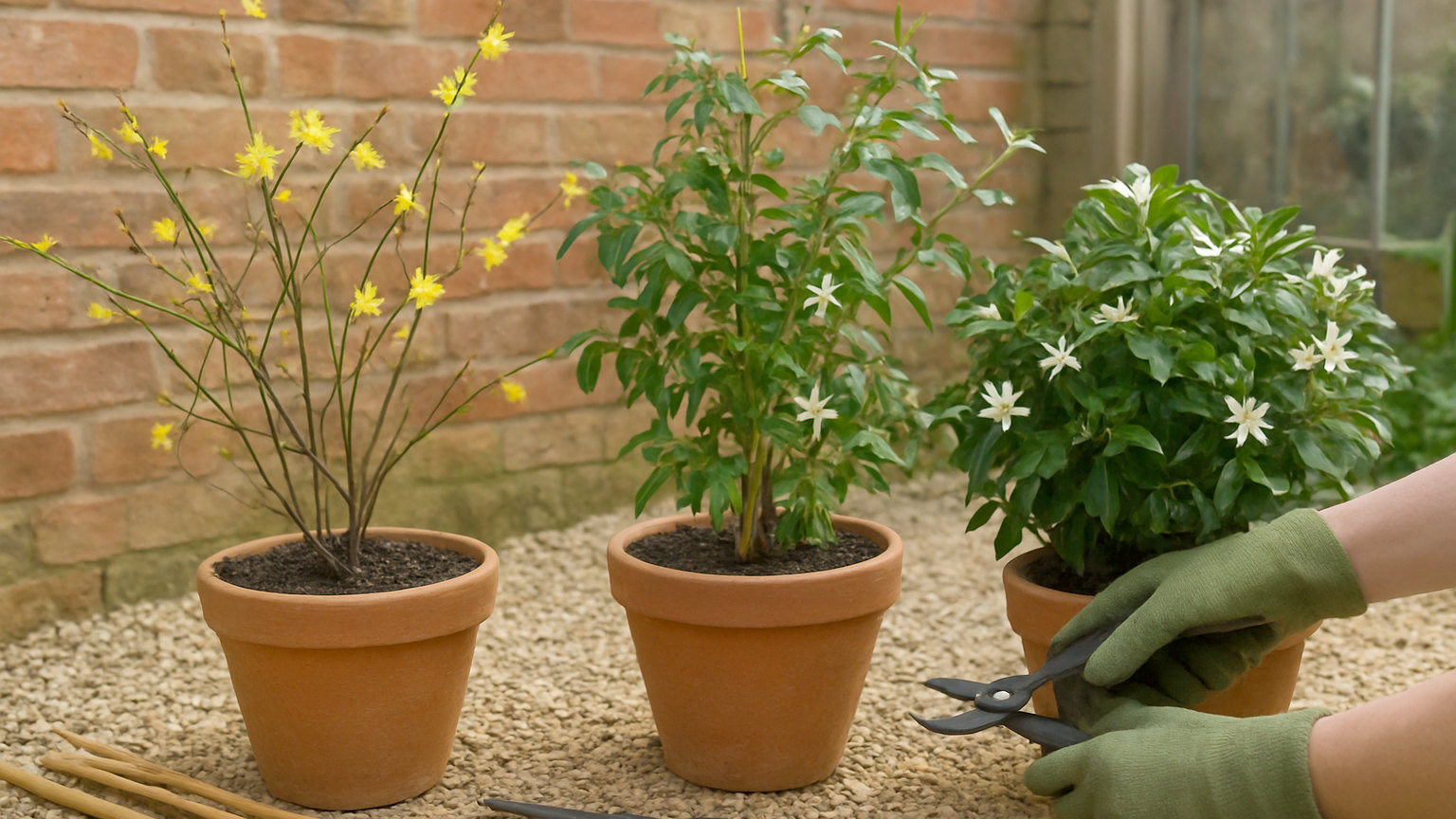
Three plants commonly sold as jasmine behave very differently. Confusing them leads to pruning at the wrong time, planting in the wrong aspect, and expecting scent from something that has none.
Summer jasmine
Jasminum officinale is the true scented jasmine: a vigorous deciduous twiner reaching four to six metres, with clusters of small white flowers from June to September and one of the finest fragrances in the garden.
It needs a warm sheltered position in full sun, ideally a south or west-facing wall, and free-draining soil. In a cold exposed garden it struggles.
It twines, so it needs wires, trellis or netting. Guide the first shoots and it manages afterwards.
Prune after flowering, in autumn, thinning out the oldest stems at the base and shortening flowered growth. It becomes a congested tangle within a few years if left, and the flowers end up out of reach at the top.
Winter jasmine
Jasminum nudiflorum is a different proposition entirely. It flowers on bare stems from November to March in bright yellow, and it has no scent at all.
It is not really a climber. It is a scrambling wall shrub with long arching green stems that cannot attach to anything, so it must be tied in to wires or trellis, or allowed to tumble down a bank or over a wall.
It is tough, tolerating shade, exposure and poor soil, and it will grow on a north wall where the summer jasmine would fail.
Prune immediately after flowering in spring, cutting flowered shoots back hard to a couple of buds and removing some old stems at the base. Left alone it becomes an untidy congested mass.
The stems root wherever they touch the ground, which makes propagation easy and can make it spread further than intended.
Star jasmine
Trachelospermum jasminoides is not a jasmine at all, though it is sold as one. It is an evergreen twiner with glossy dark leaves and small white pinwheel flowers in midsummer with a powerful sweet scent.
It is the best evergreen scented climber available for a British garden, and it is borderline hardy.
Give it the warmest, most sheltered position you have, on a south or west-facing wall. It will not survive a hard winter in an exposed cold garden.
It is slow, taking several years to establish before it begins climbing properly, and it needs wires or trellis since it twines.
Prune lightly after flowering only to keep it within bounds. It needs very little.
Trachelospermum asiaticum is slightly hardier, with smaller leaves and creamier flowers, and is worth choosing in a colder garden where the more common species would struggle.
Both are excellent in a large container against a warm wall, which allows the pot to be given extra protection in a hard winter.
Which to choose
For scent on a warm sunny wall, summer jasmine or trachelospermum. The former is faster and deciduous; the latter is evergreen, slower and needs more shelter.
For winter flowers on a difficult aspect, winter jasmine, accepting that it has no scent and needs tying in.
Planting and care
All three should be planted at least forty-five centimetres out from a wall, leaning inwards, since the ground against a wall is dry.
Improve the soil generously, mulch each spring, and water thoroughly for the first two years and in dry spells afterwards.
Feed with a general fertiliser in spring. Avoid high-nitrogen feeds, which produce growth at the expense of flowers.
Why they might not flower
Pruned at the wrong time is the commonest cause, particularly cutting summer jasmine in spring.
Too much shade, too much nitrogen, or simply too young are the others. Trachelospermum in particular often takes three or four years before it flowers well.
Frost damage to a borderline plant will remove a season's flowers without killing it, which is a common experience with trachelospermum after a hard winter.
Propagating them
All three root readily from semi-ripe cuttings taken in late summer, using non-flowering shoots inserted into gritty compost.
Winter jasmine is easier still, since the arching stems root wherever they touch the ground. A rooted section can simply be severed with secateurs and moved, which makes it one of the cheapest climbers to increase.


