
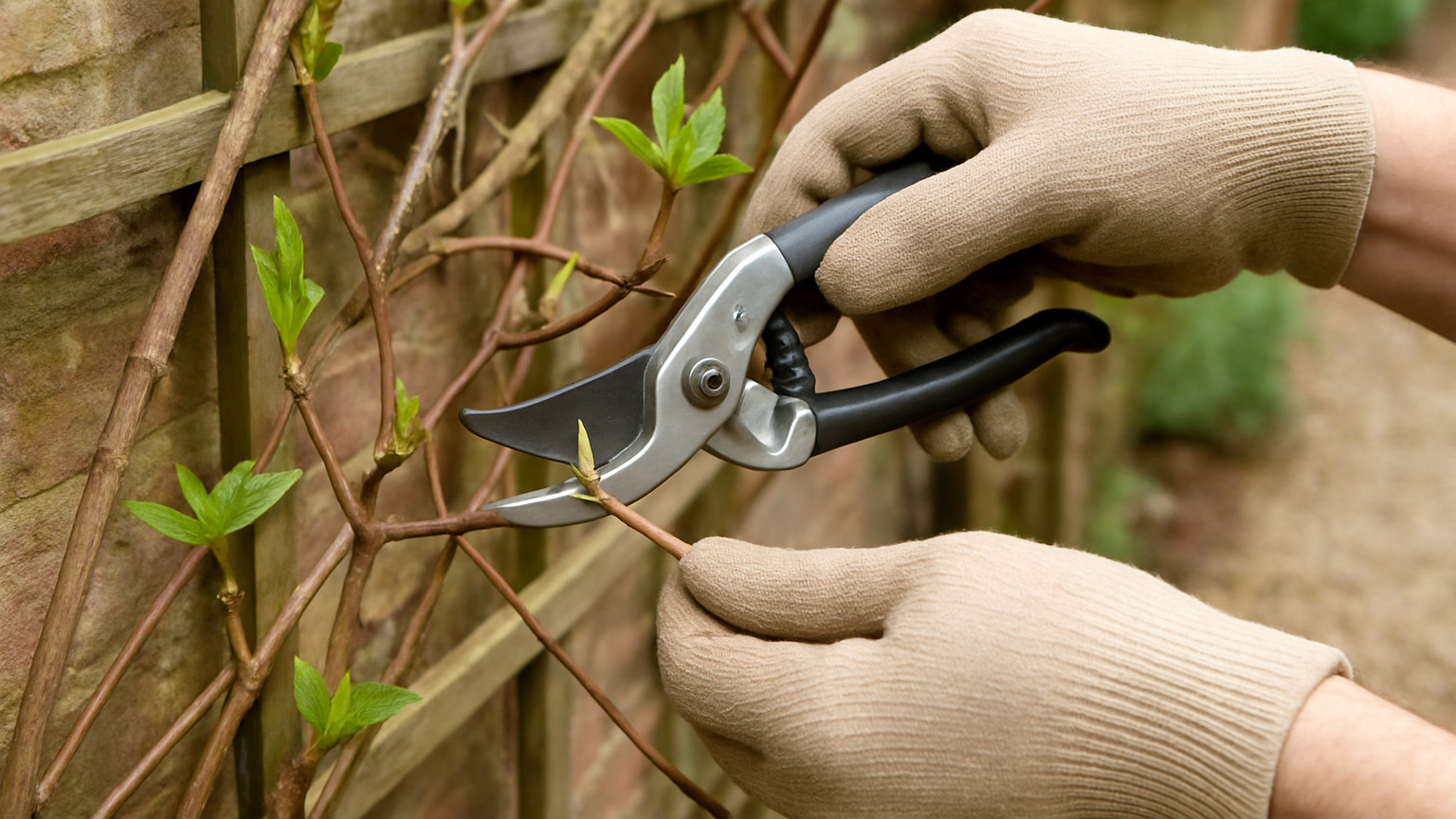
Clematis pruning is genuinely simple once you know which of three groups your plant is in, and genuinely confusing until you do. The group is decided by when the plant flowers, and if you have lost the label the flowering time tells you everything you need.
Working out the group
Watch the plant for a season and note when it flowers.
- Group 1 - flowers in early spring, roughly February to May, on growth made last year
- Group 2 - large flowers in late spring and early summer, often with a second smaller flush in late summer
- Group 3 - flowers from midsummer onwards, on growth made in the current year
If in genuine doubt, treat it as Group 2 and prune lightly. You may lose some flowers but you will not lose the plant.
Group 1: barely prune at all
This includes the montana types, alpina, macropetala and cirrhosa. They flower on wood made the previous year, so a late winter prune removes the entire display.
The rule is simple: prune only if you need to, and only immediately after flowering. Cut back to keep it within its space, remove dead or damaged growth, and untangle what you can.
Montana in particular becomes an enormous tangled mass on top of a fence if left unchecked, and it is far easier to trim it every year after flowering than to renovate it later. It will tolerate hard renovation but takes a couple of years to recover.
Group 2: light prune in February
These are the large-flowered hybrids, the ones with dinner-plate blooms in May and June. They flower on short shoots from last year's wood, then often produce a lighter second flush on new growth.
In February, work down each stem from the top until you reach the first pair of strong, fat, healthy buds, and cut just above them. Remove anything dead, weak or damaged entirely.
That is all. Cutting these hard removes the main early display, which is the reason people report that their big-flowered clematis never performs.
After the first flush in early summer, you can shorten the flowered stems by about a third to encourage a better second showing.
Group 3: cut hard in February
This is the easy group and the most satisfying. Viticella, jackmanii, texensis, tangutica and the herbaceous types all flower on growth made this year, so everything above the base is expendable.
In February, cut every stem down to a pair of strong buds about twenty to thirty centimetres above the ground. All of it, without hesitation.
The plant regrows several metres and flowers from midsummer until autumn. Left unpruned it becomes a bare tangle with flowers only at the very top, which is the classic sign of a Group 3 clematis that nobody has cut.
Planting, which affects everything after
Clematis want their heads in sun and their roots cool and moist. Plant with the crown about five to eight centimetres below soil level, deeper than for most plants.
That deep planting is deliberate insurance. If clematis wilt strikes, and the top growth collapses suddenly, buried buds below soil level allow the plant to reshoot from underground. A shallowly planted clematis that wilts is usually lost.
Shade the root area with a slab, a low shrub or a mulch, and keep it watered, particularly against a wall where the soil is dry.
Clematis wilt
Wilt causes the top growth of large-flowered hybrids to collapse suddenly, often just as the buds are about to open, with stems blackening near the base. It looks fatal and usually is not.
Cut the affected stems right back to healthy tissue or to ground level, remove the material rather than composting it, and keep the plant watered and fed. A deeply planted clematis will normally reshoot from below soil level within weeks. Viticella types are far more resistant, which is one reason they are recommended so often.
Supports
Clematis climb by twisting their leaf stalks, so they need something thin to grip: trellis, wire, netting or the stems of a host shrub. They cannot cling to a bare wall.
Fix supports at least five centimetres clear of the wall so air can circulate and the stems can twine behind.
Feeding
Clematis are hungry. Feed in spring with a rose or general fertiliser, and mulch with well-rotted manure keeping it clear of the stems. A tired, sparse-flowering plant is often simply underfed rather than wrongly pruned.


