
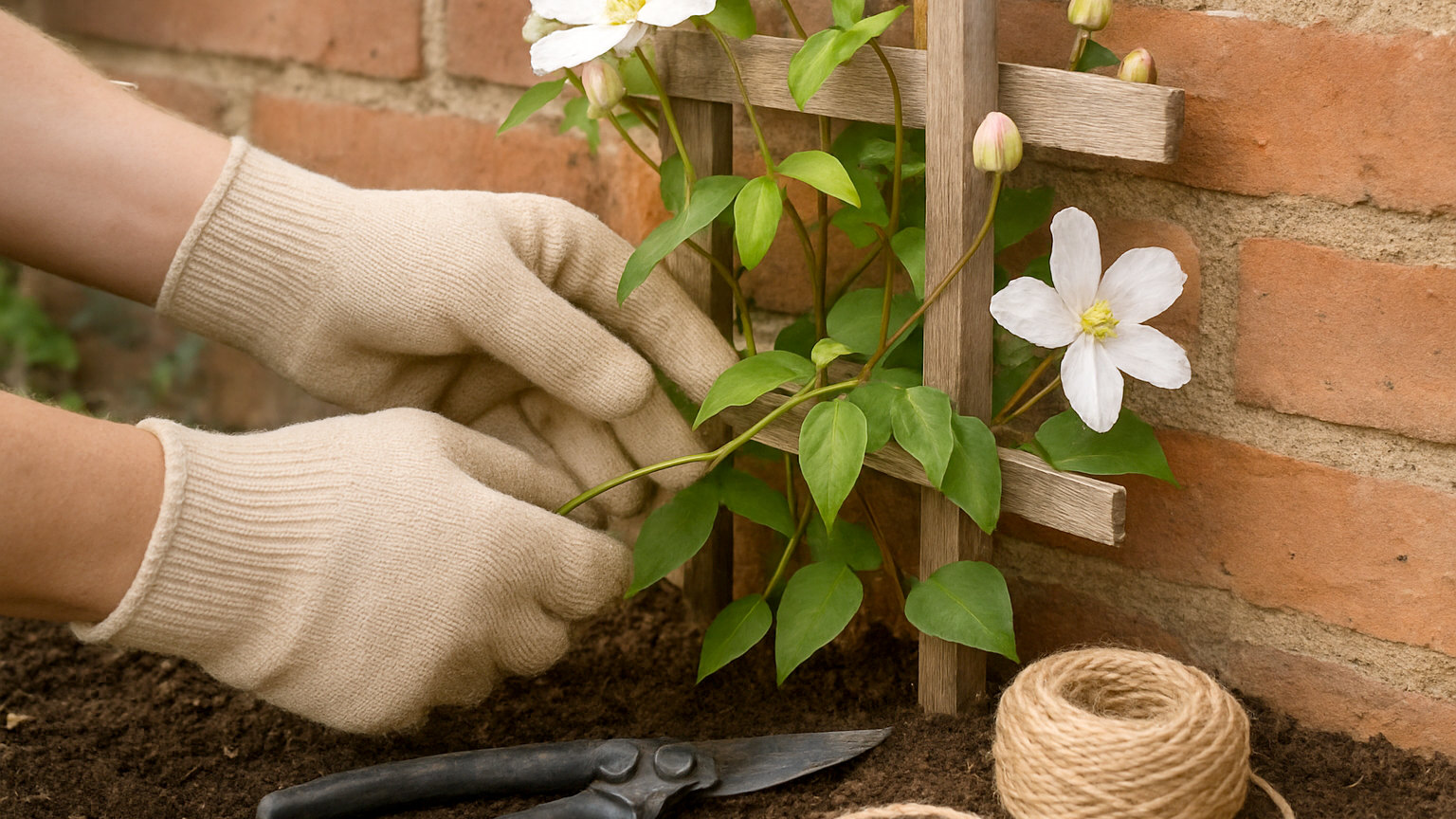
Climbers attach themselves in four quite different ways, and matching the support to the method is the difference between a plant that covers a wall and one that lies on the ground looking reproachful.
Twiners
The whole stem spirals around its support as it grows. Honeysuckle, wisteria, hops, runner beans, morning glory and akebia all climb this way.
They need something upright and reasonably slender to wrap around: wires, a post, a cane, netting or the stems of a host plant.
A twiner cannot grip a flat surface, so it will not climb a bare wall or a solid fence panel without wires or trellis.
Different species twine in a fixed direction, clockwise or anticlockwise, and will not be persuaded otherwise. Guide the first shoots by hand in the direction they want to go, and afterwards they manage alone.
Tendril climbers
These produce specialised thread-like structures that coil around anything narrow they touch.
Sweet peas, passion flower, grape vines and cucumbers use modified stems or leaf parts. Clematis is slightly different: it climbs by twisting its leaf stalks around supports.
Tendrils need thin supports. A tendril cannot grip a thick post or a broad trellis batten, which is why clematis planted against wide trellis often fails to hold on.
Netting, wires, string or twiggy growth all work. This is also why clematis grows so well through shrubs and roses, where it finds plenty of thin stems.
Self-clinging climbers
The only group that will genuinely climb a bare wall without any support.
Ivy and climbing hydrangea produce short aerial roots along the stems that grip into surface irregularities. Virginia creeper and Boston ivy produce adhesive pads at the tips of tendrils that stick to almost anything.
These need no wires at all, which is their great advantage. They are slow to start, often taking two or three years before they begin climbing in earnest, and people frequently give up on them too early.
Help them for the first year by tying the stems loosely against the wall so the young growth is in contact with the surface.
Scramblers
Not really climbers at all. Climbing and rambling roses, winter jasmine and bougainvillea produce long stems that in nature lean and hook their way up through other plants.
These cannot attach themselves to anything and must be tied in. A climbing rose left to its own devices simply flops.
They need a permanent framework of wires or trellis and regular tying in as they grow, ideally while the stems are still flexible.
Choosing the support
For twiners and tendril climbers on a wall, horizontal wires on vine eyes are the standard and best solution. Space them about forty-five centimetres apart and hold them ten centimetres clear of the wall so air circulates and stems can pass behind.
Trellis works but needs battens behind it to give the same air gap, and the battens should be thin enough for tendrils if you are growing clematis.
Netting is cheap and effective for annual climbers and for anything with tendrils.
Free-standing obelisks, arches and pergolas suit all four groups, with scramblers still needing tying.
Self-clinging and walls
Sound masonry in good condition is generally not damaged by self-clinging climbers, and the covering can even protect it from weather.
The problems arise with soft crumbling mortar, painted or rendered surfaces, and anywhere the stems reach under tiles, into gutters or behind window frames. Keep growth clear of all of those.
Removing an established self-clinging climber leaves marks on the wall that are difficult to clean off entirely.
Guiding new growth
Whatever the type, the first two years matter most. Spread the initial stems out fanwise and low down rather than letting everything race for the top.
A climber trained upwards before the base is covered will always be bare at the bottom, and correcting it later means untying and lowering the main stems.
Speed and eventual size
Check the eventual spread before buying, not just the height. Virginia creeper, Russian vine and vigorous ramblers cover an enormous area and are frequently planted against something far too small for them.
Anything described as fast-growing or vigorous keeps growing fast, which means annual work rather than a one-off job.


