
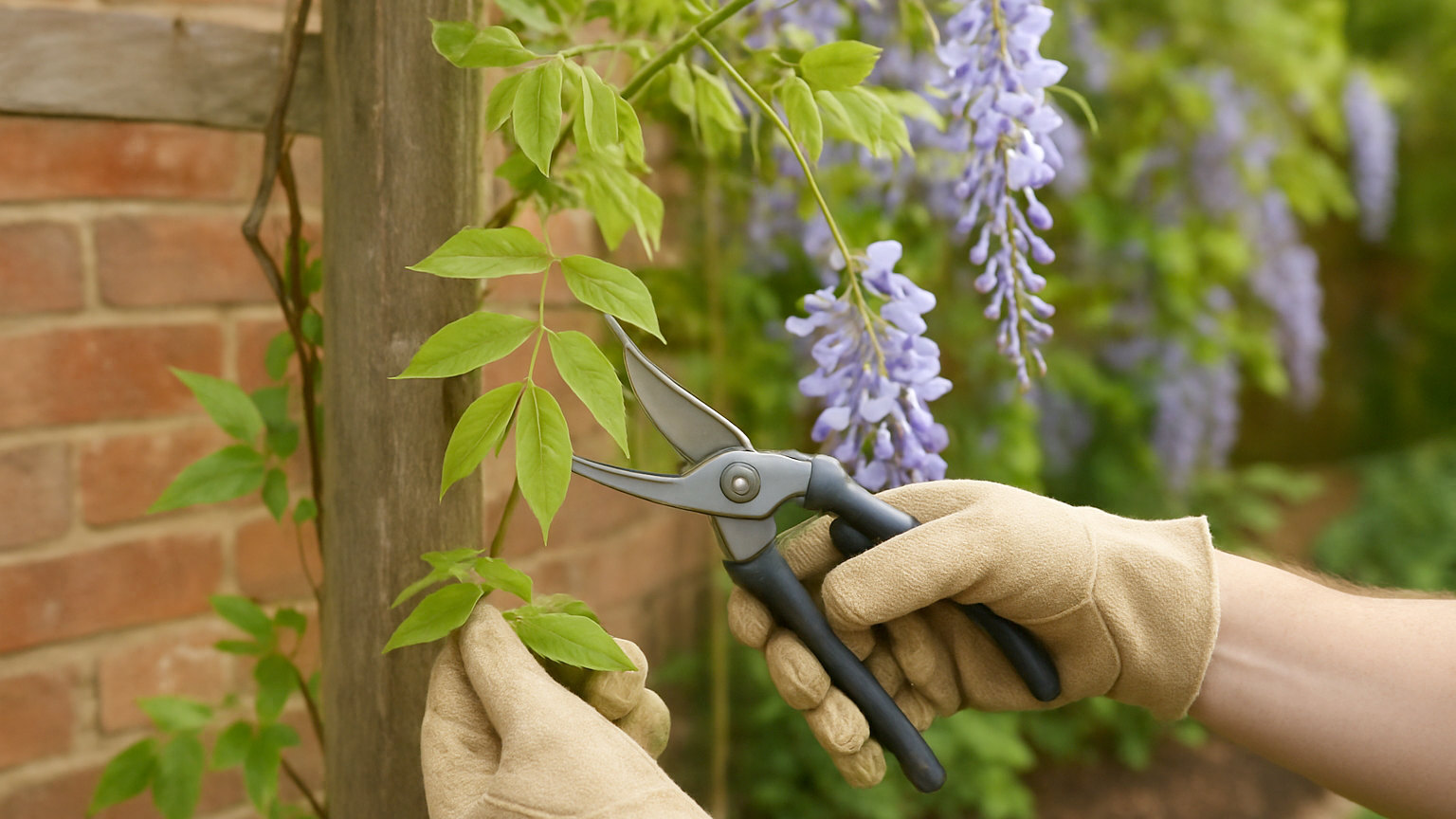
Wisteria is spectacular and demanding in equal measure. It needs a support strong enough for a plant that will eventually weigh a great deal, pruning twice a year, and patience. Given those, it is among the finest things you can grow against a house.
Buy a grafted plant in flower
Never buy a seed-raised wisteria. Plants grown from seed can take fifteen or twenty years to flower and some never do at all. This is the single commonest reason for a healthy wisteria that produces nothing but leaves.
Buy a named, grafted plant, and buy it in flower in late spring if you can, which proves it is capable of it. A graft union will be visible as a bulge low on the stem. A grafted plant typically flowers within three or four years.
Support, sized properly
A mature wisteria is heavy, woody and immensely strong, and it will pull down trellis, distort gutters and lever apart weak masonry over time.
Use heavy-gauge galvanised wire on vine eyes fixed into the wall, spaced about forty-five centimetres apart horizontally, held five to ten centimetres clear of the brickwork. Ordinary garden trellis is not adequate for the long term.
Keep it away from gutters, downpipes, roof tiles and window frames, all of which it will find and damage. Plan the framework you want before planting, because retraining a mature plant is hard work.
Planting
Full sun is best, and a south or west-facing wall gives the strongest flowering. Wisteria will grow in part shade and flowers less.
Plant in fertile, well-drained soil about forty-five centimetres out from the wall, since the ground immediately against a house is dry and often full of rubble. Lean the plant in towards the support.
Water generously for the first two years. A wisteria that dries out repeatedly while establishing sulks for a long time afterwards.
The twice-yearly prune
This is what produces flowers, and skipping it is why so many wisterias grow enormous and bloom sparsely.
In July or August, cut back the long whippy green side shoots produced that summer to about five or six leaves. This checks vegetative growth and encourages the plant to form flower buds rather than more stem.
In January or February, when the plant is bare and you can see what you are doing, cut those same shoots back further, to two or three buds from the main framework. The fat, rounded buds are flower buds; the slim pointed ones are leaf buds, and with the plant leafless you can see which you are keeping.
Both cuts matter. Doing only the winter one produces a great deal of growth to remove each year and fewer flowers.
Training a young plant
For the first few years, select a strong leading shoot and tie it in vertically to the height you want, cutting it back by about a third each winter to encourage side branching.
Train side shoots horizontally along the wires at about forty-five centimetres apart to build the permanent framework. Once that framework is established, switch to the routine summer and winter pruning above.
Why it might not flower
Several possibilities, in rough order of likelihood.
- It was grown from seed and is simply too young, or never will
- It has not been pruned, so all its energy goes into growth
- It is being fed too much nitrogen, which produces leaves at the expense of flowers. Use a high-potassium feed such as sulphate of potash in spring instead
- Frost has killed the flower buds, which is common in an exposed position after a mild winter
- It is in too much shade
- It is still establishing, and three or four years from planting is normal
Growing one as a standard
Wisteria can be trained as a free-standing standard on a stout post, which suits a lawn or a large container and avoids the problem of a house wall entirely. Train a single stem to about a metre and a half, then let a head form and prune it in exactly the same way twice a year. It takes several years and needs permanent staking.
A caution
All parts of wisteria are toxic if eaten, and the seeds in particular. The pods look interesting to children, so bear that in mind when siting one near a play area, and clear fallen pods.


