
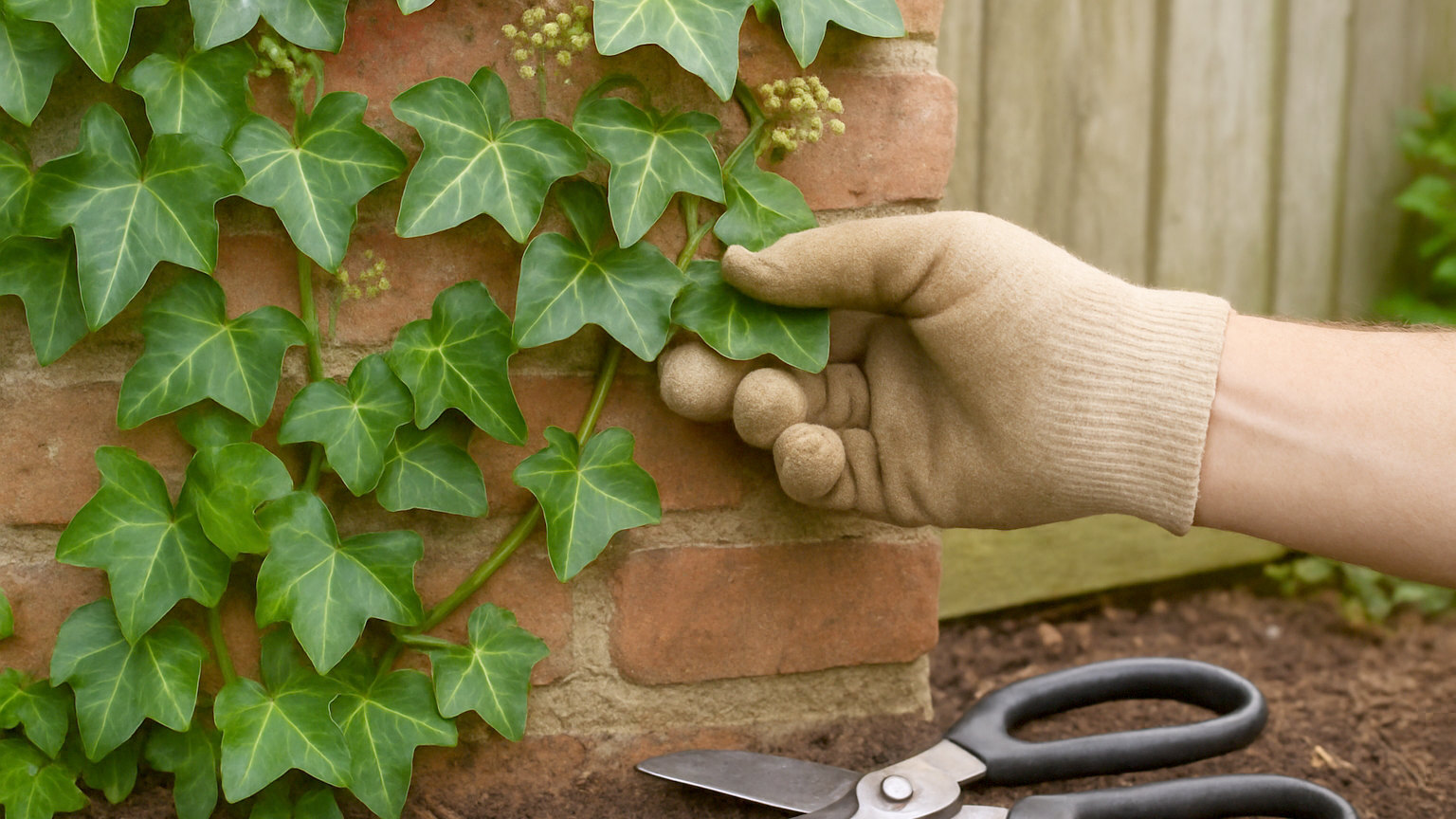
Ivy has a poor reputation that is only partly deserved. It is the single most valuable wildlife plant many gardens could grow, it thrives where almost nothing else will, and whether it damages a wall depends entirely on the wall.
Does it damage walls
Sound masonry in good condition is generally not harmed by ivy, and the covering can protect it from weather.
The aerial roots grip surface irregularities rather than boring into the structure. Research has found that an ivy covering moderates temperature swings and reduces frost damage to brickwork.
The problems are real and specific. Ivy will exploit existing weakness: crumbling mortar, cracks, and soft or damaged render. Where those exist it worsens them considerably.
It also causes trouble by growing under roof tiles, into gutters, behind fascias and around window frames, where the stems thicken and force things apart.
The practical position is to keep ivy off any wall in poor condition, off rendered or painted surfaces, and rigorously clear of the roofline. On sound brickwork below gutter level it is generally fine.
Removing established ivy leaves the aerial root remnants stuck to the surface, which are difficult to clean off entirely.
Ivy on trees
Ivy is not a parasite and takes nothing from the tree. It uses the trunk for support only, and its roots are its own.
On a healthy vigorous tree it does no harm and provides considerable wildlife benefit. On an old, weakened or unstable tree, the additional weight and wind resistance in the crown can be a factor, and it may also obscure defects during inspection.
Leave it on healthy trees. Consider reducing it on anything already in poor condition.
The wildlife value
This is where ivy is genuinely exceptional.
It flowers in September and October, when almost nothing else does, and the flowers are worked heavily by late bees, wasps, hoverflies and butterflies preparing for winter.
It then berries in late winter and early spring, exactly when birds are shortest of food.
The dense evergreen growth provides nesting sites, roosting cover and shelter for hibernating insects. The holly blue butterfly depends on it for one of its two annual broods.
Letting a patch of ivy mature enough to flower is one of the most useful things a garden can do for wildlife, and it costs nothing.
Juvenile and adult growth
Ivy has two distinct phases. Juvenile growth has the familiar lobed leaves and climbs. Adult growth, which develops once the plant reaches the top of its support and gets good light, has unlobed leaves, forms a bushy shrub and is the only stage that flowers and fruits.
This matters: an ivy that is repeatedly cut back never reaches the adult stage and never provides the autumn nectar or the berries.
Controlling it
Ivy responds well to cutting and can be trimmed at any time, though avoiding the nesting season from March to August is important where it is dense enough to hold nests.
Trim wall-grown ivy back to the wall surface with shears in late winter, which removes the outward growth and keeps it flat.
To remove it entirely, cut the stems at the base and leave the top growth to die and dry, which makes it far easier to pull away weeks later than attempting it while alive.
Dig out the roots, since it regenerates readily from anything left.
Varieties
Hedera helix is the native species and the toughest. Variegated forms brighten a dark wall and need slightly more light to hold their colour. Hedera colchica and Hedera algeriensis have much larger leaves and cover ground faster.
Small-leaved varieties suit containers, hanging baskets and topiary frames.
Cautions
Ivy sap irritates skin and can cause a rash, so wear gloves and long sleeves when cutting it, particularly in quantity.
The berries are toxic to people if eaten, though birds take them safely, so it is worth knowing where small children use the garden.
Where not to let it grow
Keep ivy off rendered and painted surfaces, off any wall with crumbling mortar, and rigorously clear of the roofline, gutters, fascias and window frames.
Cut it back annually rather than allowing it to reach those areas, since removing established growth from under tiles is a considerable job.


